Cruise ship threatens marine paradise
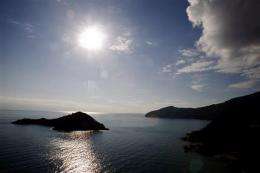
(AP) -- Stone fortresses and watchtowers which centuries ago stood guard against against marauding pirates loom above pristine waters threatened by a new and modern peril: fuel trapped within the capsized Costa Concordia luxury liner.
A half-million gallons (2,400 tons) of black goo are in danger of leaking out and polluting some of the Mediterranean's most unspoiled sea, where dolphins are known to chase playfully after sailboats and fishermen's catches are so prized that wholesalers come from across Italy to scoop up cod, lobsters, scampi, swordfish and other delicacies.
"Compared to the Caribbean, we have nothing to be envious about," said Francesco Arpino, a scuba instructor in the chic port of Porto Ercole, marveling at how the sleek granite sea bottom helps keep visibility crystal clear even 40 meters (135 feet) down.
Divers in these transparent waters marvel at sea horses and red coral, while on the surface sperm whales cut through the sea.
But worry is clouding this paradise, which includes a stretch of Tuscan coastline that has been the holiday haunt of soccer and screen stars, politicians and European royals.
Rough seas hindering the difficult search for bodies by divers in the Concordia's submerged section have delayed the start of a pumping operation expected to last weeks to remove the fuel from the ship. Floating barriers aimed at containing any spillage now surround the vessel.
Concordia lies dangerously close to a drop-off point on the sea bottom. Should strong waves nudge the vessel from its precarious perch, it could plunge some 20-30 meters (65-90 feet), further complicating the pumping operation and possibly rupturing fuel tanks. Italy's environment minister has warned that if those tanks break, globs of fuel would block sunlight vital for marine life at the seabed.
A week after the Concordia struck a reef off the fishing and tourism island of Giglio, flipping on its side, its crippled 114,000-ton hull rests on seabed rich with an underwater prairie of sea grass vital to the ecosystem. The dead weight has likely already damaged a variety of marine life, including endangered sea sponges, and crustaceans and mollusks, even before a drop of any fuel leaks, environmentalists contend.
"The longer it stays there, the longer it impedes light from reaching the vegetation," said Francesco Cinelli, an ecology professor at the University of Pisa, in Tuscany. And the sheer weight of the Concordia will also crush sea life, he said.
The seabed where the Concordia lies is a flouishing home to Poseidon sea grass native to the Mediterranean, Cinelli told The Associated Press in a telephone interview.
"Sea grass ... is to the sea what forests are to terra firma," Cinelli said: They produce oxygen and serve as a refuge for organisms to reproduce or hide from predators.
The Tuscan archipelago's seven islands are at the heart of Europe's largest marine park, extending over some 60,000 hectares (150,000 acres) of sea.
They include Elba, where Napoleon lived in exile, and the legendary island of Montecristo, a setting for Alexandre Dumas' novel "The Count of Monte Cristo" - where rare Mediterranean monk seals have been spotted near the coast.
Montecristo has a two-year waiting list of people hoping to be among the 1,000 people annually escorted ashore by forest rangers to admire the uninhabited island. Navigation, bathing and fishing are strictly prohibited up to 1 kilometer (0.6 miles) from Montecristo's rocky, cove-dotted coast. A monastery, established on Montecristo in the 7th century, was abandoned nine centuries later after repeated pirate raids.
Come spring, Porto Ercole's slips will be full, with yachts dropping anchor just outside the port. It lies at the bottom of a steep hill, whose summit gives a panoramic view of a sprawling seaside villa, once a holiday retreat of Dutch royals, and of the crescent-shaped island of Giannutri, with its ancient Roman ruins.
Alberto Teodori, 49, who said he has been hired as a skipper for the yachts of Rome's VIPs for 30 years, noted that the area thrives on tourism in the spring and summer and survives on fishing in the offseason.
If the Concordia's fuel, "thick as tar," should pollute the sea, "Giglio will be dead for 10, 15 years," Teodori fretted, as workers nearby shellacked the hull of an aging fishing boat.
The international ocean-advocacy group, Oceana, on Thursday, described the national marine park as an "ecological diamond," favored by divers for its great variety of species.
"If the pollution gets into the water, we are ruined," said Raffaella Manno, who with her husband runs a portside counter selling fresh local fish in Porto Santo Stefano, a nearby town where ferries and hydrofoils depart for Giglio.
A wholesaler as well, she said fish from the archipelago's waters is prized throughout Italy for its quality and variety.
"The water is clean and the reefs are rich" for fish to feed, she said, as trucks carrying oil-removal equipment waited to board ferries Wednesday to Giglio. "The priciest markets in Italy come here to buy, from Milan, Turin, even Naples."
Concordia's captain, initially jailed and then put in house arrest in his hometown near Naples, is suspected of having deliberately deviated from the ship's route, miles off shore, to hug Giglio's reef-studded coastline in order to perform a kind of "salute" to amuse passengers and islanders.
The maneuver is apparently a common practice by cruise ships, environmentalists lament.
"These salutes are an established practice by the big cruise ships," said Francesco Emilio Borrelli, a Green party official from Naples. He said that the Greens have received reports of numerous such sightings by ships sailing by the Naples area islands of Capri, Ischia and Procida.
Even before the Concordia tragedy, environmentalists had railed against what they brand "sea monsters," virtually floating cities - each pumping massive amounts of greenhouse gases - sailing perilously close to the sea coast to thrill passengers aboard.
They even sail up to Venice, the lagoon city whose foundations are eroded by waves churned up by passing vessels. Venice port officials defend the practice, saying they're escorted by tugboats.
"These virtual cities," said Marevivo in a statement highlighting Cinelli's concerns, "put at risk the richness of biodiversity, which that we must never forget is at the foundation of our very survival on Earth."
©2012 The Associated Press. All rights reserved. This material may not be published, broadcast, rewritten or redistributed.


