China's space ambitions ally glory with pragmatism
January 5, 2012 by Boris Cambreleng
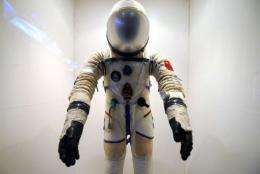
A spacesuit used by Chinese astronauts on display at the Shanghai Science and Technology Museum on January 4. As China pushes to become a global space power, experts say its ambitions go well beyond a symbolic moon landing, to satellite observation and a global positioning system to rival that of the United States.
As China pushes to become a global space power, experts say its ambitions go well beyond a symbolic moon landing, to satellite observation and a global positioning system to rival that of the United States.
The Asian powerhouse laid out its five-year plan for space exploration last week, outlining ambitious plans at a time when the United States -- historically at the forefront of the field -- has grounded its space shuttle fleet.
Isabelle Sourbes-Verger, a space expert at France's National Centre for Scientific Research, said it was widely acknowledged that "what matters to China is the role it will play as a major power."
China marked a key success in November last year when it completed its first docking in orbit high above Earth, a crucial step towards fulfilling its ambition to set up a manned space station by 2020.
In 2003, it became the third country in the world to send humans into space after Russia and America, and it is now looking into sending astronauts to the moon, although nothing has been set in stone.
The white paper issued last Thursday -- the third to have been published since 2000 -- said China "will conduct studies on the preliminary plan for a human lunar landing."
Australia-based expert Morris Jones said the logo of the China Lunar Exploration Program, which operates robotic missions to the Moon, had a human footprint at its centre, providing a "useful clue about their long-term plans."
But Beijing is not content with playing catch-up on manned flights, and is also looking to reap economic and scientific benefits from space.
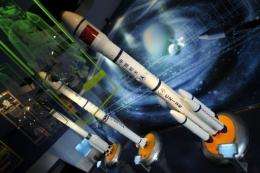
Model Chinese spacerockets are seen on display at the Shanghai Science and Technology Museum on January 4. As China pushes to become a global space power, experts say its ambitions go well beyond a symbolic moon landing, to satellite observation and a global positioning system to rival that of the United States.
By 2016, China will "increase the use of satellites to contribute to the development of strategic industries and satisfy the needs of the economy" in telecommunications, Earth observation or global positioning systems, the white paper said.China last year launched its version of the US Global Positioning System (GPS), the Beidou satellite navigation system. Further satellites will enable the new system to cover Asia this year, and the whole world by 2020.
Sourbes-Verger said China's ambitions in Earth observation -- an expertise that has both civilian and military applications -- were well ahead of anything currently planned by Europe.
The white paper outlined ambitions for "24-hour continuous, high-resolution surveillance of the Earth," she said, adding that the plan, if realised, would put China almost on a level with the United States in this field.
China has long maintained the rapid development of its space capabilities is peaceful in nature, and the white paper reiterated this, saying Beijing "opposes weaponisation or any arms race in outer space."
But concerns remain over China's intentions. In 2009, air force commander General Xu Qiliang caused a stir when he said armed forces should prepare for the "inevitable" militarisation of outer space -- a claim hastily disavowed by President Hu Jintao.
Jones noted that China had tested anti-satellite weapons by blowing up one of its own in 2007. "No nation that has a respectable major space programme has an entirely peaceful programme," he said.
"The world over, space technologies are used for military communications and to deploy spy satellites. China's no different."
The white paper also outlined plans to equip China's next-generation rockets with the ability to carry heavier cargoes.
The Long March-5 rocket being developed will be able to place 25-tonne payloads into near-Earth orbit -- more than the 20 tonnes Europe's Ariane 5 rocket can carry.
But the payload is still a lot lighter than what Saturn V -- a rocket used by the United States from 1967 to 1973 that transported the Apollo missions to the moon -- was able to carry.
"Now we need vehicles with a greater capability to send more payloads into space," Hu Haifeng, designer at the China Aerospace Science and Technology Corporation -- a contractor for the Chinese space programme -- was quoted as saying by the official Global Times.
(c) 2012 AFP
-
From lemons to lemonade: Reaction uses carbon dioxide to make carbon-based semiconductor,
32 comments
-
Thioridazine kills cancer stem cells in human while avoiding toxic side-effects of conventional cancer treatments,
3 comments
-
SpaceX private rocket blasts off for space station (Update),
42 comments
-
Climate scientists say they have solved riddle of rising sea,
31 comments
-
SpaceX capsule has 'new car' smell, astronauts say (Update),
4 comments
-
Distance of planets from stars and revolution
8 hours ago
-
revamping general concept and cosmological principle
May 25, 2012
-
Transiting Exoplanet Light Curve
May 25, 2012
-
Math behind Theoretical Physics
May 24, 2012
-
Do we know whats at the center of galaxies yet?
May 23, 2012
-
Structure of the Milky Way?
May 20, 2012
- More from Physics Forums - General Astronomy
More news stories
Land and sea species differ in climate change response: study
(Phys.org) -- Marine and terrestrial species will likely differ in their responses to climate warming, new research by Simon Fraser University and Australia’s University of Tasmania has found.
6 hours ago |
3.8 / 5 (4) |
5
|
Yale study concludes public apathy over climate change unrelated to science literacy
Are members of the public divided about climate change because they don't understand the science behind it? If Americans knew more basic science and were more proficient in technical reasoning, would public consensus match ...
8 hours ago |
4.8 / 5 (5) |
20
|
10 million years needed to recover from mass extinction
It took some 10 million years for Earth to recover from the greatest mass extinction of all time, latest research has revealed.
Space & Earth / Earth Sciences
8 hours ago |
4 / 5 (4) |
1
|
Sophisticated simulations predict future warming
The chances of our planet being hit by a global warming of 3 degrees Celsius by 2050 is as likely as it being hit by an increase of 1.4 degrees, new research shows. Presented in the journal Nature Geoscience, the British study ...
Space & Earth / Earth Sciences
May 22, 2012 |
4.1 / 5 (10) |
51
Aliens don't want to eat us, says former SETI director
Alien life probably isnt interested in having us for dinner, enslaving us or laying eggs in our bellies, according to a recent statement by former SETI director Jill Tarter.
Space & Earth / Space Exploration
May 25, 2012 |
4.4 / 5 (15) |
41
Stunning image of smallest possible five-ringed structure
Scientists have created and imaged the smallest possible five-ringed structure about 100,000 times thinner than a human hair and you'll probably recognise its shape.
'Unzipped' carbon nanotubes could help energize fuel cells, batteries
Multi-walled carbon nanotubes riddled with defects and impurities on the outside could replace some of the expensive platinum catalysts used in fuel cells and metal-air batteries, according to scientists at ...
Change in developmental timing was crucial in the evolutionary shift from dinosaurs to birds: study
At first glance, it's hard to see how a common house sparrow and a Tyrannosaurus Rex might have anything in common. After all, one is a bird that weighs less than an ounce, and the other is a dinosaur that ...
Computer model used to pinpoint prime materials for efficient carbon capture
When power plants begin capturing their carbon emissions to reduce greenhouse gases and to most in the electric power industry, it's a question of when, not if it will be an expensive undertaking.
T cells 'hunt' parasites like animal predators seek prey, study shows
By pairing an intimate knowledge of immune-system function with a deep understanding of statistical physics, a cross-disciplinary team at the University of Pennsylvania has arrived at a surprising finding: T cells use a movement ...
Scientists develop ultra-sensitive test that detects diseases in their earliest stages
Scientists have developed an ultra-sensitive test that should enable them to detect signs of a disease in its earliest stages, in research published today in the journal Nature Materials.

Jan 05, 2012
Rank: 1 / 5 (2)