Researchers uncover reason why mole rats are oblivious to acid pain
December 16, 2011 by Bob Yirka
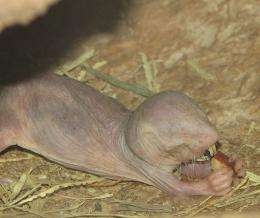
Naked Molerat Heterocephalus glaber eating. Image: Wikipedia.
(PhysOrg.com) -- Mole rats aren't the prettiest things; living underground as they do, they more resemble Gollum from the Lord of the Rings trilogy than other rats or mice. But theyre interesting to scientists nonetheless because they have some interesting traits. They live for twenty years for example, and none of them ever get cancer.
Perhaps even more interesting is the fact that because they live so close together underground, carbon dioxide builds up in their den to levels that would kill most other mammals, and because oxygen levels are low too, an environment exists that would prove painful for most animals due to acid buildup in tissues. Mole rats are impervious to pain from acid though, a fact that has intrigued scientists for years. Most assumed they simply had different types of nociceptors than other mammals.
But thats not the case, as Gary Lewin and his colleagues from the Max Delbrück Center for Molecular Medicine in Berlin write in their paper published in Science. Instead, it appears the mole rats have a species specific variant of a certain sodium channel.
In order to feel things such as acid burn, animals have sensory neurons in their tissues, the tips of which have channels called nociceptors which control the flow of sensory information to the neuron, which is responsible for sending electrical signals to the brain. Channels can let things through, or slam shut blocking things off depending on the cause of the stimulation. In the case of acid, nociceptors for most mammals are stimulated and partially close, but let enough of the sensory information pass through to allow the brain to feel the pain acidic substances create. Oddly enough, the team found that to be the case with mole rats too, which meant they had to look elsewhere. In this case that meant looking at another type of sodium channel, called NaV1.7, which they found became blocked when exposed to acid.
This new discovery by the team means they have discovered that an animal doesnt have to have a unique type of nociceptor in order to be free from acid pain, all thats necessary is a change in the NaV1.7 channel that directs the flow of information passed on to neuron below. This is quite a find because it could lead to ways to alleviate certain kinds of pain that people experience, such as inflammation from arthritis.
More information: The Molecular Basis of Acid Insensitivity in the African Naked Mole-Rat, Science, 16 December 2011: Vol. 334 no. 6062 pp. 1557-1560. DOI: 10.1126/science.1213760
ABSTRACT
Acid evokes pain by exciting nociceptors; the acid sensors are proton-gated ion channels that depolarize neurons. The naked mole-rat (Heterocephalus glaber) is exceptional in its acid insensitivity, but acid sensors (acid-sensing ion channels and the transient receptor potential vanilloid-1 ion channel) in naked mole-rat nociceptors are similar to those in other vertebrates. Acid inhibition of voltage-gated sodium currents is more profound in naked mole-rat nociceptors than in mouse nociceptors, however, which effectively prevents acid-induced action potential initiation. We describe a species-specific variant of the nociceptor sodium channel NaV1.7, which is potently blocked by protons and can account for acid insensitivity in this species. Thus, evolutionary pressure has selected for an NaV1.7 gene variant that tips the balance from proton-induced excitation to inhibition of action potential initiation to abolish acid nociception.
Journal reference:
Science
© 2011 PhysOrg.com
-
From lemons to lemonade: Reaction uses carbon dioxide to make carbon-based semiconductor,
32 comments
-
Thioridazine kills cancer stem cells in human while avoiding toxic side-effects of conventional cancer treatments,
3 comments
-
SpaceX private rocket blasts off for space station (Update),
42 comments
-
Climate scientists say they have solved riddle of rising sea,
31 comments
-
SpaceX capsule has 'new car' smell, astronauts say (Update),
4 comments
-
osmotic pressure vs diffusion
44 minutes ago
-
What would stain as translucent on light-coloured fabric?
May 26, 2012
-
How do I identify different bacteria on culture plates?
May 26, 2012
-
Why Do Dogs do Strange things...
May 25, 2012
-
What does exophillic and endophillic mean in terms of mosquito and their control?
May 24, 2012
-
Semen stains glows under black lights (uv light)?
May 23, 2012
- More from Physics Forums - Biology
More news stories
Manufacturing genes to attack flu virus
An international research team has manufactured a new protein that can combat deadly flu epidemics.
8 hours ago |
not rated yet |
0
|
Scientist: Evolution debate will soon be history
(AP) -- Richard Leakey predicts skepticism over evolution will soon be history. Not that the avowed atheist has any doubts himself.
May 26, 2012 |
3.5 / 5 (20) |
96
More plant species responding to global warming than previously thought
(Phys.org) -- Far more wild plant species may be responding to global warming than previous large-scale estimates have suggested.
May 22, 2012 |
4.6 / 5 (14) |
18
|
For monogamous sparrows, it doesn't pay to stray (but they do it anyway)
It's quite common for a female song sparrow to stray from her breeding partner and mate with the male next door, but a new study shows that sleeping around can be costly.
May 22, 2012 |
5 / 5 (2) |
8
|
Thousands of shellfish found dead in Peru
Thousands of crustaceans were found dead off the coast of Lima following the mystery mass death of dolphins and pelicans, the Peruvian Navy said Friday.
May 26, 2012 |
4.7 / 5 (7) |
7
Stunning image of smallest possible five-ringed structure
Scientists have created and imaged the smallest possible five-ringed structure about 100,000 times thinner than a human hair and you'll probably recognise its shape.
'Unzipped' carbon nanotubes could help energize fuel cells, batteries
Multi-walled carbon nanotubes riddled with defects and impurities on the outside could replace some of the expensive platinum catalysts used in fuel cells and metal-air batteries, according to scientists at ...
Change in developmental timing was crucial in the evolutionary shift from dinosaurs to birds: study
At first glance, it's hard to see how a common house sparrow and a Tyrannosaurus Rex might have anything in common. After all, one is a bird that weighs less than an ounce, and the other is a dinosaur that ...
Computer model used to pinpoint prime materials for efficient carbon capture
When power plants begin capturing their carbon emissions to reduce greenhouse gases and to most in the electric power industry, it's a question of when, not if it will be an expensive undertaking.
T cells 'hunt' parasites like animal predators seek prey, study shows
By pairing an intimate knowledge of immune-system function with a deep understanding of statistical physics, a cross-disciplinary team at the University of Pennsylvania has arrived at a surprising finding: T cells use a movement ...
Land and sea species differ in climate change response: study
(Phys.org) -- Marine and terrestrial species will likely differ in their responses to climate warming, new research by Simon Fraser University and Australia’s University of Tasmania has found.
Dec 16, 2011
Rank: 5 / 5 (3)
Dec 16, 2011
Rank: 1 / 5 (3)
Dec 16, 2011
Rank: 5 / 5 (3)
It's not being ignored. It is just NOT the topic of this particular article. Just google the subject and you'll see it's being researched.
Dec 18, 2011
Rank: not rated yet