Triton resource helps 'track' how kinesin molecules move
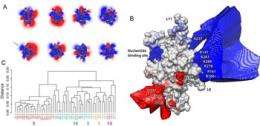
(A) Electrostatic properties of the kinesin family. Electrostatic properties of different kinesin representatives are expressed as a color spectrum ranging from positive (blue) to negative (red). (B) A consensus electrostatic potential map of the kinesin family illustrating conserved charged regions. Note the consistent positive blue patch on the rear face of the protein which binds microtubules. (C) Electrostatic clustering of available kinesin structures groups functionally similar proteins.
Researchers at UC San Diegos Department of Chemistry and Biochemistry, in collaboration with several universities in the U.S., United Kingdom, and Poland, have developed a new picture of how kinesin molecules move along microtubules, or tiny biological train tracks and how they sometimes come to a halt, causing diseases such as Alzheimers.
The new findings, published in the November 2011 issue of the journal PLoS Biology, are also significant in that these molecular locomotives play a critical role in moving the chromosomes apart during cell division. Indeed, a number of the most important existing cancer drugs, such as taxanes and vinca alkaloids, work by targeting these transport systems in rapidly dividing cancer cells.
Kinesins are a family of microtubule motor proteins active in mitosis, or cell division. These kinesins use chemical energy from the hydrolysis of ATP (adenosine triphosphatase), a compound that the body produces from food to generate energy as needed by the body.
Using the Triton Resource, a medium-scale high performance computing system at UC San Diegos San Diego Supercomputer Center (SDSC), researchers developed computational simulations of kinesin engines hauling cargo along microtubule rails within cells. The findings show that electrostatic attraction between the engine and the rail is critically important in making the railway work. Videos showing the simulations can be viewed below:
Precisely how kinesin motor proteins move along their microtubule tracks is an important question in biology, according to J. Andrew McCammon, Joseph Mayer Chair of Theoretical Chemistry and Professor of Pharmacology at UC San Diego and a Howard Hughes Medical Institute Investigator, and senior author of the research paper, called Electrostatically Biased Binding of Kinesin to Microtubules. We know that some kinesins have twin heads that alternately bind to and step along microtubules in a coordinated walking action. But more usually, kinesins have only one head, and how single-headed kinesins produce force and movement is poorly understood.
In the study, funded by the National Institutes of Health (NIH) and the National Science Foundation (NSF), researchers addressed this question and concluded that electrical attraction between single kinesin heads and microtubules is a critical factor deciding the direction of movement: each time the head approaches a microtubule, it slides forward by the electrical attraction between the engine and the track.
Implications for Nanoengineering
This research shows that computational methods can be used to rationally design mutant molecular motors, with altered electrostatic properties, that can regulate the speed of the railway, said researcher Barry J. Grant, now an assistant professor with the University of Michigan at Ann Arbor. Grant formerly was a member of McCammons research lab at UC San Diego.
In keeping with the train analogy, speeding up means having a more efficient transport of cargo, perhaps by means of a drug. Slowing the speed provides researchers with a good test of the general operational constraints for producing directed motion on the molecular scale, which is informative for future nanoengineering projects. Moreover, defects in motor-dependent processes, such as slowing down or stopping altogether, are associated with a large range of diseases, including neurodegeneration, tumorigenesis and developmental defects.
Some of these calculations for these protein simulations required quite a large amount of computer memory, so the Triton Resource proved to be very helpful in this work, said Grant, noting that each simulation in the project consumed about 7 gigabytes of ram/core with subsequent analysis of data sets measuring almost 2 terabytes in size. A single terabyte is one trillion bytes of data, about equal to the information printed on paper made from 50,000 trees.
Ultimately, construction of molecular motors to arbitrary specifications will provide a powerful tool kit for therapeutic delivery and nanotechnology applications. said McCammon.
Featuring a 2,000 processor computing cluster, a unique large-memory cluster for data-intensive computing, and a high capacity, high performance data storage system, the Triton Resource is offered on a space-available basis to researchers throughout the larger academic community, as well as private industry and government-funded organizations.
In addition to McCammon and Grant, other researchers contributing to the study include Dana M. Gheorghe, Robert A. Cross, and Maria Alonso from the Centre for Mechanochemical Cell Biology at the Warwick Medical School, University of Warwick in the U.K.; Wenjun Zheng, of the University of Buffalo, New York; Maciej Dlugosz, of the Interdisciplinary Centre for Mathematical and Computational Modelling at the University of Warsaw, Poland; and Gary Huber, with UC San Diegos Department of Pharmacology.
Provided by
University of California - San Diego
-
From lemons to lemonade: Reaction uses carbon dioxide to make carbon-based semiconductor,
32 comments
-
Thioridazine kills cancer stem cells in human while avoiding toxic side-effects of conventional cancer treatments,
3 comments
-
SpaceX private rocket blasts off for space station (Update),
42 comments
-
Climate scientists say they have solved riddle of rising sea,
31 comments
-
SpaceX capsule has 'new car' smell, astronauts say (Update),
4 comments
-
osmotic pressure vs diffusion
45 minutes ago
-
What would stain as translucent on light-coloured fabric?
May 26, 2012
-
How do I identify different bacteria on culture plates?
May 26, 2012
-
Why Do Dogs do Strange things...
May 25, 2012
-
What does exophillic and endophillic mean in terms of mosquito and their control?
May 24, 2012
-
Semen stains glows under black lights (uv light)?
May 23, 2012
- More from Physics Forums - Biology
More news stories
Manufacturing genes to attack flu virus
An international research team has manufactured a new protein that can combat deadly flu epidemics.
8 hours ago |
not rated yet |
0
|
Scientist: Evolution debate will soon be history
(AP) -- Richard Leakey predicts skepticism over evolution will soon be history. Not that the avowed atheist has any doubts himself.
May 26, 2012 |
3.5 / 5 (20) |
96
More plant species responding to global warming than previously thought
(Phys.org) -- Far more wild plant species may be responding to global warming than previous large-scale estimates have suggested.
May 22, 2012 |
4.6 / 5 (14) |
18
|
For monogamous sparrows, it doesn't pay to stray (but they do it anyway)
It's quite common for a female song sparrow to stray from her breeding partner and mate with the male next door, but a new study shows that sleeping around can be costly.
May 22, 2012 |
5 / 5 (2) |
8
|
Thousands of shellfish found dead in Peru
Thousands of crustaceans were found dead off the coast of Lima following the mystery mass death of dolphins and pelicans, the Peruvian Navy said Friday.
May 26, 2012 |
4.7 / 5 (7) |
7
Stunning image of smallest possible five-ringed structure
Scientists have created and imaged the smallest possible five-ringed structure about 100,000 times thinner than a human hair and you'll probably recognise its shape.
'Unzipped' carbon nanotubes could help energize fuel cells, batteries
Multi-walled carbon nanotubes riddled with defects and impurities on the outside could replace some of the expensive platinum catalysts used in fuel cells and metal-air batteries, according to scientists at ...
Change in developmental timing was crucial in the evolutionary shift from dinosaurs to birds: study
At first glance, it's hard to see how a common house sparrow and a Tyrannosaurus Rex might have anything in common. After all, one is a bird that weighs less than an ounce, and the other is a dinosaur that ...
Computer model used to pinpoint prime materials for efficient carbon capture
When power plants begin capturing their carbon emissions to reduce greenhouse gases and to most in the electric power industry, it's a question of when, not if it will be an expensive undertaking.
T cells 'hunt' parasites like animal predators seek prey, study shows
By pairing an intimate knowledge of immune-system function with a deep understanding of statistical physics, a cross-disciplinary team at the University of Pennsylvania has arrived at a surprising finding: T cells use a movement ...
Land and sea species differ in climate change response: study
(Phys.org) -- Marine and terrestrial species will likely differ in their responses to climate warming, new research by Simon Fraser University and Australia’s University of Tasmania has found.
Dec 08, 2011
Rank: 2 / 5 (4)
Please explain how this critical part of an incredible transport system either "just appeared by chance" or else "evolved from some primitive first step".
The more scientists discover about the inner workings of the cell, the more clear it becomes just how impossible spontaneous generation of life or even step-wise evolution becomes.
You really have to be in total denial to continue to support the evolutionary philosophy.
Just think - which is more logical? That biological things just got created by chance and of themselves, or that someone with super intelligence and the requisite tools created them?
All our commonsense, real-life experience shows us day in and day out that things do not make themselves.Yet people want to wave hands and wish that life started like that.
Dec 09, 2011
Rank: not rated yet
It's been explained to you many times. You still don't seem to grasp the basic concepts of natural selection (and science as a discipline), or rather you reject it out of wilful ignorance.
So the scientists who make these discoveries are all creationists now? Or maybe they just understand it better than you.
Genuine LOL!
You're not here to learn, and you're certainly not going to convince anyone here.
You are simply not knowledgeable enough to be in a position to express incredulity. Why do you keep embarrassing yourself?
Dec 09, 2011
Rank: not rated yet
Ignoring the fact that that is a false dichotomy:
Given that there is no evidence for your god, it is illogical as any other supernatural explanation.
The evidence supports evolution by natural selection (not your strawman misrepresentation).
Relativity isn't common sense. Neither is QM. Science is hard and often counter-intuitive.
Do you really still believe the stork brings babies? All living organisms "make themselves". All that is required for evolution is a reproducing information system. After that, evolution is inevitable.
A nice bit of projection there, helicopter hands.