Sky-watchers get rare treat: total lunar eclipse
December 11, 2011 By SUDHIN THANAWALA , Associated Press

Sky-watchers get rare treat: total lunar eclipse (AP)

Enlarge

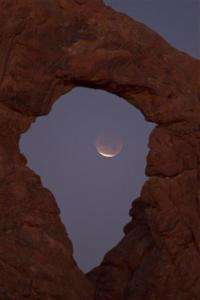
A lunar eclipse is seen framed within Turret Arch at Arches National Park, Saturday, Dec. 10, 2011, near Moab, Utah. Saturday's total lunar eclipse, resulting from the earth's position between the moon and sun, was forecasted to be the last of its kind until April 2014. (AP Photo/Julie Jacobson)

Moon watchers in the western U.S., Hawaii and elsewhere across the globe were treated Saturday to a rare celestial phenomenon: a total lunar eclipse.

For 51 minutes starting at 6:06 a.m. PST, the Earth's shadow completely blocked the moon.

The moon took on a reddish glow, as some indirect sunlight continued to reach it after passing through the Earth's atmosphere. Since the atmosphere scatters blue light, only red light strikes the moon, giving it a crimson hue.

David Sayre, who runs a public relations firm in Hawaii, said it had been cloudy and rainy around his house on Oahu, but the weather cleared just in time for the eclipse.

He awoke, as he usually does, around 3 a.m. and remembered to step outside the house in time to catch the eclipse about a half hour later. No one else in the neighborhood was up.

"Sure enough it was turning that orangy-red color," Sayre, 47, said. "I said, `Gosh I better grab a camera.'"

He added, "To be able to see it just right outside our house was really cool."

At the Griffith Observatory in Los Angeles, some 300 people, many clutching coffee cups in the frigid morning air, sat with blankets and chairs on the observatory's great lawn.

"It's a celestial festival out here," Capm Petersen, 39, told the Los Angeles Times as he set up his camera.

Perched on a slope north of downtown near the Hollywood sign, the property offers clear views of the sky. Observatory officials alerted the crowd when the eclipse began and spontaneous applause erupted when the celestial event ended.

A occurs when the moon goes through the long shadow cast by the Earth and is blocked from the sunlight that illuminates it.

The last total lunar eclipse was on June 15 although that was not visible from the U.S. The next one is on April 15, 2014, and will be seen in the U.S.

©2011 The Associated Press. All rights reserved. This material may not be published, broadcast, rewritten or redistributed.

4.8 /5 (8 votes)  

Filter


Move the slider to adjust rank threshold, so that you can hide some of the comments.


Display comments: newest first

abhishekbt
Dec 11, 2011

Rank: not rated yet
last of its kind until April 2014

Sensationalism.
Rank 4.8 /5 (8 votes)
Relevant PhysicsForums posts
  • Distance of planets from stars and revolution
    created5 hours ago
  • revamping general concept and cosmological principle
    createdMay 25, 2012
  • Transiting Exoplanet Light Curve
    createdMay 25, 2012
  • Math behind Theoretical Physics
    createdMay 24, 2012
  • Do we know whats at the center of galaxies yet?
    createdMay 23, 2012
  • Structure of the Milky Way?
    createdMay 20, 2012
  • More from Physics Forums - General Astronomy

More news stories

Land and sea species differ in climate change response: study

(Phys.org) -- Marine and terrestrial species will likely differ in their responses to climate warming, new research by Simon Fraser University and Australia’s University of Tasmania has found.

Space & Earth / Environment

created 3 hours ago | popularity 3.7 / 5 (3) | comments 3 | with audio podcast

Yale study concludes public apathy over climate change unrelated to science literacy

Are members of the public divided about climate change because they don't understand the science behind it? If Americans knew more basic science and were more proficient in technical reasoning, would public consensus match ...

Space & Earth / Environment

created 5 hours ago | popularity 4.8 / 5 (4) | comments 11 | with audio podcast

10 million years needed to recover from mass extinction

It took some 10 million years for Earth to recover from the greatest mass extinction of all time, latest research has revealed.

Space & Earth / Earth Sciences

created 5 hours ago | popularity 5 / 5 (3) | comments 1 | with audio podcast

Sophisticated simulations predict future warming

The chances of our planet being hit by a global warming of 3 degrees Celsius by 2050 is as likely as it being hit by an increase of 1.4 degrees, new research shows. Presented in the journal Nature Geoscience, the British study ...

Space & Earth / Earth Sciences

created May 22, 2012 | popularity 4.4 / 5 (9) | comments 51

Aliens don't want to eat us, says former SETI director

Alien life probably isn’t interested in having us for dinner, enslaving us or laying eggs in our bellies, according to a recent statement by former SETI director Jill Tarter.

Space & Earth / Space Exploration

created May 25, 2012 | popularity 4.4 / 5 (14) | comments 41


'Unzipped' carbon nanotubes could help energize fuel cells, batteries

Multi-walled carbon nanotubes riddled with defects and impurities on the outside could replace some of the expensive platinum catalysts used in fuel cells and metal-air batteries, according to scientists at ...

Change in developmental timing was crucial in the evolutionary shift from dinosaurs to birds: study

At first glance, it's hard to see how a common house sparrow and a Tyrannosaurus Rex might have anything in common. After all, one is a bird that weighs less than an ounce, and the other is a dinosaur that ...

Computer model used to pinpoint prime materials for efficient carbon capture

When power plants begin capturing their carbon emissions to reduce greenhouse gases – and to most in the electric power industry, it's a question of when, not if – it will be an expensive undertaking.

T cells 'hunt' parasites like animal predators seek prey, study shows

By pairing an intimate knowledge of immune-system function with a deep understanding of statistical physics, a cross-disciplinary team at the University of Pennsylvania has arrived at a surprising finding: T cells use a movement ...

Scientists develop ultra-sensitive test that detects diseases in their earliest stages

Scientists have developed an ultra-sensitive test that should enable them to detect signs of a disease in its earliest stages, in research published today in the journal Nature Materials.

Manufacturing genes to attack flu virus

An international research team has manufactured a new protein that can combat deadly flu epidemics.