Polar quest: Will Antarctic worms warm to changing climate?
(PhysOrg.com) -- Researchers at the University of Delaware are examining tiny worms that inhabit the frigid sea off Antarctica to learn not only how these organisms adapt to the severe cold, but how they will survive as ocean temperatures increase.
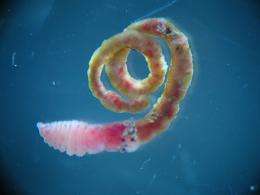
The National Science Foundation study, led by Adam Marsh, associate professor of marine biosciences in UD’s College of Earth, Ocean, and Environment, also will compare the process of temperature adaptation in the polar worm, known scientifically as Capitella perarmata, with that of a close relative that inhabits temperate waters, Capitella teleta.
“By comparing these two marine species, we hope to assess how a polar environment shapes responses to environmental stress,” says Marsh. “By better understanding how the environment can trigger genetic changes – through the genes the polar worm turns on or ‘expresses’ – we can gain insight into the potential impact of global warming on marine ecosystems.”
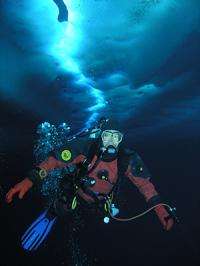
Arriving in late August at McMurdo Station on Ross Island, Antarctica’s largest outpost, Marsh and his research team undertook a series of dives in the freezing waters over the next two months to collect the polar sea worms, which are segmented like earthworms but belong to the class known as "polychaetes."
At a mere half-inch long and no thicker than the lead in a No. 2 pencil, Capitella perarmata would be a challenge to collect even on dry land. Because the worms feed on organic matter, the researchers have found the most abundant concentrations in the top layer of sediment from McMurdo Station’s old sewage outfall. The divers collect buckets filled with sediment, from which the worms are sieved.
Just getting to the underwater site takes some doing, as UD doctoral student Annamarie Pasqualone points out. Pasqualone, who is from Medford, N.J., stayed on to complete the experiments in Crary Laboratory, McMurdo Station’s science building. She will depart the frozen continent before Christmas to travel back to Delaware.
“A three-foot-diameter hole needs to be drilled through about seven feet of ice, and then a heated dive hut must be placed over the newly drilled hole in order to prevent it from freezing over -- and to keep the divers happy when they surface out of the seawater, which is at a temperature of minus one degree Celsius,” she says.
Pasqualone has been assessing the worms’ physiological and biochemical responses as they acclimate to an increase in environmental temperature from -1.5 degrees C to 4 degrees C in laboratory experiments. Additional experiments are under way in Marsh’s lab at UD’s Hugh R. Sharp Campus in Lewes.
For this project, the Marsh laboratory is focusing on identifying epigenetic changes in DNA methylation in these worms – in other words, how the environment is influencing the worms’ genetic code. DNA methylation is a process in animals and plants where environmental signals are “imprinted” on genes in a genome by chemical modification of cytosine—one of the bases of the DNA code—to 5’-methyl-cytosine. By tracking changes in metabolic activity and locating genes where methylation changes are active, the scientists will be able to pinpoint the types of genes involved in the temperature acclimation process.
Marsh says he hopes the results of the study will shed light on the ability of some Antarctic species to survive current levels of ocean warming.
“The coastal waters around Antarctica have been at very stable temperatures for millions of years,” Marsh says. “This low-temperature environment has led to the evolution of many endemic polar marine species. As global sea-surface temperatures rise, temperatures in Antarctica will also increase. For animals that are used to constant cold conditions, even slight increases in temperature can have large impacts on survival.”
Data yielded by the study on how extreme environmental conditions help shape genes and proteins also could have important economic applications.
Marsh and colleague Joe Grzymski at the Desert Research Institute in Nevada recently co-founded Evozym Biologics, a startup company, to accelerate the discovery of useful proteins for developing new antibiotic drugs and biofuels. The catalyst was their respective research on other Antarctic “extremophiles”—soil microbes for Grzymski and Antarctic sea urchins for Marsh.
“This information has a huge potential for commercial use in the field of synthetic biology,” Marsh notes. “Many of the industrial-scale processes that utilize enzymes require that these proteins are synthetically designed to work efficiently under extreme conditions. In bioreactors, for example, conditions of high heat or high acid are common and require bioengineered proteins for increased stability and catalytic efficiency.”
Marsh’s Antarctic team also included Stacy Kim, a scientist at California’s Moss Landing Marine Laboratories, Stephanie Guida, a UD doctoral student from Milton, Del., and Michael League, a science teacher at Millsboro Middle School in Millsboro, Del.
Provided by University of Delaware


