Plasmonic nanocrosses that heat up when illuminated can be used to kill cancer
December 23, 2011 By Lee Swee Heng
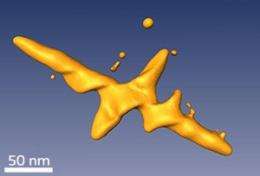
A reconstructed image of a gold nanocross surface. Credit: 2011 ACS
Plasmonic nanoparticles are extremely sensitive to light, and even the tiniest amount can cause these particles to heat up. Scientists are now trying to use plasmonic nanoparticles in cancer therapy whereby light energy is converted into heat in order to kill cancer cells. The advantage of such treatment is that it does not cause side effects that are common to chemotherapy. Mingyong Han at the A*STAR Institute of Materials Research and Engineering and co-workers have now developed gold plasmonic nanocrosses that are particularly suited to eliminating cancer cells in cancer therapy. The team demonstrated the usefulness of these nanocrosses by using them to kill human lung cancer cells.
In general, metallic nanostructures have a particular frequency at which light excites electrons close to their surface. The collective movement of electrons, or resonance, in the metal is what converts the light energy into heat. The wavelength at which the resonance occurs is strongly dependent on the size and shape of the nanostructures.
For biomedical applications, the nanostructures should be effective no matter which direction they are illuminated from. Furthermore, the nanostructures should be efficient in absorbing near- to mid-infrared wavelengths because tissue is transparent to the light of these wavelengths.
Based on these requirements, the researchers decided to make gold nanocrosses (see image). In normal synthesis, however, gold would usually grow into the shape of the nanorods. To fabricate nanocrosses, the researchers added copper ions to the growth solution. The incorporation of small amounts of copper caused a twinning of the golds crystal structure, which in turn led to the growth of side arms from the crystal facets. The unique cross-shaped gold structure enables multi-directional excitation to achieve a strong plasmonic resonance in the near- and mid-infrared region. This greatly lowers the laser power required for photothermal cancer therapy compared to nanorods, says Han.
The researchers tested the performance of their gold nanocrosses by modifying their surfaces and binding them to human lung cancer cells. When irradiated with near-infrared laser light of relatively modest powers of 4.2 W/cm2 for 30 seconds, all cancer cells were killed. The researchers are now planning to test the effectiveness of the gold nanocrosses on animal models in future experiments.
Other applications of the gold nanocrosses are also possible, including photothermal imaging, in which small amounts of light are converted into local heat, or the sterilization of surfaces. In our current research, we are studying gold nanocrosses for the photothermal destruction of superbugs on biofilms, says Han.
More information: Research article in the Journal of the American Chemical Society
Provided by Agency for Science, Technology and Research (A*STAR)
-
From lemons to lemonade: Reaction uses carbon dioxide to make carbon-based semiconductor,
32 comments
-
Thioridazine kills cancer stem cells in human while avoiding toxic side-effects of conventional cancer treatments,
3 comments
-
SpaceX private rocket blasts off for space station (Update),
42 comments
-
Climate scientists say they have solved riddle of rising sea,
31 comments
-
SpaceX capsule has 'new car' smell, astronauts say (Update),
4 comments
-
What would stain as translucent on light-coloured fabric?
May 26, 2012
-
How do I identify different bacteria on culture plates?
May 26, 2012
-
Why Do Dogs do Strange things...
May 25, 2012
-
What does exophillic and endophillic mean in terms of mosquito and their control?
May 24, 2012
-
Semen stains glows under black lights (uv light)?
May 23, 2012
-
Question on Human Chromosome 2
May 23, 2012
- More from Physics Forums - Biology
More news stories
'Unzipped' carbon nanotubes could help energize fuel cells, batteries
Multi-walled carbon nanotubes riddled with defects and impurities on the outside could replace some of the expensive platinum catalysts used in fuel cells and metal-air batteries, according to scientists at ...
Nanotechnology / Nanomaterials
5 hours ago |
1 / 5 (1) |
0
|
Dopant gives graphene solar cells highest efficiency yet
(Phys.org) -- By taking advantage of graphenes favorable electrical and optical properties, and then adding an organic dopant, researchers have achieved the highest power conversion efficiency yet for ...
In nanorod crystal growth, nanoparticles seen as artificial atoms
In the growth of crystals, do nanoparticles act as "artificial atoms" forming molecular-type building blocks that can assemble into complex structures? This is the contention of a major but controversial theory ...
May 24, 2012 |
4.8 / 5 (6) |
0
|
First direct observation of oriented attachment in nanocrystal growth
Berkeley Lab researchers have reported the first direct observation of nanoparticles undergoing oriented attachment, the critical step in biomineralization and the growth of nanocrystals. A better understanding ...
May 24, 2012 |
4.7 / 5 (3) |
0
|
Synthetic nano-waste does not disappear
(Phys.org) -- Tiny particles of cerium oxide do not burn or change in the heat of a waste incineration plant. They remain intact on combustion residues or in the incineration system, as a new study by Swiss ...
Nanotechnology / Bio & Medicine
May 25, 2012 |
5 / 5 (2) |
1
|
Change in developmental timing was crucial in the evolutionary shift from dinosaurs to birds: study
At first glance, it's hard to see how a common house sparrow and a Tyrannosaurus Rex might have anything in common. After all, one is a bird that weighs less than an ounce, and the other is a dinosaur that ...
Computer model used to pinpoint prime materials for efficient carbon capture
When power plants begin capturing their carbon emissions to reduce greenhouse gases and to most in the electric power industry, it's a question of when, not if it will be an expensive undertaking.
T cells 'hunt' parasites like animal predators seek prey, study shows
By pairing an intimate knowledge of immune-system function with a deep understanding of statistical physics, a cross-disciplinary team at the University of Pennsylvania has arrived at a surprising finding: T cells use a movement ...
Land and sea species differ in climate change response: study
(Phys.org) -- Marine and terrestrial species will likely differ in their responses to climate warming, new research by Simon Fraser University and Australia’s University of Tasmania has found.
Yale study concludes public apathy over climate change unrelated to science literacy
Are members of the public divided about climate change because they don't understand the science behind it? If Americans knew more basic science and were more proficient in technical reasoning, would public consensus match ...
10 million years needed to recover from mass extinction
It took some 10 million years for Earth to recover from the greatest mass extinction of all time, latest research has revealed.