LRO lets you stand on the rim of Aristarchus crater
December 30, 2011 By Nancy Atkinson, Universe Today

LRO lets you stand on the rim of Aristarchus crater

Enlarge

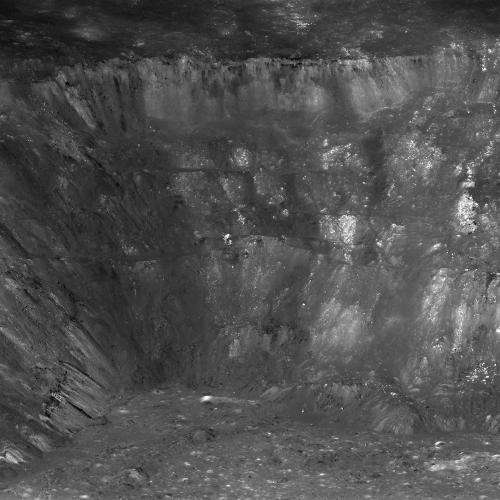
West wall of Aristarchus crater seen obliquely by the LROC NACs from an altitude of only 26 km. Scene is about 12 km wide at the base. Credit: NASA/GSFC/Arizona State University.

Have you ever you looked up at the bright, cavernous Aristarchus Crater on the Moon through a telescope or binoculars and wondered what it would be like to stand on the rim and peer inside? Spectacular new views from the Lunar Reconnaissance Orbiter is almost as good as being there, and a new video lets you “rappel” down and take a closer look at the west side of the crater walls.

LRO Camera Principal Investigator Mark Robinson describes the region around the , known as the Aristarchus plateau, as one of the most geologically diverse places on the Moon. “A mysterious raised flat plateau, a giant rille carved by enormous outpourings of lava, fields of explosive volcanic ash, and all surrounded by massive flood basalts,” Robinson wrote on the LROC website. “A relatively recent asteroid (or comet) slammed into this geologic wonderland, blowing a giant hole in the ground revealing a cross section of over 3,000 meters (9,800 ft) of geology. No wonder planners for the Apollo missions put this plateau high on its list of targets for human exploration.”
LRO lets you stand on the rim of Aristarchus crater
Enlarge

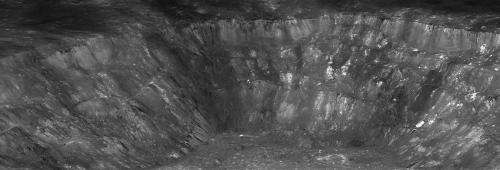
Full panoramic view of the west wall of Aristarchus crater revealing impact melt deposits, exposures of high reflectance anorthosite, streamers of pyroclastic ash, and blocks up to 100 meters in size. Full width of panorama is about 25 km. Credit: NASA/GSFC/Arizona State University.

These new amazing images were acquired on November 10, 2011 as LRO passed only 26 km (16.2 miles) above the surface, which is about two times lower than normal, due to LRO’s current elliptical orbit. The spacecraft was slewed to the west for an oblique or “sideways” look at the crater, instead of looking straight down as LRO normally does, to provide this unique perspective on Aristarchus. For a sense of scale, Robinson said that altitude is only a little over twice as high as commercial jets fly above the Earth. This crater is only one-tenth the size of Earth’s Grand Canyon, but the views from up above are similarly spectacular.

This video is not supported by your browser at this time.

Aristarchus crater is located on the southeast edge of the Aristarchus Plateau. This yawning crater is 40 km wide and 3.5 km deep. The edges appear scalloped, almost like it crater was strip-mined. Since the crater is relatively young, Aristarchus is one of the brightest regions on the Moon. Robinson says these bright rocks may be anorthositic like the highlands, or they may be a more silicic rock like granite — or both.

“Although granites have been found in Apollo rock samples, the formation of granite on the is not well understood at this time – another reason why we need to get samples from this region,” he said.

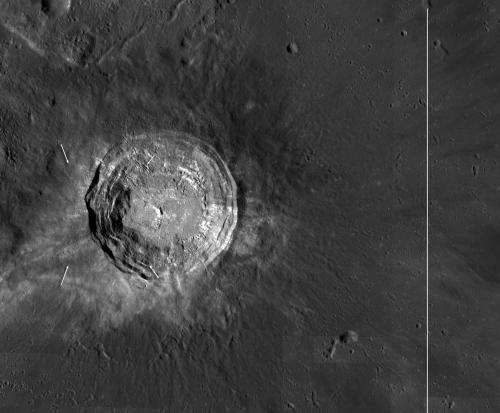
From this ‘straight down’ view, you can see the bright ejecta, contrasted by darker areas, which reflects the compositional difference between the various rocks in the region.

On the floor of Aristarchus crater is a wide variety of lunar rocks and geologic processes.
LRO lets you stand on the rim of Aristarchus crater
Enlarge

A 'straight down' view of Aristarchus, Aristarchus crater.. Small white arrows indicate approximate corners of the NAC panorama. Vertical line on right shows LRO orbit ground track Credit: NASA/GSFC/Arizona State University.

“Diverse materials such as dark, multilayered mare basalts in the walls, bright crustal rocks in the central peak, impact melt, and even regional pyroclastic materials blanketing the crater are brought to the floor and accumulated through mass wasting, creating a bountiful trove of geologic materials,” Robinson said.

Who’s ready to go exploring?!

More information: Click here to see the full-resolution panoramic view of Aristarchus Crater.

Provided by Universe Today

Filter


Move the slider to adjust rank threshold, so that you can hide some of the comments.


Display comments: newest first

FrankHerbert
Dec 30, 2011

Rank: 1.2 / 5 (57)
MODERATORS: Why is omatumr exempt from the following?
Comments Guidelines

Stay on topic: Acceptable comments include those that add to the discussion in a meaningful and thought-provoking manner or provide an intelligent counterpoint to our articles.

Keep science: Include references to the published scientific literature to support your statements. Pseudoscience comments (including non-mainstream theories) will be deleted


Do not paste articles: If you find a relevant article, include a link or an excerpt.

Do not include links in signatures or links to irrelevant materials: Comments that contain irrelevant links (including links in signatures) will be deleted. Linking to obviously "crackpot" sites is prohibited.

Comments that will be deleted include:
promotion of services, publications or work unless it is relevant to the post;
pseudoscience theories.

yyz
Dec 30, 2011

Rank: 5 / 5 (4)
These views are somewhat reminiscent of LRO's oblique view of the central peak of Tycho: http://wms.lroc.a...62350671

I've had many views of both features with a variety of telescopes, but images like these put you right down in the crater. Some really nice work by the LRO team.
Caliban
Dec 30, 2011

Rank: 1 / 5 (1)
Looks very much like a pit mine...oh, uh --excellent photography!!
Rank 5 /5 (6 votes)
Relevant PhysicsForums posts
  • Distance of planets from stars and revolution
    created5 hours ago
  • revamping general concept and cosmological principle
    createdMay 25, 2012
  • Transiting Exoplanet Light Curve
    createdMay 25, 2012
  • Math behind Theoretical Physics
    createdMay 24, 2012
  • Do we know whats at the center of galaxies yet?
    createdMay 23, 2012
  • Structure of the Milky Way?
    createdMay 20, 2012
  • More from Physics Forums - General Astronomy

More news stories

Land and sea species differ in climate change response: study

(Phys.org) -- Marine and terrestrial species will likely differ in their responses to climate warming, new research by Simon Fraser University and Australia’s University of Tasmania has found.

Space & Earth / Environment

created 3 hours ago | popularity 3.7 / 5 (3) | comments 2 | with audio podcast

Yale study concludes public apathy over climate change unrelated to science literacy

Are members of the public divided about climate change because they don't understand the science behind it? If Americans knew more basic science and were more proficient in technical reasoning, would public consensus match ...

Space & Earth / Environment

created 5 hours ago | popularity 4.8 / 5 (4) | comments 11 | with audio podcast

10 million years needed to recover from mass extinction

It took some 10 million years for Earth to recover from the greatest mass extinction of all time, latest research has revealed.

Space & Earth / Earth Sciences

created 5 hours ago | popularity 5 / 5 (3) | comments 1 | with audio podcast

Sophisticated simulations predict future warming

The chances of our planet being hit by a global warming of 3 degrees Celsius by 2050 is as likely as it being hit by an increase of 1.4 degrees, new research shows. Presented in the journal Nature Geoscience, the British study ...

Space & Earth / Earth Sciences

created May 22, 2012 | popularity 4.4 / 5 (9) | comments 51

Aliens don't want to eat us, says former SETI director

Alien life probably isn’t interested in having us for dinner, enslaving us or laying eggs in our bellies, according to a recent statement by former SETI director Jill Tarter.

Space & Earth / Space Exploration

created May 25, 2012 | popularity 4.4 / 5 (14) | comments 40


Nvidia trumpets Tegra 3 phone design wins for 2012

(Phys.org) -- Nvidia’s competitive war paint has a name, Tegra 3. On the heels of Nvidia announcements about lowering costs of its Tegra 3 processors and Nvidia-enabled tablets running Android Ice Cream ...

'Unzipped' carbon nanotubes could help energize fuel cells, batteries

Multi-walled carbon nanotubes riddled with defects and impurities on the outside could replace some of the expensive platinum catalysts used in fuel cells and metal-air batteries, according to scientists at ...

T cells 'hunt' parasites like animal predators seek prey, study shows

By pairing an intimate knowledge of immune-system function with a deep understanding of statistical physics, a cross-disciplinary team at the University of Pennsylvania has arrived at a surprising finding: T cells use a movement ...

Computer model used to pinpoint prime materials for efficient carbon capture

When power plants begin capturing their carbon emissions to reduce greenhouse gases – and to most in the electric power industry, it's a question of when, not if – it will be an expensive undertaking.

Change in developmental timing was crucial in the evolutionary shift from dinosaurs to birds: study

At first glance, it's hard to see how a common house sparrow and a Tyrannosaurus Rex might have anything in common. After all, one is a bird that weighs less than an ounce, and the other is a dinosaur that ...

Scientist: Evolution debate will soon be history

(AP) -- Richard Leakey predicts skepticism over evolution will soon be history. Not that the avowed atheist has any doubts himself.