New horned dinosaur announced nearly 100 years after discovery
December 6, 2011

New horned dinosaur announced nearly 100 years after discovery

Enlarge

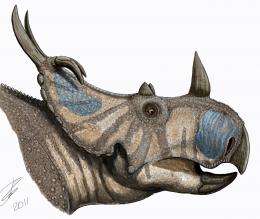
"Artist's restoration of the head of Spinops sternbergorum." Credit: Copyright Dmitry Bogdanov, courtesy of Raymond M. Alf Museum of Paleontology. Usage restrictions: This image may be used by news organizations in reports describing the research of Farke and colleagues on Spinops.

A new species of horned dinosaur was announced today by an international team of scientists, nearly 100 years after the initial discovery of the fossil.

The animal, named Spinops sternbergorum, lived approximately 76 million years ago in southern Alberta, Canada. Spinops was a plant-eater that weighed around two tons when alive, a smaller cousin of Triceratops. A single large horn projected from the top of the nose, and a bony neck frill sported at least two long, backward-projecting spikes as well as two forward-curving hooks. These unique structures distinguish Spinops from related horned dinosaurs.
New horned dinosaur announced nearly 100 years after discovery
Enlarge

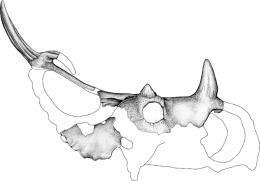
"Artist's rendering of the skull bones of Spinops sternbergorum." Credit: Copyright Lukas Panzarin, courtesy of Raymond M. Alf Museum of Paleontology. Usage restrictions: This image may be used by news organizations in reports describing the research of Farke and colleagues on Spinops.

"I was amazed to learn the story behind these specimens, and how they went unstudied for so long," said Andrew Farke, Augustyn Family Curator of Paleontology at the Raymond M. Alf Museum of Paleontology, and lead author on the study naming Spinops. "This animal is an important addition to our understanding of horned dinosaur diversity and evolution," Farke continued.

Parts of the skulls of at least two Spinops were discovered in 1916 by Charles H. and Levi Sternberg, a father-and-son fossil collecting team. The Sternbergs recognized that their find represented a new species and sent the fossils to The (London). However, the fossils were deemed too scrappy for exhibit, and consequently were shelved for decades. It wasn't until recognized the importance of the fossil that the bones were finally cleaned for study.

"This study highlights the importance of museum collections for understanding the history of our planet," commented Farke. "My colleagues and I were pleasantly surprised to find these fossils on the museum shelf, and even more astonished when we determined that they were a previously of dinosaur."

The name Spinops sternbergorum (pronounced "SPIN-ops stern-berg-OR-uhm") means "Sternbergs' spine face", referring to the of the animal and honoring the original discoverers of the fossil. Although the face of Spinops is similar to its close relatives Centrosaurus and Styracosaurus, the unique anatomy of the bony neck frill gives scientists better insight into how this structure evolved. In particular, the fossils of Spinops clarify the identification of the long frill spikes common in some horned dinosaurs. Previously, scientists had inferred that these spikes evolved only once in the group. Careful study of Spinops, however, suggests that its spikes are located in a different position from that seen in most other , implying that the structures evolved independently. This finding allows a more accurate reconstruction of evolutionary relationships, and is being tested with additional study.

More information: Farke, A. A., M. J. Ryan, P. M. Barrett, D. H. Tanke, D. R. Braman, M. A. Loewen, and M. R. Graham. 2011. A new centrosaurine from the Late Cretaceous of Alberta, Canada, and the evolution of parietal ornamentation in horned dinosaurs. Acta Palaeontologica Polonica 56(4). doi:10.4202/app.2010.0121

Provided by Raymond M. Alf Museum of Paleontology


Rank 4 /5 (5 votes)
Relevant PhysicsForums posts

More news stories

Change in developmental timing was crucial in the evolutionary shift from dinosaurs to birds: study

At first glance, it's hard to see how a common house sparrow and a Tyrannosaurus Rex might have anything in common. After all, one is a bird that weighs less than an ounce, and the other is a dinosaur that ...

Other Sciences / Archaeology & Fossils

created 7 hours ago | popularity 5 / 5 (4) | comments 0 | with audio podcast

Social welfare cuts ultimately come with heavy price, researchers say

(Phys.org) -- Slashing government funding for Medicaid, food stamps and other programs that serve the poor – while politically popular with some lawmakers and many conservatives – may do more harm ...

Other Sciences / Social Sciences

created May 24, 2012 | popularity 4 / 5 (21) | comments 155

Ancient Bethlehem seal unearthed in Jerusalem

Israeli archaeologists have discovered a 2,700-year-old seal that bears the inscription "Bethlehem," the Israel Antiquities Authority announced Wednesday, in what experts believe to be the oldest artifact ...

Other Sciences / Archaeology & Fossils

created May 23, 2012 | popularity 3.3 / 5 (15) | comments 24

Dollars and sense: Why are some people morally against tax?

As the U.S. presidential election campaigns heat up, the economic debate is dominated by bailouts, austerity and, inevitably, taxation. Now a new study published in Symbolic Interaction asks why tax is such an important issue ...

Other Sciences / Social Sciences

created May 23, 2012 | popularity 2.3 / 5 (3) | comments 19

Oldest Jewish archaeological evidence on the Iberian Peninsula

German archaeologists of the Friedrich Schiller University Jena found one of the oldest archaeological evidence so far of Jewish Culture on the Iberian Peninsula at an excavation site in the south of Portugal, ...

Other Sciences / Archaeology & Fossils

created May 25, 2012 | popularity 4.2 / 5 (6) | comments 12


Stunning image of smallest possible five-ringed structure

Scientists have created and imaged the smallest possible five-ringed structure – about 100,000 times thinner than a human hair – and you'll probably recognise its shape.

'Unzipped' carbon nanotubes could help energize fuel cells, batteries

Multi-walled carbon nanotubes riddled with defects and impurities on the outside could replace some of the expensive platinum catalysts used in fuel cells and metal-air batteries, according to scientists at ...

Computer model used to pinpoint prime materials for efficient carbon capture

When power plants begin capturing their carbon emissions to reduce greenhouse gases – and to most in the electric power industry, it's a question of when, not if – it will be an expensive undertaking.

T cells 'hunt' parasites like animal predators seek prey, study shows

By pairing an intimate knowledge of immune-system function with a deep understanding of statistical physics, a cross-disciplinary team at the University of Pennsylvania has arrived at a surprising finding: T cells use a movement ...

Land and sea species differ in climate change response: study

(Phys.org) -- Marine and terrestrial species will likely differ in their responses to climate warming, new research by Simon Fraser University and Australia’s University of Tasmania has found.

Yale study concludes public apathy over climate change unrelated to science literacy

Are members of the public divided about climate change because they don't understand the science behind it? If Americans knew more basic science and were more proficient in technical reasoning, would public consensus match ...