Model shows how facade pollutants make it into the environment
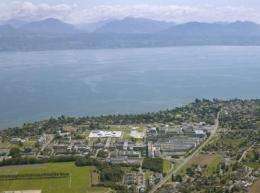
This is the EPFL Campus in Lausanne, near to where the samples were taken. Credit: EPFL / Alain Herzog
Anti-fungal and anti-bacterial additives in house paint are present in dangerous quantities in the Vauchère river basin in the city of Lausanne, says a study to be presented the 9th of December, at the American Geophysical Union (AGU) conference in San Francisco. Chemicals engineered to kill microorganisms, called biocides, are added to exterior paints in order to prevent molding and plant growth. Washed off of building facades during heavy rains, however, these chemicals can be wind up in soil, groundwater and river basins where they attack bacteria, fungi and algae at the bottom of the food chain. Researchers at EPFL's Ecological Engineering Laboratory have now modeled the flow of biocides from building façades into river basins with surprising accuracy, which could lead to stricter regulations for Switzerland and abroad.
In Switzerland, biocides are present in exterior paint on some 60% of buildings and they are common worldwide. The global demand on all biocides for use in industrial and consumer goods was estimated at US$6.4 billion in 2008. Certain antifouling biocides have been phased out of use on boat hulls after being proven toxic to marine life.
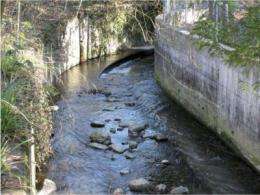
This is the river near EPFL campus that was the subject of the study. Credit: EPFL
The mathematical tool developed by Sylvain Coutu at EPFL accurately predicts peak concentration levels in a local river of three biocides commonly found in industrial paint: DCMU, Terbutryn and Carbendazim. Coutu predicted the concentration of these biocides after four rainstorms during the spring of 2011 and compared the numbers to actual measurements taken from the river. The model proved accurate up to a couple of nanograms per liter, an impressive feat considering the variety and complexity of variables. The model's strength comes from its ability to simplify urban surface hydraulic behaviorshow water is channeled down streets and gutters or lawns and gardensand still remain extremely accurate."A true toxicology report should include peak levels of concentration after rainfall, and we have created the first model that takes them into account over a period of time," says Coutu.
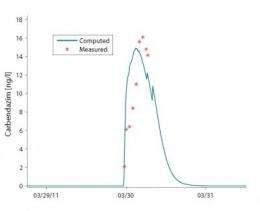
This is a graph showing the modeled results and the actual data -- close to a couple nanograms per liter. Credit: EPFL - Sylvain Coutu
Establishing a working model has the advantage of reproducibility as well as reducing dependency on expensive testing. Once a reliable model has been created it can be used in other regions, although the model needs to be adapted to the specific geography, for example the surface area of contaminated façades as well as the quick water drainage of urban surfaces. Once the input is determined and the dynamics of the hazardous substances reacting to rainfall are worked out, it is possible to estimate the concentrations of these substances to see if they exceed acceptable levels.The biocides that reached the river basin in Switzerland did so in extremely small concentrations30 nanograms per liter, or 30 parts per trillion, of the chemical DCMU were present after heavy rains. DCMU is a common herbicide and algicide developed in the 1950s in Germany and the threshold concentration after which this substance is considered a threat for the environment is 20 nanograms per liter. DCMU is considered harmful and can potentially kill algae and other plantlife by inhibiting photosynthesis and thus depriving the organisms of energy. Biocides in general do not degrade easily, thus increasing their risk of moving up the food chain and making their way, in higher and higher concentrations, throughout the environment.
"While it may seem like a very small concentration, 20 nanograms is all that is needed to have an impact on the ecosystem since these chemicals are engineered to kill at very low doses," explains Coutu. Furthermore, the study also proves that water behavior in urban environments can be accurately modeled, opening the door to further toxicology studies for city ecosystems.
Provided by Ecole Polytechnique Federale de Lausanne
-
From lemons to lemonade: Reaction uses carbon dioxide to make carbon-based semiconductor,
32 comments
-
Thioridazine kills cancer stem cells in human while avoiding toxic side-effects of conventional cancer treatments,
3 comments
-
SpaceX private rocket blasts off for space station (Update),
42 comments
-
Climate scientists say they have solved riddle of rising sea,
31 comments
-
SpaceX capsule has 'new car' smell, astronauts say (Update),
4 comments
-
Hypothetical desert earth
22 hours ago
-
More human population = greater mass?
May 25, 2012
-
Conversion from aircraft bearing to normal degrees
May 23, 2012
-
Interpretation/Analysis of the Lab results(HEPA filter)
May 22, 2012
-
Has anyone here attended the The Urbino Summer School in Paleoclimatology?
May 22, 2012
-
Earthquakes: Mag 6 N. Italy and Mag 5.6 W. Bulgaria
May 21, 2012
- More from Physics Forums - Earth
More news stories
Land and sea species differ in climate change response: study
(Phys.org) -- Marine and terrestrial species will likely differ in their responses to climate warming, new research by Simon Fraser University and Australia’s University of Tasmania has found.
5 hours ago |
3.7 / 5 (3) |
5
|
Yale study concludes public apathy over climate change unrelated to science literacy
Are members of the public divided about climate change because they don't understand the science behind it? If Americans knew more basic science and were more proficient in technical reasoning, would public consensus match ...
7 hours ago |
4.8 / 5 (5) |
19
|
10 million years needed to recover from mass extinction
It took some 10 million years for Earth to recover from the greatest mass extinction of all time, latest research has revealed.
Space & Earth / Earth Sciences
7 hours ago |
4 / 5 (4) |
1
|
Sophisticated simulations predict future warming
The chances of our planet being hit by a global warming of 3 degrees Celsius by 2050 is as likely as it being hit by an increase of 1.4 degrees, new research shows. Presented in the journal Nature Geoscience, the British study ...
Space & Earth / Earth Sciences
May 22, 2012 |
4.1 / 5 (10) |
51
Aliens don't want to eat us, says former SETI director
Alien life probably isnt interested in having us for dinner, enslaving us or laying eggs in our bellies, according to a recent statement by former SETI director Jill Tarter.
Space & Earth / Space Exploration
May 25, 2012 |
4.4 / 5 (15) |
41
Stunning image of smallest possible five-ringed structure
Scientists have created and imaged the smallest possible five-ringed structure about 100,000 times thinner than a human hair and you'll probably recognise its shape.
'Unzipped' carbon nanotubes could help energize fuel cells, batteries
Multi-walled carbon nanotubes riddled with defects and impurities on the outside could replace some of the expensive platinum catalysts used in fuel cells and metal-air batteries, according to scientists at ...
Change in developmental timing was crucial in the evolutionary shift from dinosaurs to birds: study
At first glance, it's hard to see how a common house sparrow and a Tyrannosaurus Rex might have anything in common. After all, one is a bird that weighs less than an ounce, and the other is a dinosaur that ...
Computer model used to pinpoint prime materials for efficient carbon capture
When power plants begin capturing their carbon emissions to reduce greenhouse gases and to most in the electric power industry, it's a question of when, not if it will be an expensive undertaking.
T cells 'hunt' parasites like animal predators seek prey, study shows
By pairing an intimate knowledge of immune-system function with a deep understanding of statistical physics, a cross-disciplinary team at the University of Pennsylvania has arrived at a surprising finding: T cells use a movement ...
Scientists develop ultra-sensitive test that detects diseases in their earliest stages
Scientists have developed an ultra-sensitive test that should enable them to detect signs of a disease in its earliest stages, in research published today in the journal Nature Materials.

