How exposure to irregular light affects plant circadian rhythms
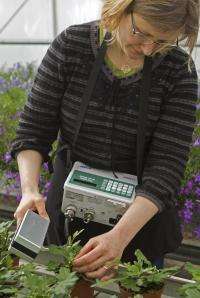
Researchers exposed plants to irregular light breaks during the night and discovered a correlation between circadian-regulated processes and plant growth. Credit: Photo courtesy of Katrine Kjaer
Scientists know that plants can actually "sense" day length, and "schedule" their growth to coincide with specific environmental conditions. These natural events are based on the circadian clock, a 24-hour system found in most biochemical and physiological processes. Plants grow better in circadian conditions that correspond to natural environments, but until now researchers have not understood how plants' internal circadian clocks respond to irregular lighting environments such as those found in many greenhouses.
Greenhouses in northern latitudes rely heavily on supplemental light sources to extend the number of light hours during the day. To conserve electricity and lower costs, newer low-energy input systems use lights only during less expensive off-peak hours and turn lighting off during peak load periods in the afternoon and in the morning. These systems, though more cost-effective than conventional lighting methods, create irregular lighting patterns of natural sunlight interrupted with artificial lightinga challenge for both growers and plants.
Danish scientists Katrine Heinsvig Kjaer and Carl-Otto Ottosen from the Department of Horticulture at Aarhus University published a study in a recent issue of the Journal of the American Society for Horticultural Science that sheds light on the question of plants' response to interruptions in lighting cycles. "Circadian rhythms are believed to be of great importance to plant growth and performance under fluctuating climate conditions. However, it has not been known how plants with a functioning circadian clock respond to irregular light environments that disturb circadian-regulated parameters related to growth", they explained.
For their experiments, the team used 300 cuttings of chrysanthemum (Chrysanthemum morifolium 'Coral Charm') grown in 19 hours of light for 2 weeks. The plants were then randomly placed in either of two greenhouse compartments with similar temperatures and carbon (CO2) concentration. "The plants were exposed to supplemental light provided as irregular light breaks during the night, which we achieved by controlling the light based on forecasted solar irradiance and electricity prices', explained the authors. "Growth, in terms of carbon gain, was linearly correlated to both day length and daily light integral."
The scientists observed that chrysanthemum plants grown in short days with irregular light breaks during the night showed more rapid leaf development and stem growth than plants grown in a climate with a consecutive long light period, proving that low average light intensity promotes expansion of the photosynthetic area of the plants. Though the experiments showed that irregular light periods disturb circadian rhythm and induce changes in leaf characteristics, the authors noted that the study also proved that plants can naturally adapt to irregular light periods.
Kjaer and Ottosen say their research should help greenhouse operators realize energy savings in the area of supplemental light usage.
More information: The complete study and abstract are available on the ASHS Journal of the American Society for Horticultural Science electronic journal web site: http://journal.ash … ract/136/1/3
Provided by American Society for Horticultural Science
-
From lemons to lemonade: Reaction uses carbon dioxide to make carbon-based semiconductor,
32 comments
-
Thioridazine kills cancer stem cells in human while avoiding toxic side-effects of conventional cancer treatments,
3 comments
-
SpaceX private rocket blasts off for space station (Update),
42 comments
-
Climate scientists say they have solved riddle of rising sea,
31 comments
-
SpaceX capsule has 'new car' smell, astronauts say (Update),
4 comments
-
What would stain as translucent on light-coloured fabric?
May 26, 2012
-
How do I identify different bacteria on culture plates?
May 26, 2012
-
Why Do Dogs do Strange things...
May 25, 2012
-
What does exophillic and endophillic mean in terms of mosquito and their control?
May 24, 2012
-
Semen stains glows under black lights (uv light)?
May 23, 2012
-
Question on Human Chromosome 2
May 23, 2012
- More from Physics Forums - Biology
More news stories
Manufacturing genes to attack flu virus
An international research team has manufactured a new protein that can combat deadly flu epidemics.
7 hours ago |
not rated yet |
0
|
Scientist: Evolution debate will soon be history
(AP) -- Richard Leakey predicts skepticism over evolution will soon be history. Not that the avowed atheist has any doubts himself.
May 26, 2012 |
3.5 / 5 (20) |
95
More plant species responding to global warming than previously thought
(Phys.org) -- Far more wild plant species may be responding to global warming than previous large-scale estimates have suggested.
May 22, 2012 |
4.6 / 5 (14) |
18
|
For monogamous sparrows, it doesn't pay to stray (but they do it anyway)
It's quite common for a female song sparrow to stray from her breeding partner and mate with the male next door, but a new study shows that sleeping around can be costly.
May 22, 2012 |
5 / 5 (2) |
8
|
Thousands of shellfish found dead in Peru
Thousands of crustaceans were found dead off the coast of Lima following the mystery mass death of dolphins and pelicans, the Peruvian Navy said Friday.
May 26, 2012 |
4.7 / 5 (7) |
7
Stunning image of smallest possible five-ringed structure
Scientists have created and imaged the smallest possible five-ringed structure about 100,000 times thinner than a human hair and you'll probably recognise its shape.
'Unzipped' carbon nanotubes could help energize fuel cells, batteries
Multi-walled carbon nanotubes riddled with defects and impurities on the outside could replace some of the expensive platinum catalysts used in fuel cells and metal-air batteries, according to scientists at ...
Change in developmental timing was crucial in the evolutionary shift from dinosaurs to birds: study
At first glance, it's hard to see how a common house sparrow and a Tyrannosaurus Rex might have anything in common. After all, one is a bird that weighs less than an ounce, and the other is a dinosaur that ...
Computer model used to pinpoint prime materials for efficient carbon capture
When power plants begin capturing their carbon emissions to reduce greenhouse gases and to most in the electric power industry, it's a question of when, not if it will be an expensive undertaking.
T cells 'hunt' parasites like animal predators seek prey, study shows
By pairing an intimate knowledge of immune-system function with a deep understanding of statistical physics, a cross-disciplinary team at the University of Pennsylvania has arrived at a surprising finding: T cells use a movement ...
Land and sea species differ in climate change response: study
(Phys.org) -- Marine and terrestrial species will likely differ in their responses to climate warming, new research by Simon Fraser University and Australia’s University of Tasmania has found.
Dec 14, 2011
Rank: not rated yet
..you've got to be kidding me.....this is old science, I learned this stuff at Penn state almost 20 years ago. No need to administer hormones to stimulate polyploids in some plants for example, you use photoperiodic interruptions to trigger the growth instead, I've been using this technique for at least as long.