Earth always has a second temporary moon, researchers claim
December 21, 2011 By Amy Shira Teitel, Universe Today

Earth's other moons

Enlarge

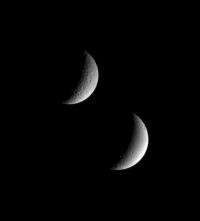
Saturn's moons Rhea and Dione as seen by the Cassini spacecraft. Could this be a future view from Earth? Image credit: NASA/JPL/Space Science Institute

In the fall of 2006, observers at the Catalina Sky Survey in Arizona found an object orbiting the Earth. At first, it looked like a spent rocket stage -- it had a spectrum similar to the titanium white paint NASA uses on rocket stages that end up in heliocentric orbits. But closer inspection revealed that the object was a natural body. Called 2006 RH120, it was a tiny asteroid measuring just a few metres across but it still qualified as a natural satellite just like out Moon. By June 2007, it was gone. Less than a year after it arrived, it left Earth’s orbit in search of a new cosmic companion.

Now, astrophysicists at Cornell are suggesting that 2006 RH120 wasn’t an anomaly; a second temporary moon is actually the norm for our planet.

Temporary satellites are a result of the gravitational pull of and the . Both bodies pull on one another and also pull on anything else in nearby space. The most common objects that get pulled in by the Earth-Moon system’s gravity are near Earth objects (NEOs) — comets and asteroids are nudged by the outer planets and end up in orbits that bring them into Earth’s neighbourhood.

The team from Cornell, astrophysicists Mikael Granvik, Jeremie Vaubaillon, Robert Jedicke, has modeled the way our Earth-Moon system captures these NEOs to understand how often we have additional moons and how long they stick around.

They found that the Earth-Moon system captures NEOs quite frequently. “At any given time, there should be at least one natural Earth satellite of 1-meter diameter orbiting the Earth,” the team said. These NEOs the Earth for about ten months, enough time to make about three orbits, before leaving.

Luckily, and very interestingly, this discovery has implication well beyond academic applications.

Knowing that these small satellites come and go but that one is always present around the Earth, astronomers can work on detecting them. With more complete information on these bodies, specifically their position around the Earth at a given time, could send a crew out to investigate. A crew wouldn’t be able to land on something a few metres across, but they could certainly study it up close and gather samples.

Proposals for a manned mission to an asteroid have been floating around NASA for years. Now, astronauts won’t have to go all the way out to an asteroid to learn about the Solar System’s early history. NASA can wait for an asteroid to come to us.

If the Cornell team is right and there is no shortage of second satellites around the Earth, the gains from such missions increases. The possible information about the solar system’s formation that we could obtain would be amazing, and amazingly cost-efficient.

More information: The population of natural Earth satellites, arXiv:1112.3781v1 [astro-ph.EP] http://arxiv.org/abs/1112.3781

Abstract
We have for the first time calculated the population characteristics of the Earth's irregular natural satellites (NES) that are temporarily captured from the near-Earth-object (NEO) population. The steady-state NES size-frequency and residence-time distributions were determined under the dynamical influence of all the massive bodies in the solar system (but mainly the Sun, Earth, and Moon) for NEOs of negligible mass. To this end, we compute the NES capture probability from the NEO population as a function of the latter's heliocentric orbital elements and combine those results with the current best estimates for the NEO size-frequency and orbital distribution. At any given time there should be at least one NES of 1-meter diameter orbiting the Earth. The average temporarily-captured orbiter (TCO; an object that makes at least one revolution around the Earth in a co-rotating coordinate system) completes $(2.88pm0.82)rev$ around the Earth during a capture event that lasts $(286pm18)days$. We find a small preference for capture events starting in either January or July. Our results are consistent with the single known natural TCO, 2006 RH$_{120}$, a few-meter diameter object that was captured for about a year starting in June 2006. We estimate that about 0.1% of all meteors impacting the Earth were TCOs.

Source: Universe Today

4.4 /5 (14 votes)  

Filter


Move the slider to adjust rank threshold, so that you can hide some of the comments.


Display comments: newest first

Isaacsname
Dec 21, 2011

Rank: 3 / 5 (2)
Almost makes me wonder if NEO's have grazed other atmospheres in our solar system and inadvertently brought things here when they got too close,... like Nitrile from Pluto ?
eigenbasis
Dec 21, 2011

Rank: not rated yet
That's cool, maybe they will 'sweep' away all the crud orbiting the earth due to high altitude nuclear tests and space junk! ^_^
scidog
Dec 22, 2011

Rank: not rated yet
some sort of dock and return would be quite the event.why get a spoon full when a meter size rock could be locked in a cargo bay of some sort and be landed like the Russia crew capsule.
SleepTech
Dec 22, 2011

Rank: 3 / 5 (2)
In this article, NEO = Moons. Ugh! I thought Physorg was beyond fabricating hype in their article titles.
HydraulicsNath
Dec 22, 2011

Rank: not rated yet
The moon believed that they should see other people...
Isaacsname
Dec 22, 2011

Rank: not rated yet
The moon believed that they should see other people...


" The course of true love never did run smooth.. "

~ W. Shakespeare
alq131
Dec 22, 2011

Rank: not rated yet
so, objects a couple meters across should be pretty easy to capture. What about a robotic probe that would gather these and put them in a holding lagrange point? or bring them slowly down to LEO and the space station for analysis? What if one was full of platinum or other rare elements, it would be a pretty "easy" mining method. Pop a heatshield cone on one and drop it into the desert....we could be analyzing these things!!!!
Nanobanano
Dec 22, 2011

Rank: 1 / 5 (1)
8,000kg moving about 11km/s...

Woo hoo.

Match velocity with a robotic probe, and then slow it down and put it back on course for the earth, with a big parachute.

Doing that would be about as compliated as a round trip mission to the moon, maybe even more complicated.

In fact, it would probably be easier to go catch an asteroid from the main belt and bring it back, since matching velocity and orbits would be more manageable.

the lunar missions worked primarily by abusing gravitational acceleration and conservation of momentum.

The NEOs are on some chaotic orbits not on the same planes, etc, so you'd have to go out there and intercept, "brake", match velocity, attach a rocket, and then accelerate back to Earth.

Cost probably 2 or 3 times as much fuel, if not a great deal more than that...
nkalanaga
Dec 22, 2011

Rank: 5 / 5 (1)
Solar sails would be ideal for this project, although the return would be slow. Once the sail was in orbit no fuel would be needed.
Xbw
Dec 22, 2011

Rank: 3 / 5 (2)
so, objects a couple meters across should be pretty easy to capture. What about a robotic probe that would gather these and put them in a holding lagrange point? or bring them slowly down to LEO and the space station for analysis? What if one was full of platinum or other rare elements, it would be a pretty "easy" mining method. Pop a heatshield cone on one and drop it into the desert....we could be analyzing these things!!!!

I'm sure it's a bit more complicated than that but yes, that is a neat idea. It would save fuel costs compared to sending probes much further into the solar system :)
WhiteJim
Dec 22, 2011

Rank: 5 / 5 (2)
just put instruments on it and see where you go. use it as a shuttle to get closer to other objects and then launch from near there to land on something else in motio. We can have all kinds of instruments autonimously moving about between the planets jumping from rock to rock to rock
Rank 4.4 /5 (14 votes)
Relevant PhysicsForums posts
  • Distance of planets from stars and revolution
    created7 hours ago
  • revamping general concept and cosmological principle
    createdMay 25, 2012
  • Transiting Exoplanet Light Curve
    createdMay 25, 2012
  • Math behind Theoretical Physics
    createdMay 24, 2012
  • Do we know whats at the center of galaxies yet?
    createdMay 23, 2012
  • Structure of the Milky Way?
    createdMay 20, 2012
  • More from Physics Forums - General Astronomy

More news stories

Land and sea species differ in climate change response: study

(Phys.org) -- Marine and terrestrial species will likely differ in their responses to climate warming, new research by Simon Fraser University and Australia’s University of Tasmania has found.

Space & Earth / Environment

created 5 hours ago | popularity 3.7 / 5 (3) | comments 5 | with audio podcast

Yale study concludes public apathy over climate change unrelated to science literacy

Are members of the public divided about climate change because they don't understand the science behind it? If Americans knew more basic science and were more proficient in technical reasoning, would public consensus match ...

Space & Earth / Environment

created 7 hours ago | popularity 4.8 / 5 (5) | comments 19 | with audio podcast

10 million years needed to recover from mass extinction

It took some 10 million years for Earth to recover from the greatest mass extinction of all time, latest research has revealed.

Space & Earth / Earth Sciences

created 7 hours ago | popularity 4 / 5 (4) | comments 1 | with audio podcast

Sophisticated simulations predict future warming

The chances of our planet being hit by a global warming of 3 degrees Celsius by 2050 is as likely as it being hit by an increase of 1.4 degrees, new research shows. Presented in the journal Nature Geoscience, the British study ...

Space & Earth / Earth Sciences

created May 22, 2012 | popularity 4.1 / 5 (10) | comments 51

Aliens don't want to eat us, says former SETI director

Alien life probably isn’t interested in having us for dinner, enslaving us or laying eggs in our bellies, according to a recent statement by former SETI director Jill Tarter.

Space & Earth / Space Exploration

created May 25, 2012 | popularity 4.4 / 5 (15) | comments 41


Stunning image of smallest possible five-ringed structure

Scientists have created and imaged the smallest possible five-ringed structure – about 100,000 times thinner than a human hair – and you'll probably recognise its shape.

'Unzipped' carbon nanotubes could help energize fuel cells, batteries

Multi-walled carbon nanotubes riddled with defects and impurities on the outside could replace some of the expensive platinum catalysts used in fuel cells and metal-air batteries, according to scientists at ...

Change in developmental timing was crucial in the evolutionary shift from dinosaurs to birds: study

At first glance, it's hard to see how a common house sparrow and a Tyrannosaurus Rex might have anything in common. After all, one is a bird that weighs less than an ounce, and the other is a dinosaur that ...

Computer model used to pinpoint prime materials for efficient carbon capture

When power plants begin capturing their carbon emissions to reduce greenhouse gases – and to most in the electric power industry, it's a question of when, not if – it will be an expensive undertaking.

T cells 'hunt' parasites like animal predators seek prey, study shows

By pairing an intimate knowledge of immune-system function with a deep understanding of statistical physics, a cross-disciplinary team at the University of Pennsylvania has arrived at a surprising finding: T cells use a movement ...

Scientists develop ultra-sensitive test that detects diseases in their earliest stages

Scientists have developed an ultra-sensitive test that should enable them to detect signs of a disease in its earliest stages, in research published today in the journal Nature Materials.