Cosmic research picked in breakthroughs of 2011
December 19, 2011

Cosmic research picked in breakthroughs of 2011

Enlarge

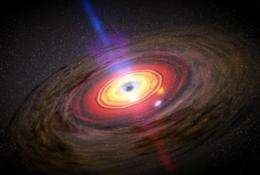
Every galaxy has a supermassive black hole at its heart, millions to billions of times the mass of the Sun. When these dark hearts of galaxies actively accrete matter they become incredibly bright. These are quasars, and they outshine everything else in the universe.

(PhysOrg.com) -- Astronomers from the Dark Cosmology Center at the Niels Bohr Institute have developed a groundbreaking method for measuring long distances in the universe using light from quasars. Quasars are active black holes and their light surpasses all other sources of light in the universe. This new groundbreaking method was published in Astrophysical Journal Letters in September, and now Physics World, the magazine of the UK's physical society has chosen this research as one of the most important breakthroughs in physics in 2011. 

“It means a lot to me that the work has been recognized and it is an honour that it was selected among all sorts of research worldwide”, says astrophysicist Darach Watson, Dark Centre at Niels Bohr Institute at the University of Copenhagen.

To measure great distances, astronomers need powerful light sources, which light up like cosmic lighthouses and can be observed across the . Darach Watson got the idea to use quasars to measure distances in the universe during a lecture, where one of his colleagues was talking about quasars. Quasars are active at the centre of early galaxies. Because of the enormous gravitational pull, matter is dragged from the surroundings in towards the black hole and as the material swirls together, it is heated to millions of degrees. This extremely hot matter emits X-ray and ultraviolet radiation, which then irradiates the huge dense clouds of gas that circulate at a distance from the black hole.

The heated material lights up with a radiation that is stronger than the light from 1000 galaxies. But in order to use quasars to measure distances in the universe, you need to know the exact brightness of the light source, and up until now it has not been possible to calculate this.

“I got the idea that if the brightness of the quasar was linked to the size of the gas cloud around it and if you could measure the size of this cloud, then you would be able to calculate the distance to the quasar”, explains Darach Watson.

The key to the calculations is that the size of the irradiated clouds depends on the luminosity of the quasar - the brighter the quasars the greater the irradiated cloud around it. There was already a method to measure the size of the gas cloud, so they could now calculate the luminosity of the quasar. The result is that quasars are a good source for measurements far back into the very early universe – as far as 85 % of the universe’s age back in time, and the measurements have proven to be very accurate.

It is this breakthrough that has now received this international recognition from , which especially points out that the research has fundamental importance, represents significant progress in knowledge, has a strong connection between theory and practical experiments and is of general interest for all physicists. “We are particularly impressed with how you and your colleagues have expanded ’ ability to look back in time using , which are ubiquitous in the universe”, reads the citation from Physics World.

More information: http://iopscience. … 5/740/2/L49/

Provided by Niels Bohr Institute

4.5 /5 (6 votes)  

Filter


Move the slider to adjust rank threshold, so that you can hide some of the comments.


Display comments: newest first

dtyarbrough
Dec 20, 2011

Rank: 1.5 / 5 (8)
How does spaghettification, gravity pulling harder on nearby objects than those trailing behind, cause friction and heating? It doesn't. These gases are not hot. Neutrinos or other highspeed particles escaping the black hole, clear the way for cold photons to escape the surrounding gas in the form of xrays and gamma rays. Xrays and gamma rays are not the energetic photons physicists believe them to be. There exist in the coldness of space and are freed from their environment by high energy particles from fast spinning corpses of dead stars. The colder the spinning corpse, the nearer the photons are and the more the escaping particles will affect them. Even the nutrinos from the sun can reach far enough to release xrays in the solar corona and gamma rays farther out during mass ejections. The solar corona isn't as hot as the solar surface as proved by comet Lovejoy's recent socalled brush with death.
omatumr
Dec 27, 2011

Rank: 1 / 5 (3)
Every galaxy has a supermassive black hole at its heart


Compact nuclear matter is at the heart of every atom, star and galaxy, but neutron repulsion prevents collapse.

Neutron repulsion is shown in the Cradle of the Nuclides on the front cover of this symposium organized by Glenn T. Seaborg (Element #106 is Seaborgium in his honor)

www.amazon.com/Or...06465620

Since E = mc^2 and every nucleus is composed of positive
(+) charged protons (P) and (A-Z) uncharged neutrons (N):

1. Attractive forces between N and P
__ reduce the rest mass when Z /A ~0.5

2. Repulsive forces between N and N
__ increase the rest mass for Z/A <0.5

3. Repulsive forces between P and P
__ increase the rest mass for Z/A >0.5

That explains the ~265 Bohr-Wheeler mass parabolas.

http://arxiv.org/...2.1499v1

Individual mass data points also provide a Seasonal Message of Hope:

https://dl-web.dr...8949abdc

O Manuel
Rank 4.5 /5 (6 votes)
Relevant PhysicsForums posts
  • Distance of planets from stars and revolution
    created8 hours ago
  • revamping general concept and cosmological principle
    createdMay 25, 2012
  • Transiting Exoplanet Light Curve
    createdMay 25, 2012
  • Math behind Theoretical Physics
    createdMay 24, 2012
  • Do we know whats at the center of galaxies yet?
    createdMay 23, 2012
  • Structure of the Milky Way?
    createdMay 20, 2012
  • More from Physics Forums - General Astronomy

More news stories

Land and sea species differ in climate change response: study

(Phys.org) -- Marine and terrestrial species will likely differ in their responses to climate warming, new research by Simon Fraser University and Australia’s University of Tasmania has found.

Space & Earth / Environment

created 5 hours ago | popularity 3.7 / 5 (3) | comments 5 | with audio podcast

Yale study concludes public apathy over climate change unrelated to science literacy

Are members of the public divided about climate change because they don't understand the science behind it? If Americans knew more basic science and were more proficient in technical reasoning, would public consensus match ...

Space & Earth / Environment

created 7 hours ago | popularity 4.8 / 5 (5) | comments 19 | with audio podcast

10 million years needed to recover from mass extinction

It took some 10 million years for Earth to recover from the greatest mass extinction of all time, latest research has revealed.

Space & Earth / Earth Sciences

created 7 hours ago | popularity 4 / 5 (4) | comments 1 | with audio podcast

Sophisticated simulations predict future warming

The chances of our planet being hit by a global warming of 3 degrees Celsius by 2050 is as likely as it being hit by an increase of 1.4 degrees, new research shows. Presented in the journal Nature Geoscience, the British study ...

Space & Earth / Earth Sciences

created May 22, 2012 | popularity 4.1 / 5 (10) | comments 51

Aliens don't want to eat us, says former SETI director

Alien life probably isn’t interested in having us for dinner, enslaving us or laying eggs in our bellies, according to a recent statement by former SETI director Jill Tarter.

Space & Earth / Space Exploration

created May 25, 2012 | popularity 4.4 / 5 (15) | comments 41


Stunning image of smallest possible five-ringed structure

Scientists have created and imaged the smallest possible five-ringed structure – about 100,000 times thinner than a human hair – and you'll probably recognise its shape.

'Unzipped' carbon nanotubes could help energize fuel cells, batteries

Multi-walled carbon nanotubes riddled with defects and impurities on the outside could replace some of the expensive platinum catalysts used in fuel cells and metal-air batteries, according to scientists at ...

Change in developmental timing was crucial in the evolutionary shift from dinosaurs to birds: study

At first glance, it's hard to see how a common house sparrow and a Tyrannosaurus Rex might have anything in common. After all, one is a bird that weighs less than an ounce, and the other is a dinosaur that ...

Computer model used to pinpoint prime materials for efficient carbon capture

When power plants begin capturing their carbon emissions to reduce greenhouse gases – and to most in the electric power industry, it's a question of when, not if – it will be an expensive undertaking.

T cells 'hunt' parasites like animal predators seek prey, study shows

By pairing an intimate knowledge of immune-system function with a deep understanding of statistical physics, a cross-disciplinary team at the University of Pennsylvania has arrived at a surprising finding: T cells use a movement ...

Scientists develop ultra-sensitive test that detects diseases in their earliest stages

Scientists have developed an ultra-sensitive test that should enable them to detect signs of a disease in its earliest stages, in research published today in the journal Nature Materials.