US-Russian crew blasts off for space station
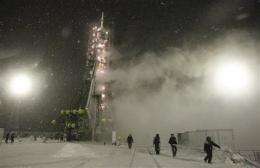
A Russian spacecraft carrying an American and two Russians blasted off Monday from the snow-covered Kazakh steppes in a faultless launch that eased anxiety about the future of U.S. and Russian space programs.
The Soyuz TMA-22 lifted off as scheduled at 8:14 a.m. (0414 GMT) from the Russian-leased Baikonur cosmodrome to carry NASA astronaut Dan Burbank and Russians Anton Shkaplerov and Anatoly Ivanishin on a mission to the International Space Station.
The launch had been delayed for two months due to the crash of an unmannned Progress cargo ship in August. The failed launch raised doubts about future missions to the station, because the rocket that crashed used the same upper stage as the booster rockets carrying Soyuz ships to orbit.
NASA had warned that the space outpost would need to be abandoned temporarily for the first time in nearly 11 years if a new crew could not be launched before the last of the station's six residents flew back to Earth in mid-November.
Russian space officials tracked down the Progress launch failure to an "accidental" manufacturing flaw and recalled all Soyuz rockets from space launch pads for a thorough examination. The successful launch of a Progress ship last month cleared the way for the crew to be sent off.
The crew said they trusted the Soyuz, a workhorse of the Soviet and then Russian space program for more than 40 years. "We have no black thoughts and full confidence in our technology," Shkaplerov told journalists before the launch.
The new crew are to arrive just in time to keep the orbiting station manned. The three crew members currently on board the station are set to return to Earth on Nov. 21. Another launch next month is to take the station back to its normal six-person crew mode.
The 39-year-old Shkaplerov and 42-year-old Ivanishin are making their first flights into space. Burbank, 50, who will take over command of the space station, is a veteran of 12-day shuttle missions in 2000 and 2006. The three men are to remain aboard the space station until March.
Russian Space Agency head Vladimir Popovkin said the agency was actively recruiting women to become cosmonauts. Only one woman is now in training and Popovkin told journalists at Baikonur that he was determined to send her into orbit, Russian news agencies reported.
Even in the case of an engine failure like the one that led to the Progress crash in August, a Soyuz crew would be rescued by an emergency escape system. But any further launch trouble would have prompted NASA to rethink the space station program, which now relies exclusively on Russian spacecraft after the retirement of the U.S. space shuttle fleet in July.
The Progress crash was one in a string of spectacular launch failures that raised concerns about the state of Russia's space industries. Last December, Russia lost three navigation satellites when a rocket carrying them failed to reach orbit. A military satellite was lost in February, and the launch of the Express-AM4, described by officials as Russia's most powerful telecommunications satellite, went awry in August.
In the latest failure, an unmanned probe intended to collect ground samples on Phobos, a moon of Mars, in the most ambitious Russian interplanetary mission since the Soviet era, suffered an equipment failure shortly after Wednesday's launch and got stuck in Earth orbit.
Efforts to contact the craft have been unsuccessful, but Popovkin said there was still time to prevent it from crashing down.
"The prognosis shows that it will fly through January, and we have until the first days of December (to establish control) so it can fulfill its intended function," the RIA Novosti news agency quoted the space chief as saying.
Popovkin said engineers were making the necessary adjustments to contact the probe as it flies about 200 kilometers (120 miles) above the Earth. "Therefore I can say that there is still a chance," he was quoted as saying.
Russian space officials have blamed the botched launches on obsolete equipment and an aging workforce. The space agency said it will establish its own quality inspection teams at rocket factories to tighten oversight over production quality.
©2011 The Associated Press. All rights reserved. This material may not be published, broadcast, rewritten or redistributed.


