Przewalski's wild horses gallop back to life
November 14, 2011 by Jan Marchal

Prague zoo has been breeding these sturdy animals for decades

Enlarge

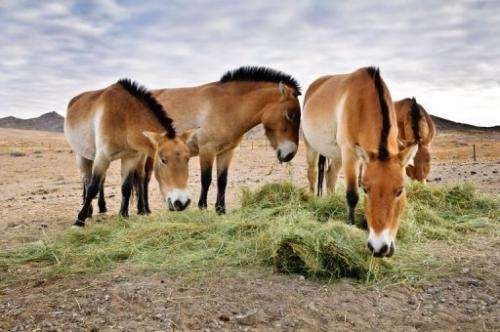
Four Przewalski horses graze in the western Mongolian reserve of Khomiin Tal. The Prague Zoo says it will transport more rare wild horses to Mongolia next year as part of its efforts to reintroduce the endangered species to its native habitat.

Their galloping stocky, sandy-brown silhouettes inspired dreamy pre-historic cave paintings.

Now, an known as Przewalski's wild horse has narrowly avoided extinction thanks to zoos worldwide and is cautiously being re-introduced to its homeland on the vast Mongolian steppe.

In charge of keeping the world genealogy book for this , the Prague zoo has played a key role in this historic homecoming.

"Three mares and one stallion have been acclimatising in the Mongolian province of Khomiin Tal since June," said zoo director Miroslav Bobek.

"We expect to move another four horses in 2012," he added.

For decades, Prague zoo has been breeding these sturdy animals which have survived in captivity since the last wild horse was seen in Mongolia in 1969.
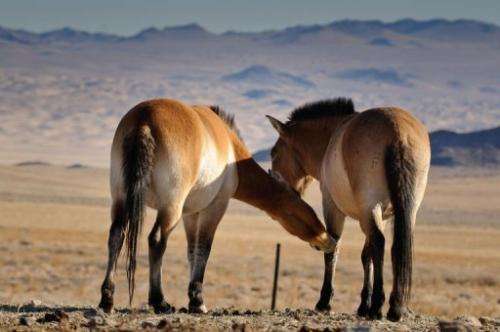
The species is thought to have lived in Europe 20,000 years ago but climate change chased the animals away to Asia
Enlarge

Characterised by thick necks, large heads and stocky barrels, Przewalski's horses weigh between 250-350 kilograms, are about 1.2-1.3 metres tall at withers and two metres long.

More than one-third of some 1,800 Przewalski horses living all over the world today, including 1,600 in captivity, are related to horses bred at the Prague zoo.

Characterised by thick necks, large heads and stocky barrels, Przewalski's horses weigh between 250-350 kilograms (551-771 pounds), are about 1.2-1.3 metres (3.9-4.3 feet) tall at withers and two metres long.

To kick up the dust on the land of their ancestors, the horses spend about 30 hours inside special containers aboard a Czech army plane and then a lorry.

The newcomers to Mongolia -- a young stallion named Matyas and particularly the mares named Kordula, Lima and Cassovia -- have already attracted the interest of the denizens of the Khomiin Tal provincial in western Mongolia.

An earlier group of Przewalski horses were brought to the province six years ago from another location in Mongolia by Takh, a French association bearing the Mongolian name of Przewalski's horses.

"One dominant stallion, Carex, jumped over the fence into the acclimatisation enclosure and joined the (new) group," Bobek said.

"He started to harass Matyas, but he soon had to face the competition of another 'jumper', a stallion named Bo, who turned out to be an even stronger natural leader," he added.

"Bo is an abbreviation of 'Born to be Wild', so he's doing credit to his name," Bobek said in an interview with AFP, shortly after he had returned from Mongolia.

"We hope that the arrival of our young horses will provide new stimulus to reproduction in the group in Khomiin Tal," he added.

With ancient in Lascaux, France, featuring wild horses eerily resembling the Przewalski variety, the species is thought to have lived in Europe 20,000 years ago but climate change chased the animals away to Asia.

Europeans only encountered the wild horses at the end of the 19th century when Russian explorer and geographer Nikolai Mikhailovich Przewalski (1839-1888) discovered the animals in mountains bordering on the Gobi desert.
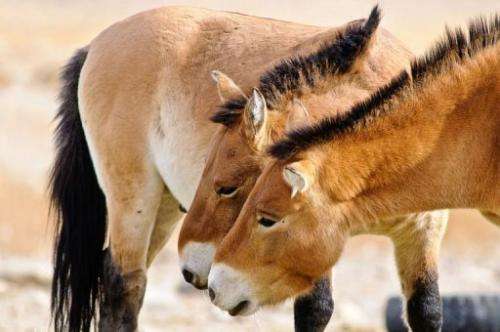
This ancient species known as Przewalski's wild horse has narrowly avoided extinction thanks to zoos worldwide
Enlarge

Przewalski horses graze in the western Mongolian reserve of Khomiin Tal. More than one-third of some 1,800 Przewalski horses living all over the world today, including 1,600 in captivity, are related to horses bred at the Prague zoo.

In the 20th century, hunting brought Przewalski's horses to the verge of extinction.

Today's survivors all hail from a group of 12 reproducers, said Bobek.

In 1959, Prague zoo spearheaded an international symposium focused on saving the .

Different zoos and foundations then kicked off programmes to exchange the reproducers and expand their population.

In the 1980s, when the number of Przewalski's horses bred in captivity reached 500, experts started reintroduction programmes.

Four other animals will leave Prague for Mongolia next year -- a herd that will undoubtedly comprise another three mares and one stallion.

"The horses live a harem life with a stallion inseminating several mares," said zoologist Jaroslav Simek, deputy head of the Prague zoo.

He hopes that young Matyas -- ruthlessly cornered by his rivals in Khomin Tal this summer -- will soon assert his authority.

"To a great extent, this depends only on himself, on his ability to attract mares and to create his own harem," Simek added.

(c) 2011 AFP


Rank 5 /5 (3 votes)
Relevant PhysicsForums posts

More news stories

Manufacturing genes to attack flu virus

An international research team has manufactured a new protein that can combat deadly flu epidemics.

Biology / Biotechnology

created 7 hours ago | popularity not rated yet | comments 0 | with audio podcast

Scientist: Evolution debate will soon be history

(AP) -- Richard Leakey predicts skepticism over evolution will soon be history. Not that the avowed atheist has any doubts himself.

Biology / Evolution

created May 26, 2012 | popularity 3.5 / 5 (20) | comments 93

More plant species responding to global warming than previously thought

(Phys.org) -- Far more wild plant species may be responding to global warming than previous large-scale estimates have suggested.

Biology / Ecology

created May 22, 2012 | popularity 4.6 / 5 (14) | comments 18 | with audio podcast

For monogamous sparrows, it doesn't pay to stray (but they do it anyway)

It's quite common for a female song sparrow to stray from her breeding partner and mate with the male next door, but a new study shows that sleeping around can be costly.

Biology / Plants & Animals

created May 22, 2012 | popularity 5 / 5 (2) | comments 8 | with audio podcast

Thousands of shellfish found dead in Peru

Thousands of crustaceans were found dead off the coast of Lima following the mystery mass death of dolphins and pelicans, the Peruvian Navy said Friday.

Biology / Ecology

created May 26, 2012 | popularity 4.7 / 5 (7) | comments 7


Stunning image of smallest possible five-ringed structure

Scientists have created and imaged the smallest possible five-ringed structure – about 100,000 times thinner than a human hair – and you'll probably recognise its shape.

'Unzipped' carbon nanotubes could help energize fuel cells, batteries

Multi-walled carbon nanotubes riddled with defects and impurities on the outside could replace some of the expensive platinum catalysts used in fuel cells and metal-air batteries, according to scientists at ...

Change in developmental timing was crucial in the evolutionary shift from dinosaurs to birds: study

At first glance, it's hard to see how a common house sparrow and a Tyrannosaurus Rex might have anything in common. After all, one is a bird that weighs less than an ounce, and the other is a dinosaur that ...

Computer model used to pinpoint prime materials for efficient carbon capture

When power plants begin capturing their carbon emissions to reduce greenhouse gases – and to most in the electric power industry, it's a question of when, not if – it will be an expensive undertaking.

T cells 'hunt' parasites like animal predators seek prey, study shows

By pairing an intimate knowledge of immune-system function with a deep understanding of statistical physics, a cross-disciplinary team at the University of Pennsylvania has arrived at a surprising finding: T cells use a movement ...

Land and sea species differ in climate change response: study

(Phys.org) -- Marine and terrestrial species will likely differ in their responses to climate warming, new research by Simon Fraser University and Australia’s University of Tasmania has found.