PRIMEHPC FX10 supercomputer wins crown for Fujitsu
November 8, 2011 by Nancy Owano report

PRIMEHPC FX10 supercomputer wins crown for Fujitsu

Enlarge

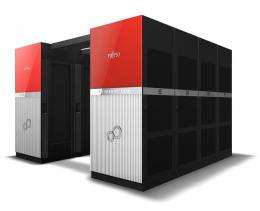
(PhysOrg.com) -- Fujitsu yesterday announced a new commercial supercomputer, the PRIMEHPC FX10. The announcement is a stunner because of its specs, and right on the heels of this month’s other Fujitsu headliner, the K computer, a record-breaking 10-petaflop supercomputer in partnership with Japan’s RIKEN. The K announcement said they completed the final build-out of the system and achieved 10.51 petaflops on Linpack, the benchmark performance test.

That marked the displacement of China as having the number one position in supercomputers. This week’s news from Fujitsu carries more record-breaking statistics. The PRIMEHPC FX10 made headlines in two directions: It's scaling up to 23.2 petaflops --more than double the current performance of the K computer. Also, rather than an undertaking for the Japanese government, as is the K computer for Japan's Ministry of Education, Culture, Sports, Science and Technology (MEXT), the FX10 will be available commercially and outside Japan.

PRIMEHPC FX10 will be available as of January 2012. Customers for the Fujitsu supercomputer will include any organization or company seeking large-scale simulations. Medical research and energy and weather analysis are a few examples. Fujitsu hopes to deploy fifty FX10 configurations over the next three years.

Details of the PRIMEHPC FX10 highlight what is termed a “theoretical computational performance” topping out at 23.2 petaflops. That figure is based on deploying 98,304 nodes across 1,024 racks. The K computer’s “theoretical computational performance” tops out at 11.28 petaflops. The Register explains this further: The fully loaded K machine running at RIKEN was tested using the Linpack Fortran benchmark test and rated 10.51 petaflops against the peak theoretical performance of 11.28 petaflops.
PRIMEHPC FX10 supercomputer wins crown for Fujitsu
Enlarge


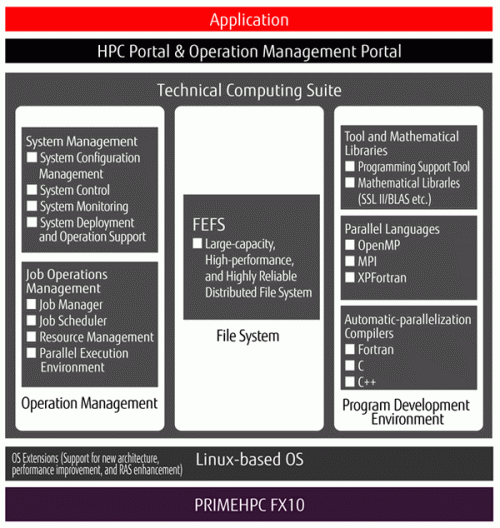
Another talking point about the supercomputer is Fujitsu's new Sparc64-IXfx processor. This is a 16-core chip, nearly twice as powerful as the 8-core SPARC64 VIIIfx CPUs used in K supercomputer. The FX10 runs Linux on Sparc.

Yesterday’s announcement will be a proud talking point overall for Japan ahead of the SC11 supercomputing conference in Seattle next week, the global conference for supercomputing, from November 12 through Nov 18. No supercomputing competitor takes its foot off the pedal and the Fujitsu achievement is a challenge for other supercomputer giants.

“So now , IBM, and Cray have all set their sights on breaking the 20 petaflops barrier on their way to the exascale heavens,” comments The Register, for good reason: The world of supercomputing is competitive in a rush to build the fastest supercomputer. The numbers of highest-ranking supercomputers keep shifting. Supercomputers, as platforms for handling “big data,” keep on increasing in scale and performance, on a closely watched scoreboard over which is the fastest and most powerful.

More information: Press release

© 2011 PhysOrg.com

4.7 /5 (7 votes)  

Filter


Move the slider to adjust rank threshold, so that you can hide some of the comments.


Display comments: newest first

Sonhouse
Nov 08, 2011

Rank: 5 / 5 (2)
I really want one of those 10 PETRAflop computers!:)
ScienceFreak86
Nov 08, 2011

Rank: 5 / 5 (2)
this article is full of mistakes

"The fully loaded K machine running at RIKEN was tested using the Linpack Fortran benchmark test and rated 10.51 teraflops against the peak theoretical performance of 11.28 teraflops."

teraflops?

"The announcement is a stunner because of its specs, and right on the heels of this months other Fujitsu headliner, the K computer, a record-breaking 10-petraflop supercomputer in partnership with Japans RI"

petraflop? the person who wrote this, has no clue about supercomputers
Raygunner
Nov 08, 2011

Rank: not rated yet
I think it's more of a Japanese to English translation problem with the article. Sloppily done for sure, but not intentional IMO.
El_Nose
Nov 08, 2011

Rank: not rated yet
looks like they updated the article Science
ziprar2
Nov 08, 2011

Rank: 1 / 5 (1)
but will it run Crysis?

j/k
Roxphonyx
Nov 08, 2011

Rank: not rated yet
Just remember...although the pride goes to the inventor, the spoils goes to the marketer. The guy who invented Coca-Cola was not the same guy who became a billionaire off of it. The brothers who created McDonalds, aren't the same guys who brought it to it's modern day existance. Creating the fastest computer is neat, but most likely it will be toppled twice before the end of the year. No, the real power goes to those who actually successfully take it to market. Otherwise, you're just a broke inventor.
dan42day
Nov 08, 2011

Rank: not rated yet
I really want one of those 10 PETRAflop computers!:)


Well just wait ten years and it'll be available in a laptop for under $1000.
Rank 4.7 /5 (7 votes)
Relevant PhysicsForums posts

More news stories

Nvidia trumpets Tegra 3 phone design wins for 2012

(Phys.org) -- Nvidia’s competitive war paint has a name, Tegra 3. On the heels of Nvidia announcements about lowering costs of its Tegra 3 processors and Nvidia-enabled tablets running Android Ice Cream ...

Electronics / Hardware

created 14 hours ago | popularity 5 / 5 (2) | comments 1 | with audio podcast report

Dell tablet leak: 10.1-inch display, two-battery choice

(Phys.org) -- Headline after headline talks about vendors’ tablets in the wings as likely number-one contenders for the iPad. Such claims have justifiably been taken with a grain of salt, considering ...

Electronics / Consumer & Gadgets

created May 26, 2012 | popularity 4 / 5 (4) | comments 11 | with audio podcast report

Nvidia says Kai platform will turn price tide for tablets

(Phys.org) -- In March, Nvidia gave some signs that they were working to lower the cost of their Tegra 3 processors and they suggested consumers might see prices for Android tablets as low as $199. Connect ...

Electronics / Hardware

created May 24, 2012 | popularity 4.3 / 5 (4) | comments 3 | with audio podcast report

OmniVision tops up sensors for cameras, phones

(Phys.org) -- OmniVision has announced two high-resolution image sensors for the digital still and digital video camera market (DS/DVC) and higher end smartphones. In end-user language, it is a claim for superior ...

Electronics / Hardware

created May 25, 2012 | popularity 5 / 5 (6) | comments 3 | with audio podcast report

MIT researchers devise new means to synchronize a group of robots (w/ Video)

(Phys.org) -- For several years, roboticists have been working out ways to get a group of robots to perform synchronized activities as demonstrated most often in dance routines. It’s not just about trying ...

Electronics / Robotics

created May 25, 2012 | popularity 5 / 5 (1) | comments 1 | with audio podcast report


Stunning image of smallest possible five-ringed structure

Scientists have created and imaged the smallest possible five-ringed structure – about 100,000 times thinner than a human hair – and you'll probably recognise its shape.

'Unzipped' carbon nanotubes could help energize fuel cells, batteries

Multi-walled carbon nanotubes riddled with defects and impurities on the outside could replace some of the expensive platinum catalysts used in fuel cells and metal-air batteries, according to scientists at ...

Change in developmental timing was crucial in the evolutionary shift from dinosaurs to birds: study

At first glance, it's hard to see how a common house sparrow and a Tyrannosaurus Rex might have anything in common. After all, one is a bird that weighs less than an ounce, and the other is a dinosaur that ...

Computer model used to pinpoint prime materials for efficient carbon capture

When power plants begin capturing their carbon emissions to reduce greenhouse gases – and to most in the electric power industry, it's a question of when, not if – it will be an expensive undertaking.

T cells 'hunt' parasites like animal predators seek prey, study shows

By pairing an intimate knowledge of immune-system function with a deep understanding of statistical physics, a cross-disciplinary team at the University of Pennsylvania has arrived at a surprising finding: T cells use a movement ...

Land and sea species differ in climate change response: study

(Phys.org) -- Marine and terrestrial species will likely differ in their responses to climate warming, new research by Simon Fraser University and Australia’s University of Tasmania has found.