Moscow 'Mars mission' ends after 520 days
November 4, 2011 by Stuart Williams
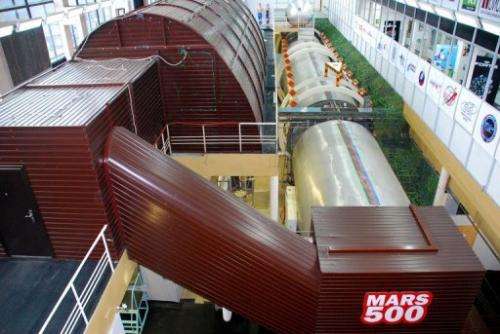
The Mars500 special isolation facility at the Russian Institute of Biomedical Problems in Moscow. Six volunteers stepped out into the outside world after spending the last one-and-a-half-years locked away in an isolation module in Moscow to simulate the effects of a return trip to Mars.
Six volunteers on Friday stepped out into the outside world after spending the last one-and-a-half-years locked away in an isolation module in Moscow to simulate the effects of a return trip to Mars.
The multi-national crew showed no ill effects after emerging from the capsule where they had lived and slept for the last 520 days but were clearly delighted they had completed their earth-bound "journey" to the Red Planet.
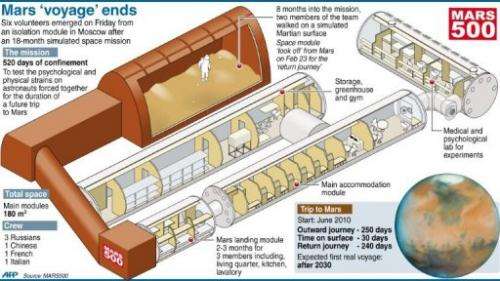
Graphic illustrating experiment simulating a future journey to Mars. Six volunteers stepped out into the outside world after spending the last one-and-a-half-years locked away in an isolation module in Moscow to simulate the effects of a return trip to Mars.
After the pressure in the capsule was equalised with the outside, a researcher broke the seal and then opened the door of the module. All six crew members, dressed in blue overalls, walked out one-by-one in good health.Looking slightly dazzled by their first encounter with other human beings for 18 months, the crew of one Chinese, one Italian, one Frenchman and three Russians lined up in a row to receive the congratulations from scientists.
"The international crew has completed the 520 day mission," commander Alexei Sityov, one of three Russian participants in the experiment, told Russia's space bosses in formal military style.
"The programme has been fully carried out. All the crew members are in good health. We are now ready for further tests," he added in comments broadcast by Russian television and the European Space Agency (ESA).
Italian Diego Urbina, who clenched his fists with delight as he finally stepped out of the capsule, said it had been an honour to have been involved in the programme.
He said he hoped that the experiment would help humans reach "a distant but reachable planet". Fellow "Marsonaut", Frenchman Romain Charles, said the crew were ready to "embark on the next spaceship" that would go to Mars.
Chinese participant Wang Yue put it simply: "After 520 days, we are finally back."
They were each presented with a flower by young female researchers in white coats as a reward for their endeavours.
But they were then immediately ushered away by scientists from Moscow Institute of Biomedical Problems (IMBP) for several days of medical and psychological tests. They are next due to appear in public for a news conference on Tuesday.
The unprecedented experiment has simulated the duration and isolation of a return journey to the Red Planet, even including "walks" on a replica of the Martian surface and 20-minute time gaps in communication with outside.
Yet ever since the crew were first locked up back on June 3, 2010, their 180-square-metre (1,900 square foot) module has stayed firmly rooted to the earth in a car park outside the Moscow research facility.
While there were some titters when the volunteers donned space suits for their "space walk" in a glorified sandpit at the halfway point, scientists insist the experiment was vital preparation for an eventual voyage to Mars.
"I welcome the courage, determination and generosity of these young people who have devoted almost two years of their lives to this project, for the progress of human space exploration," said ESA director general Jean-Jacques Dordain.
The deputy head of the Russian space agency, Vitaly Davydov, said a manned voyage to Mars was being considered sometime in the mid-2030s, although he noted that humans would have to return to the Moon first.
"The end of Mars-500 is not only the start of serious preparation for a real voyage to Mars," he told the ITAR-TASS news agency. "The results are going to be used in the bio-medicine sector and will be used in the national space programme up to 2030."
Controversially, the experiment did not include a woman, with researchers clearly wanting to avoid it degenerating into a scientific version of television's sexual tension-filled "Big Brother".
Each of the participants is receiving three million rubles (around $100,000) for his work, the Interfax news agency quoted the head of the project Boris Morukov as saying.
Initially, the Russians were to receive less but the sum was increased once ESA revealed how much its two volunteers were being paid, Interfax said.
(c) 2011 AFP
-
From lemons to lemonade: Reaction uses carbon dioxide to make carbon-based semiconductor,
32 comments
-
Thioridazine kills cancer stem cells in human while avoiding toxic side-effects of conventional cancer treatments,
3 comments
-
SpaceX private rocket blasts off for space station (Update),
42 comments
-
Climate scientists say they have solved riddle of rising sea,
31 comments
-
SpaceX capsule has 'new car' smell, astronauts say (Update),
4 comments
-
Distance of planets from stars and revolution
4 hours ago
-
revamping general concept and cosmological principle
May 25, 2012
-
Transiting Exoplanet Light Curve
May 25, 2012
-
Math behind Theoretical Physics
May 24, 2012
-
Do we know whats at the center of galaxies yet?
May 23, 2012
-
Structure of the Milky Way?
May 20, 2012
- More from Physics Forums - General Astronomy
More news stories
Land and sea species differ in climate change response: study
(Phys.org) -- Marine and terrestrial species will likely differ in their responses to climate warming, new research by Simon Fraser University and Australia’s University of Tasmania has found.
2 hours ago |
5 / 5 (2) |
2
|
Yale study concludes public apathy over climate change unrelated to science literacy
Are members of the public divided about climate change because they don't understand the science behind it? If Americans knew more basic science and were more proficient in technical reasoning, would public consensus match ...
4 hours ago |
4 / 5 (1) |
11
|
10 million years needed to recover from mass extinction
It took some 10 million years for Earth to recover from the greatest mass extinction of all time, latest research has revealed.
Space & Earth / Earth Sciences
4 hours ago |
not rated yet |
1
|
Sophisticated simulations predict future warming
The chances of our planet being hit by a global warming of 3 degrees Celsius by 2050 is as likely as it being hit by an increase of 1.4 degrees, new research shows. Presented in the journal Nature Geoscience, the British study ...
Space & Earth / Earth Sciences
May 22, 2012 |
4.4 / 5 (9) |
51
Aliens don't want to eat us, says former SETI director
Alien life probably isnt interested in having us for dinner, enslaving us or laying eggs in our bellies, according to a recent statement by former SETI director Jill Tarter.
Space & Earth / Space Exploration
May 25, 2012 |
4.4 / 5 (14) |
40
Nvidia trumpets Tegra 3 phone design wins for 2012
(Phys.org) -- Nvidias competitive war paint has a name, Tegra 3. On the heels of Nvidia announcements about lowering costs of its Tegra 3 processors and Nvidia-enabled tablets running Android Ice Cream ...
'Unzipped' carbon nanotubes could help energize fuel cells, batteries
Multi-walled carbon nanotubes riddled with defects and impurities on the outside could replace some of the expensive platinum catalysts used in fuel cells and metal-air batteries, according to scientists at ...
T cells 'hunt' parasites like animal predators seek prey, study shows
By pairing an intimate knowledge of immune-system function with a deep understanding of statistical physics, a cross-disciplinary team at the University of Pennsylvania has arrived at a surprising finding: T cells use a movement ...
Computer model used to pinpoint prime materials for efficient carbon capture
When power plants begin capturing their carbon emissions to reduce greenhouse gases and to most in the electric power industry, it's a question of when, not if it will be an expensive undertaking.
Change in developmental timing was crucial in the evolutionary shift from dinosaurs to birds: study
At first glance, it's hard to see how a common house sparrow and a Tyrannosaurus Rex might have anything in common. After all, one is a bird that weighs less than an ounce, and the other is a dinosaur that ...
Scientist: Evolution debate will soon be history
(AP) -- Richard Leakey predicts skepticism over evolution will soon be history. Not that the avowed atheist has any doubts himself.

Nov 04, 2011
Rank: 5 / 5 (1)
Nov 04, 2011
Rank: 1 / 5 (1)
I'm not sure why this detail was important to mention, especially the fact that they were young females.
Perhaps it was meant both literally and metaphorically? 520 days is a long time to spend apart from your preferred gender for sexual encounters.
Nov 04, 2011
Rank: 5 / 5 (2)
Kudos to them for the sacrifice in the name of science, though. Hopefully it'll help get us to Mars and beyond someday
Nov 04, 2011
Rank: 5 / 5 (1)
Nov 04, 2011
Rank: 5 / 5 (4)
I doubt that this test will do anything much to further that goal as it is deeply flawed, for several reasons:
1) There is no real sense of danger and thus heightened psychological pressure as everyone knows that in case of some emergency, they can simply walk out and get treatment.
2) There is no radiation hazard.
3) They're in a normal 1g gravity field which negates all manner of problems a real crew would face in space, both physical and psychological.
They would have obtained some data on the psychology of prolonged confinement, but that's hardly a new field of study. The biggest benefit that I can see is how they would adept to increasing delays in communication (which was simulated based on changing distance from Earth).