Communal living of the insect kind
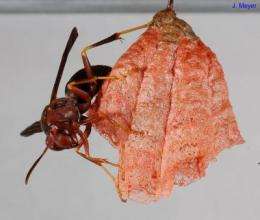
Paper wasps represent an intermediate stage in the evolution of eusocial behavior. While many social insects have distinct social classes that differ in appearance, in paper wasp society all castes look alike. Credit: Photo by J. Meyer
The social lives of ants, wasps and bees have long been a puzzle to scientists. How did complex insect societies colonies ruled by a queen and many workers come to be? A new model adds to discontent with old ideas.
Social insect society is divided into specialized castes that take on different roles within the nest. Most of the members of a colony the workers forego their own chance for reproduction and instead spend their lives raising offspring that aren't their own. Generations of scientists have tried to understand why. In other words, "what's in it for the workers?" said author James Hunt, who developed his model while at the National Evolutionary Synthesis Center in Durham, NC.
The question continues to spark debate. For the past 40 years, the dominant answer was based on the idea that having kids of your own isn't the only way to pass on your genes. According to a theory called Hamilton's rule, proposed in 1964 by British biologist William Hamilton, sometimes helping a relative can spread more of your genes to the next generation than having kids of your own. When the benefits to a queen outweigh the costs to her workers, the theory goes, altruism can evolve.
But there's one thing Hamilton's rule fails to consider. "Direct benefit to the worker is not part of the equation," Hunt said. According to Hunt, the evolutionary beginnings of worker behavior may be more selfish than they seem.
He bases his ideas on more than three decades of research on a family of wasps called the Vespidae, which is made up of nearly 5000 species. The majority of those species live alone, but some such as hornets, yellowjackets, and paper wasps live in complex societies with specialized castes that take on different tasks within the nest.
In paper wasps, for example, workers help build and defend the nest where they were born and feed and care for the larvae. By helping out around the nest, worker paper wasps are able to stock up on the food they need to eventually leave and lay eggs on their own, and the queen gets some babysitting help in return. "It's a situation of reciprocal exploitation," Hunt said.
Debates over how social behavior comes to be can be notoriously fierce in scientific circles. In recent years, a handful of studies have thrown Hamilton's rule into question, including a 2010 paper in the journal Nature that inspired dozens of scientists to write replies. Hunt's hypothesis says the 2010 study is basically correct, but it overplays the importance of genes.
Much of the debate stems from a failure to parse out key intermediate steps in the evolutionary transition from solitary to social, Hunt says. Paper wasps, for example, cooperate to care for young, but haven't yet evolved the distinct differences in appearance that characterize castes in the most highly social insects.
At these earliest stages, Hunt says, it doesn't matter whether workers and queens are related or not, or how many genes they share. The workers could be lingering around the nest simply because they're looking out for number one.
"The model that I'm putting forward proposes that at the very beginning of social behavior, the workers and the queens are both acting in their own self-interest," Hunt said.
The study will be published this week in the Journal of Evolutionary Biology.
More information: Hunt, J. "A conceptual model for the origin of worker behaviour and adaptation of eusociality." Journal of Evolutionary Biology.
Journal reference:
Journal of Evolutionary Biology
Provided by National Evolutionary Synthesis Center (NESCent)
-
From lemons to lemonade: Reaction uses carbon dioxide to make carbon-based semiconductor,
32 comments
-
Thioridazine kills cancer stem cells in human while avoiding toxic side-effects of conventional cancer treatments,
3 comments
-
SpaceX private rocket blasts off for space station (Update),
42 comments
-
Climate scientists say they have solved riddle of rising sea,
31 comments
-
SpaceX capsule has 'new car' smell, astronauts say (Update),
4 comments
-
What would stain as translucent on light-coloured fabric?
May 26, 2012
-
How do I identify different bacteria on culture plates?
May 26, 2012
-
Why Do Dogs do Strange things...
May 25, 2012
-
What does exophillic and endophillic mean in terms of mosquito and their control?
May 24, 2012
-
Semen stains glows under black lights (uv light)?
May 23, 2012
-
Question on Human Chromosome 2
May 23, 2012
- More from Physics Forums - Biology
More news stories
Manufacturing genes to attack flu virus
An international research team has manufactured a new protein that can combat deadly flu epidemics.
6 hours ago |
not rated yet |
0
|
Scientist: Evolution debate will soon be history
(AP) -- Richard Leakey predicts skepticism over evolution will soon be history. Not that the avowed atheist has any doubts himself.
May 26, 2012 |
3.5 / 5 (20) |
91
More plant species responding to global warming than previously thought
(Phys.org) -- Far more wild plant species may be responding to global warming than previous large-scale estimates have suggested.
May 22, 2012 |
4.6 / 5 (14) |
18
|
For monogamous sparrows, it doesn't pay to stray (but they do it anyway)
It's quite common for a female song sparrow to stray from her breeding partner and mate with the male next door, but a new study shows that sleeping around can be costly.
May 22, 2012 |
5 / 5 (2) |
8
|
Thousands of shellfish found dead in Peru
Thousands of crustaceans were found dead off the coast of Lima following the mystery mass death of dolphins and pelicans, the Peruvian Navy said Friday.
May 26, 2012 |
4.7 / 5 (7) |
7
Stunning image of smallest possible five-ringed structure
Scientists have created and imaged the smallest possible five-ringed structure about 100,000 times thinner than a human hair and you'll probably recognise its shape.
'Unzipped' carbon nanotubes could help energize fuel cells, batteries
Multi-walled carbon nanotubes riddled with defects and impurities on the outside could replace some of the expensive platinum catalysts used in fuel cells and metal-air batteries, according to scientists at ...
Change in developmental timing was crucial in the evolutionary shift from dinosaurs to birds: study
At first glance, it's hard to see how a common house sparrow and a Tyrannosaurus Rex might have anything in common. After all, one is a bird that weighs less than an ounce, and the other is a dinosaur that ...
Computer model used to pinpoint prime materials for efficient carbon capture
When power plants begin capturing their carbon emissions to reduce greenhouse gases and to most in the electric power industry, it's a question of when, not if it will be an expensive undertaking.
T cells 'hunt' parasites like animal predators seek prey, study shows
By pairing an intimate knowledge of immune-system function with a deep understanding of statistical physics, a cross-disciplinary team at the University of Pennsylvania has arrived at a surprising finding: T cells use a movement ...
Land and sea species differ in climate change response: study
(Phys.org) -- Marine and terrestrial species will likely differ in their responses to climate warming, new research by Simon Fraser University and Australia’s University of Tasmania has found.
Nov 16, 2011
Rank: 1 / 5 (1)
do an evolutionary breeding experiment.
1) breed antisocial wasps to be more social until the beginnings of a cast system can be seen
2) breed the wasps that operate in casts to behave more anti- social ( breed colonies that kill their own queens , and colonieswhere workers start laying eggs)
Nov 16, 2011
Rank: 1 / 5 (2)
You could test that by comparing the reactions to adverse stimuli when in social and asocial settings.
Nov 16, 2011
Rank: not rated yet