The human cost of Russia's lost spacecraft
It hasn’t been a great year for Roscosmos, the Russian Federal Space Agency. In the last twelve months, it has lost four major missions on top of the aerospace industry’s failure to produce its planned number of spacecraft.
For the most part, lost missions conjure up feelings of despair for the spacecraft from a scientific or exploration perspective – what does the silent satellite or failed launch mean for the agency’s immediate and overall goals? But there’s another side to lost missions that are less common. What does a lost mission or failed launch mean for the people responsible? All four missions Roscosmos has lost in the last year have been substantial. In December 2010, a Proton-M booster failed to put three Glonass-M satellites in orbit. These were meant to enhance Russia’s Global Navigation Satellite System, the Russian counterpart to America’s GPS system, and just recently, Russia successfully launched replacements.
In February, a Rokot booster carrying the Geo-IK-2 satellite ended in failure. The satellite was designed to build on Russia’s geodesic research. Acting as a precise reference point, it would help scientists take accurate measurements of the Earth’s shape and the properties of its gravitational field and support such fields as cartography, missile guidance, study of tectonic plate movements, ocean tides, and ice conditions.
The loss of these missions was doubtless devastating for the teams who designed them, but the After the loss of Geo-IK-2, a number of senior space industry officials were fired and Roscosmos’s chief, Anatoly Perminov, was forced to resign.
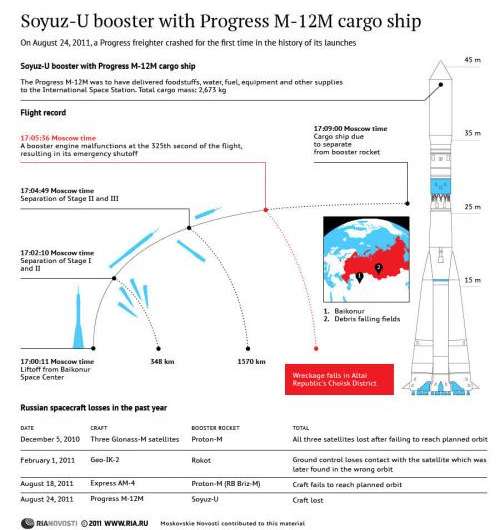
In August, another Proton-M rocket failed to launch an Ekspress-AM4. The communications satellite was designed to provide digital television and secure government communications throughout the Russian Federation extending far into Siberia and the Far East.
This failure prompted further disciplinary action. A Russian State Commission of inquiry was established to determine the reasons for the failure. The International Launch Services (ILS), a joint US-Russian venture with exclusive rights to launch commercial payload from the Baikonur Cosmodrome in Kazakhstan, formed its own Failure Review Oversight Board to review Roscosmos‘ final internal report. The final verdict was both missions were lost due to negligence.
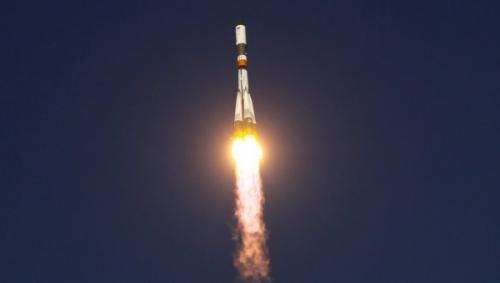
Things didn’t get better for the Russian Space Agency. Only a week after the loss of Eskpress-AM4, A Soyuz-U booster failed. Its cargo, the Progress M-12 expendable cargo spacecraft, never reached the crew waiting for its contents aboard the International Space Station.
Now, it looks like further harsh disciplinary action might befall the scientists and engineers behind the failed Phobos-Grunt. Designed to land on Mars’ larger moon and return a soil sample, the spacecraft got stuck in Earth orbit in November. Russian President Dmitry Medvedev has suggested that those responsible for the failure need to be punished. They could he fined, he said. He even went so far as to suggest criminal prosecution. The threat might be directed at Lavochkin, the company that built Phobos-Grunt.
It’s possible Medvedev is protecting the Russian people who, like Americans, foot the bill of their nation’s space program. But he might not be. The failures do, after all, deal a serious blow to Russia’s technological pride and standing as a power in space.
“I am not suggesting putting them up against the wall like under Josef Vissarionovich (Stalin), but seriously punish either financially or, if the fault is obvious, it could be a disciplinary or even criminal punishment,” Medvedev said.
Surprisingly, or perhaps not, Roscosmos isn’t the only Russian industry to be target by Medvedev’s calls for disciplinary action. Similar calls have been made for disciplinary action after carelessness, corruption, and problems within Russia’s infrastructure, such as a riverboat sinking in July that killed 122. The difference is that no one dies when an unmanned spacecraft fails to complete its mission.
Source: Universe Today


