French zoo steps up rhino surveillance against poachers
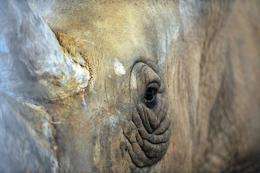
A French zoo has placed its white rhinos under video surveillance fearing poachers could kill them for their horns which can fetch hundreds of thousands of euros on the black market.
The owner of the Thoiry zoo and wildlife park west of Paris took the measure following a spate of rhino horn thefts from zoos and museums around Europe, broadening security measures already in place for small primates.
"We have extended the surveillance that we initiated for our small monkeys, which were regularly stolen and sold illegally, to the white rhinos that weigh 2.5 tonnes," zoo owner Paul de la Panouse told AFP.
"Their enclosures are under surveillance by cameras and staff who make regular rounds."
Rhinos are often poached for their horns, made of keratin and sold on the black market for ornamental or medicinal purposes, particularly in Asia.
Horns can fetch between 25,000 and 200,000 euros depending on their size.
Panouse said that thieves had already stolen rhino horns that had been on display for educational purposes from the Sigean wildlife park in the south west of the country.
"Today I'm worried for the living rhinos," Panouse said.
"It's absurd to kill these animals for their horns that some people think might treat illnesses like cancer or impotence," he said.
"The horn is only made of a mass of hair and eating it is the same as eating your nails."
Europol, the European Union's criminal intelligence agency, suspects an Irish organised crime group is behind the spate of robberies that has hit European zoos, auction houses, antique dealers and private collectors.
Trade in rhino horns is banned under the CITES international agreement, the 1975 Convention on International Trade in Endangered Species of Wild Fauna and Flora.
(c) 2011 AFP
-
From lemons to lemonade: Reaction uses carbon dioxide to make carbon-based semiconductor,
32 comments
-
Thioridazine kills cancer stem cells in human while avoiding toxic side-effects of conventional cancer treatments,
3 comments
-
SpaceX private rocket blasts off for space station (Update),
42 comments
-
Climate scientists say they have solved riddle of rising sea,
31 comments
-
SpaceX capsule has 'new car' smell, astronauts say (Update),
4 comments
-
What would stain as translucent on light-coloured fabric?
21 hours ago
-
How do I identify different bacteria on culture plates?
May 26, 2012
-
Why Do Dogs do Strange things...
May 25, 2012
-
What does exophillic and endophillic mean in terms of mosquito and their control?
May 24, 2012
-
Semen stains glows under black lights (uv light)?
May 23, 2012
-
Question on Human Chromosome 2
May 23, 2012
- More from Physics Forums - Biology
More news stories
Manufacturing genes to attack flu virus
An international research team has manufactured a new protein that can combat deadly flu epidemics.
2 hours ago |
not rated yet |
0
|
Scientist: Evolution debate will soon be history
(AP) -- Richard Leakey predicts skepticism over evolution will soon be history. Not that the avowed atheist has any doubts himself.
20 hours ago |
3.4 / 5 (19) |
78
More plant species responding to global warming than previously thought
(Phys.org) -- Far more wild plant species may be responding to global warming than previous large-scale estimates have suggested.
May 22, 2012 |
4.6 / 5 (14) |
18
|
Thousands of shellfish found dead in Peru
Thousands of crustaceans were found dead off the coast of Lima following the mystery mass death of dolphins and pelicans, the Peruvian Navy said Friday.
May 26, 2012 |
4.8 / 5 (5) |
7
For monogamous sparrows, it doesn't pay to stray (but they do it anyway)
It's quite common for a female song sparrow to stray from her breeding partner and mate with the male next door, but a new study shows that sleeping around can be costly.
May 22, 2012 |
5 / 5 (2) |
8
|
Land and sea species differ in climate change response: study
(Phys.org) -- Marine and terrestrial species will likely differ in their responses to climate warming, new research by Simon Fraser University and Australia’s University of Tasmania has found.
Almost half of new vets seek disability
(AP) -- America's newest veterans are filing for disability benefits at a historic rate, claiming to be the most medically and mentally troubled generation of former troops the nation has ever seen.
'Unzipped' carbon nanotubes could help energize fuel cells, batteries
Multi-walled carbon nanotubes riddled with defects and impurities on the outside could replace some of the expensive platinum catalysts used in fuel cells and metal-air batteries, according to scientists at ...
T cells 'hunt' parasites like animal predators seek prey, study shows
By pairing an intimate knowledge of immune-system function with a deep understanding of statistical physics, a cross-disciplinary team at the University of Pennsylvania has arrived at a surprising finding: T cells use a movement ...
Computer model used to pinpoint prime materials for efficient carbon capture
When power plants begin capturing their carbon emissions to reduce greenhouse gases and to most in the electric power industry, it's a question of when, not if it will be an expensive undertaking.
Change in developmental timing was crucial in the evolutionary shift from dinosaurs to birds: study
At first glance, it's hard to see how a common house sparrow and a Tyrannosaurus Rex might have anything in common. After all, one is a bird that weighs less than an ounce, and the other is a dinosaur that ...