How drought-tolerant grasses came to be
November 23, 2011

How drought-tolerant grasses came to be

Enlarge

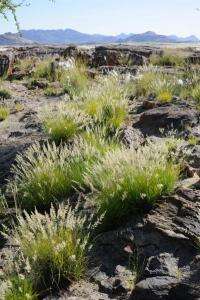
Grasses that use the C4 photosynthetic pathway -- like these tufts of Enneapogon scaber from Namibia -- are particularly good at growing in hot, dry environments. Credit: Photo by study co-author J. Travis Columbus, Rancho Santa Ana Botanic Garden and Claremont Graduate University.

If you eat bread stuffing or grain-fed turkey this Thanksgiving, give thanks to the grasses — a family of plants that includes wheat, oats, corn and rice. Some grasses, such as corn and sugar cane, have evolved a unique way of harvesting energy from the sun that's more efficient in hot, arid conditions. A new grass family tree reveals how this mode of photosynthesis came to be.

The results may one day help scientists develop more drought-tolerant grains, say scientists working at the U. S. National Evolutionary Synthesis Center.

From the grasslands of North America, to the pampas of South America, to the steppes of Eurasia and the savannas of the tropics, the grass family contains more than 10,000 species, including the world's three most important crops: wheat, rice and corn. We rely on grasses for sugar, liquor, bread, and livestock fodder.

Like all plants, grasses harvest energy from sunlight by means of photosynthesis. But grasses use two strategies that differ in how they take up carbon dioxide from the air and convert it into the starches and sugars vital to plant growth. The majority of grasses use a mode of photosynthesis called the C3 pathway, but many species — especially those in hot, tropical climates — use an alternate mode of photosynthesis known as C4. In hot, arid environments, C4 grasses such as maize, sugar cane, sorghum and millet have a leg up over C3 plants because they use water more efficiently.
How drought-tolerant grasses came to be
Enlarge

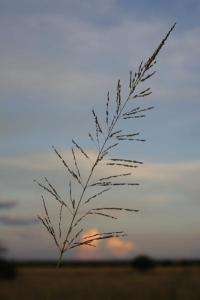
Grasses have been around since the dinosaurs, but despite their economic importance we know little about their history. Credit: Photo by study co-author J. Travis Columbus, Rancho Santa Ana Botanic Garden and Claremont Graduate University.

An international team of researchers wanted to figure out how many times, and when, the C4 strategy came to be. To find out, they used DNA sequence data from three chloroplast genes to reconstruct the grass family tree. The resulting phylogeny represents 531 species, including 93 species for which DNA sequence data was previously unavailable.

"By working collaboratively across many labs, from the US to Argentina to Ireland to Switzerland — with some people providing new plant material, and others doing the DNA sequencing — we were able to get a lot done in a very short amount of time," said co-author Erika Edwards of Brown University.

The results suggest that the C4 pathway has evolved in the grasses more than 20 separate times within the last 30 or so million years, Edwards said.

What's most surprising, she added, is that C4 evolution seems to be a one-way street – i.e., once the pathway evolves, there's no turning back. "We can't say whether it is evolutionarily 'impossible', or whether there simply hasn't been a good reason to do it, but it seems increasingly unlikely that any C4 grasses have ever reverted to the C3 condition," Edwards said.

"The new tree will be extremely useful for anyone who works on grasses," she added.

For example, scientists are currently trying to engineer the C4 photosynthetic pathway into C3 crops like rice to produce more stress-tolerant plants. By helping researchers identify pairs of closely related C3 and C4 species, the evolutionary relationships revealed in this study could help pinpoint the genetic changes necessary to do that.

"The next challenge is getting these species into cultivation and studying them closely, and ideally, sequencing their genomes," Edwards said.

The results will be published this week in the journal New Phytologist.

More information: Grass Phylogeny Working Group II (2011). "New grass phylogeny resolves deep evolutionary relationships and discovers C4 origins." New Phytologist. doi: 10.1111/j.1469-8137.2011.03972.x

Journal reference: New Phytologist search and more info website

Provided by National Evolutionary Synthesis Center (NESCent)


Rank not rated yet
Relevant PhysicsForums posts

More news stories

Manufacturing genes to attack flu virus

An international research team has manufactured a new protein that can combat deadly flu epidemics.

Biology / Biotechnology

created 1 hour ago | popularity not rated yet | comments 0 | with audio podcast

Scientist: Evolution debate will soon be history

(AP) -- Richard Leakey predicts skepticism over evolution will soon be history. Not that the avowed atheist has any doubts himself.

Biology / Evolution

created 20 hours ago | popularity 3.4 / 5 (19) | comments 73

More plant species responding to global warming than previously thought

(Phys.org) -- Far more wild plant species may be responding to global warming than previous large-scale estimates have suggested.

Biology / Ecology

created May 22, 2012 | popularity 4.6 / 5 (14) | comments 18 | with audio podcast

Thousands of shellfish found dead in Peru

Thousands of crustaceans were found dead off the coast of Lima following the mystery mass death of dolphins and pelicans, the Peruvian Navy said Friday.

Biology / Ecology

created May 26, 2012 | popularity 4.8 / 5 (5) | comments 7

For monogamous sparrows, it doesn't pay to stray (but they do it anyway)

It's quite common for a female song sparrow to stray from her breeding partner and mate with the male next door, but a new study shows that sleeping around can be costly.

Biology / Plants & Animals

created May 22, 2012 | popularity 5 / 5 (2) | comments 8 | with audio podcast


'Unzipped' carbon nanotubes could help energize fuel cells, batteries

Multi-walled carbon nanotubes riddled with defects and impurities on the outside could replace some of the expensive platinum catalysts used in fuel cells and metal-air batteries, according to scientists at ...

T cells 'hunt' parasites like animal predators seek prey, study shows

By pairing an intimate knowledge of immune-system function with a deep understanding of statistical physics, a cross-disciplinary team at the University of Pennsylvania has arrived at a surprising finding: T cells use a movement ...

Computer model used to pinpoint prime materials for efficient carbon capture

When power plants begin capturing their carbon emissions to reduce greenhouse gases – and to most in the electric power industry, it's a question of when, not if – it will be an expensive undertaking.

Change in developmental timing was crucial in the evolutionary shift from dinosaurs to birds: study

At first glance, it's hard to see how a common house sparrow and a Tyrannosaurus Rex might have anything in common. After all, one is a bird that weighs less than an ounce, and the other is a dinosaur that ...

Yale study concludes public apathy over climate change unrelated to science literacy

Are members of the public divided about climate change because they don't understand the science behind it? If Americans knew more basic science and were more proficient in technical reasoning, would public consensus match ...

Same gene that stunts infants' growth also makes them grow too big: research

UCLA geneticists have identified the mutation responsible for IMAGe* syndrome, a rare disorder that stunts infants' growth. The twist? The mutation occurs on the same gene that causes Beckwith-Wiedemann syndrome, which makes ...