Dinosaur species attracted mates similar to a peacock
Nov 09, 2011 by Deborah Braconnier report
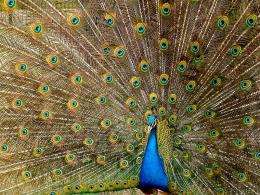
A Peafowl flaring his feathers. Image: Wikipedia.

(PhysOrg.com) -- A new study presented at the Society for Vertebrate Paleontology shows that the Oviraptor dinosaur had a tail structure that allowed it to shake its tail feathers, possibly to attract potential mates.

Oviraptors roamed the Earth during the . Their name, which is Latin for “egg thief,” was given to them because the first remains found of this dinosaur was discovered near a pile of eggs. However, as more were discovered it was determined that the eggs in fact probably belonged to the dinosaur. Researchers are still not sure what their exact diet would have consisted of.

Oviraptors are a member of the theropod group of dinosaurs. Their tail structure is similar to that of modern-day birds. Doctoral student Scott Persons from the University of Alberta was studying this group of dinosaurs when he discovered that the Oviraptors had a different and odd arrangement of bones in the tail.
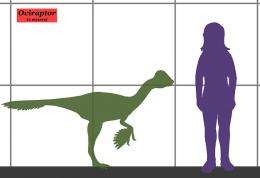
Size comparison between the dinosaur Oviraptor and a human. Image: Wikipedia.

The tail structure of the Oviraptor is shorter than most other . He discovered that this short size was not because of missing bones but because each individual vertebra are compacted together. This dense arrangement of the bones makes the tails extremely flexible.

Fossil impressions of these birds show that they had a large fan of feathers that were attached to the end of their tails. These feathers were attached by fused vertebrae at the end of the tail. Combined together, this flexible fan of may have been used as a way to attract potential mates, similar to modern-day peacocks.

Explore further: Actor Johnny Depp immortalized in ancient fossil find

Related Stories

The color of dinosaur feathers identified

Jan 27, 2010

(PhysOrg.com) -- The colour of some feathers on dinosaurs and early birds has been identified for the first time, reports a paper published in Nature this week.

Recommended for you

The eloquence of the otoliths

May 16, 2013

Fish fossils that are about 23 million years old give unprecedented insight into the evolutionary history of the gobioid order, one of the most species-rich groups among the modern bony fishes.

Light cast on lifestyle and diet of first New Zealanders

May 16, 2013

(Phys.org) —A University of Otago-led multidisciplinary team of scientists have shed new light on the diet, lifestyles and movements of the first New Zealanders by analysing isotopes from their bones and teeth.

mtDNA study shows Minoans came from Europe not Africa

May 15, 2013

(Phys.org) —A new study conducted by a team of American and Greek researchers has found that the people of the ancient Minoan civilization living on the island of Crete most likely came from Europe. In ...

User comments : 1

Adjust slider to filter visible comments by rank

Display comments: newest first

xznofile
not rated yet Nov 09, 2011
most lizards and some birds also use their tail for combat. it's possible the tail feathers could have been used the way pigeons and doves use their wingtips to defend their nests. or like porcupines and tarantulas shed body hairs. the wrist feathers shown also seem to be for something utilitarian aside from flight, but if it were for show, as a secondary sex trait, it's possible flight could have become possible just through showing off ("Hey baby, watch this...")

More news stories

Evolution of lying

(Phys.org) —Ultimately, our ability to convincingly lie to each other may have evolved as a direct result of our cooperative nature.

Russia retrieves mice, newts from space

A Russian capsule filled with 45 mice and 15 newts along with other small animals returned from a month's mission in orbit on Sunday with data scientists hope will pave the way for a manned flight to Mars.

Honeybees trained in Croatia to find land mines

(AP)—Mirjana Filipovic is still haunted by the land mine blast that killed her boyfriend and blew off her left leg while on a fishing trip nearly a decade ago. It happened in a field that was supposedly ...

German energy shift faces headwinds

Tense engineers have their eyes peeled on complex colour-coded diagrams on a wall-sized screen that makes their control room look like the inside of a spaceship.

Internet in 'coma' as Iran election looms

Iran is tightening control of the Internet ahead of next month's presidential election, mindful of violent street protests that social networkers inspired last time around over claims of fraud, users and ...