Climate change 'threatens Nile, Limpopo rivers'
November 14, 2011

Researchers say rising temperatures raise the risk of conflicts erupting over use of the Nile and Limpopo

Enlarge

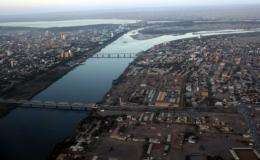
An aerial view shows the Nile river cutting through the Sudanese capital Khartoum. Rising global temperatures and shifting rainfall patterns could affect water flows on Africa's mighty Nile and Limpopo rivers, an agricultural research group says.

Rising global temperatures and shifting rainfall patterns could affect water flows on Africa's mighty Nile and Limpopo rivers, an agricultural research group said Monday.

The Consultative Group on International Agricultural Research, a global think-tank, warned the changes could have major effects for countries that share the rivers -- raising the risk of conflicts erupting over water use, already a subject of often touchy regional relations.

Their study raised the greatest concerns for the Limpopo River Basin, including parts of Botswana, South Africa, Mozambique and Zimbabwe, and running through a region already chronically dry.

The findings were presented at the International Forum on Water and Food in Pretoria.

The group's projections found that between now and 2050 hotter weather and fewer rains could hurt food production and deepen poverty.

"We need to ask whether current agriculture development strategies in the Limpopo, which are predicated on current levels of , are in fact realistic for a climate future that may present new challenges and different opportunities," said Simon Cook, a scientist who worked on the project.

"In some parts of the Limpopo, even widespread adoption of innovations like drip irrigation may not be enough to overcome the negative on water availability," Cook added.

For the Nile, the researchers projected that increased could "reduce the water balance of the upper Blue Nile Basin."

That could affect regional talks on management of the river, after years of tensions over Ethiopia's plans for new dams, the researchers said.

"The new insights regarding the effect of on may indicate a need to revisit assumptions about water availability," said Alain Vidal, director of the group's water and food programme.

In rivers around the world, the study found that higher would make more water evaporate from rivers, which in most cases should be set off by increased rainfall.

But within river basins, changes could prove dramatic, and flip weather trends from wet to dry for regions that previously have known consistent patterns, it found.

"Such changes will create a management nightmare and require a much greater focus on adaptive approaches and long-term climate projections than historically have been necessary," said Vidal.

(c) 2011 AFP


Rank not rated yet
Relevant PhysicsForums posts

More news stories

Land and sea species differ in climate change response: study

(Phys.org) -- Marine and terrestrial species will likely differ in their responses to climate warming, new research by Simon Fraser University and Australia’s University of Tasmania has found.

Space & Earth / Environment

created 1 hour ago | popularity not rated yet | comments 1 | with audio podcast

Yale study concludes public apathy over climate change unrelated to science literacy

Are members of the public divided about climate change because they don't understand the science behind it? If Americans knew more basic science and were more proficient in technical reasoning, would public consensus match ...

Space & Earth / Environment

created 3 hours ago | popularity 4 / 5 (1) | comments 10 | with audio podcast

10 million years needed to recover from mass extinction

It took some 10 million years for Earth to recover from the greatest mass extinction of all time, latest research has revealed.

Space & Earth / Earth Sciences

created 3 hours ago | popularity not rated yet | comments 1 | with audio podcast

Sophisticated simulations predict future warming

The chances of our planet being hit by a global warming of 3 degrees Celsius by 2050 is as likely as it being hit by an increase of 1.4 degrees, new research shows. Presented in the journal Nature Geoscience, the British study ...

Space & Earth / Earth Sciences

created May 22, 2012 | popularity 4.4 / 5 (9) | comments 51

Aliens don't want to eat us, says former SETI director

Alien life probably isn’t interested in having us for dinner, enslaving us or laying eggs in our bellies, according to a recent statement by former SETI director Jill Tarter.

Space & Earth / Space Exploration

created May 25, 2012 | popularity 4.4 / 5 (14) | comments 39


'Unzipped' carbon nanotubes could help energize fuel cells, batteries

Multi-walled carbon nanotubes riddled with defects and impurities on the outside could replace some of the expensive platinum catalysts used in fuel cells and metal-air batteries, according to scientists at ...

T cells 'hunt' parasites like animal predators seek prey, study shows

By pairing an intimate knowledge of immune-system function with a deep understanding of statistical physics, a cross-disciplinary team at the University of Pennsylvania has arrived at a surprising finding: T cells use a movement ...

Computer model used to pinpoint prime materials for efficient carbon capture

When power plants begin capturing their carbon emissions to reduce greenhouse gases – and to most in the electric power industry, it's a question of when, not if – it will be an expensive undertaking.

Change in developmental timing was crucial in the evolutionary shift from dinosaurs to birds: study

At first glance, it's hard to see how a common house sparrow and a Tyrannosaurus Rex might have anything in common. After all, one is a bird that weighs less than an ounce, and the other is a dinosaur that ...

Nvidia trumpets Tegra 3 phone design wins for 2012

(Phys.org) -- Nvidia’s competitive war paint has a name, Tegra 3. On the heels of Nvidia announcements about lowering costs of its Tegra 3 processors and Nvidia-enabled tablets running Android Ice Cream ...

Almost half of new vets seek disability

(AP) -- America's newest veterans are filing for disability benefits at a historic rate, claiming to be the most medically and mentally troubled generation of former troops the nation has ever seen.