Strange hollows discovered on Mercury

October 25, 2011 By Dauna Coulter
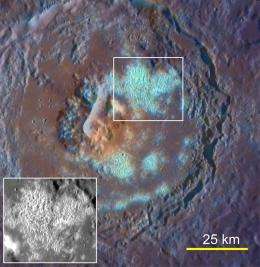
Hollows inside the Raditladi impact basin. Credit: NASA/Johns Hopkins University Applied Physics Laboratory/Carnegie Institution of Washington.
NASA's MESSENGER spacecraft has discovered strange hollows on the surface of Mercury. Images taken from orbit reveal thousands of peculiar depressions at a variety of longitudes and latitudes, ranging in size from 60 feet to over a mile across and 60 to 120 feet deep. No one knows how they got there.
"These hollows were a major surprise," says David Blewett, science team member from the Johns Hopkins University Applied Physics Laboratory. "We've been thinking of Mercury as a relic a place that's really not changing much anymore, except by impact cratering. But the hollows appear to be younger than the craters in which they are found, and that means Mercury's surface is still evolving in a surprising way."
Mars Reconnaissance Orbiter spotted similar depressions in the carbon dioxide ice at Mars' south pole, giving that surface a "swiss cheese" appearance. But on Mercury they're found in rock and often have bright interiors and halos.
"We've never seen anything quite like this on a rocky surface."
If you could stand in one of these "sleepy" hollows on Mercury's surface, you'd find yourself, like Ichabod Crane, in a quiet, still, haunting place, with a black sky above your head.
"There's essentially no atmosphere on Mercury," explains Blewett. "And with no atmosphere, wind doesn't blow and rain doesn't fall. So the hollows weren't carved by wind or water. Other forces must be at work."
Another example of hollows in crater Tyagaraja. Credit: Science/AAAS
As the planet closest to the Sun, Mercury is exposed to fierce heat and extreme space weather. Blewett believes these factors play a role.A key clue, he says, is that many of the hollows are associated with central mounds or mountains inside Mercury's impact craters. These so-called peak rings are thought to be made of material forced up from the depths by the impact that formed the crater. Excavated material could be unstable when it finds itself suddenly exposed at Mercury's surface.
"Certain minerals, for example those that contain sulfur and other volatiles, would be easily vaporized by the onslaught of heat, solar wind, and micrometeoroids that Mercury experiences on a daily basis," he says. "Perhaps sulfur is vaporizing, leaving just the other minerals, and therefore weakening the rock and making it spongier. Then the rock would crumble and erode more readily, forming these depressions."
MESSENGER has indeed proven Mercury unexpectedly rich in sulfur. That in itself is a surprise that's forcing scientists to rethink how Mercury was formed. The prevailing models suggest that either (1) very early in Solar System history, during the final sweep-up of the large planetesimals that formed the planets, a colossal impact tore off much of Mercury's rocky outer layering; or (2) a hot phase of the early Sun heated up the surface enough to scorch off the outer layers. In either case, the elements with a low boiling point volatiles like sulfur and potassium would have been driven off.
But they're still there.
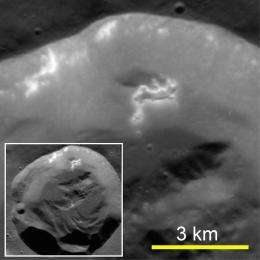
A fresh impact crater. Hollows are present on a section of the crater wall that has slid partway down toward the floor. Credit: Science/AAAS
"The old models just don't fit with the new data, so we'll have to look at other hypotheses."To figure out how the planets and Solar System came to be, scientists must understand Mercury.
"It's the anchor at one end of the Solar System. Learning how Mercury formed will have major implications for the rest of the planets. And MESSENGER is showing that, up to now, we've been completely wrong about this little world in so many ways!"
What other surprises does Mercury hold? The sleepy hollows of the innermost planet may be just the beginning.
Provided by Science@NASA
-
From lemons to lemonade: Reaction uses carbon dioxide to make carbon-based semiconductor,
32 comments
-
Thioridazine kills cancer stem cells in human while avoiding toxic side-effects of conventional cancer treatments,
3 comments
-
SpaceX private rocket blasts off for space station (Update),
42 comments
-
Climate scientists say they have solved riddle of rising sea,
31 comments
-
SpaceX capsule has 'new car' smell, astronauts say (Update),
3 comments
-
Distance of planets from stars and revolution
1 hour ago
-
revamping general concept and cosmological principle
May 25, 2012
-
Transiting Exoplanet Light Curve
May 25, 2012
-
Math behind Theoretical Physics
May 24, 2012
-
Do we know whats at the center of galaxies yet?
May 23, 2012
-
Structure of the Milky Way?
May 20, 2012
- More from Physics Forums - General Astronomy
More news stories
Yale study concludes public apathy over climate change unrelated to science literacy
Are members of the public divided about climate change because they don't understand the science behind it? If Americans knew more basic science and were more proficient in technical reasoning, would public consensus match ...
1 hour ago |
not rated yet |
8
|
10 million years needed to recover from mass extinction
It took some 10 million years for Earth to recover from the greatest mass extinction of all time, latest research has revealed.
Space & Earth / Earth Sciences
1 hour ago |
not rated yet |
1
|
Sophisticated simulations predict future warming
The chances of our planet being hit by a global warming of 3 degrees Celsius by 2050 is as likely as it being hit by an increase of 1.4 degrees, new research shows. Presented in the journal Nature Geoscience, the British study ...
Space & Earth / Earth Sciences
May 22, 2012 |
4.4 / 5 (9) |
51
Aliens don't want to eat us, says former SETI director
Alien life probably isnt interested in having us for dinner, enslaving us or laying eggs in our bellies, according to a recent statement by former SETI director Jill Tarter.
Space & Earth / Space Exploration
May 25, 2012 |
4.4 / 5 (14) |
39
Kyoto Protocol architect 'frustrated' by climate dialogue
UN climate talks are going nowhere, as politicians dither or bicker while the pace of warming dangerously speeds up, one of the architects of the Kyoto Protocol told AFP.
May 23, 2012 |
3.7 / 5 (7) |
39
'Unzipped' carbon nanotubes could help energize fuel cells, batteries
Multi-walled carbon nanotubes riddled with defects and impurities on the outside could replace some of the expensive platinum catalysts used in fuel cells and metal-air batteries, according to scientists at ...
T cells 'hunt' parasites like animal predators seek prey, study shows
By pairing an intimate knowledge of immune-system function with a deep understanding of statistical physics, a cross-disciplinary team at the University of Pennsylvania has arrived at a surprising finding: T cells use a movement ...
Computer model used to pinpoint prime materials for efficient carbon capture
When power plants begin capturing their carbon emissions to reduce greenhouse gases and to most in the electric power industry, it's a question of when, not if it will be an expensive undertaking.
Change in developmental timing was crucial in the evolutionary shift from dinosaurs to birds: study
At first glance, it's hard to see how a common house sparrow and a Tyrannosaurus Rex might have anything in common. After all, one is a bird that weighs less than an ounce, and the other is a dinosaur that ...
Same gene that stunts infants' growth also makes them grow too big: research
UCLA geneticists have identified the mutation responsible for IMAGe* syndrome, a rare disorder that stunts infants' growth. The twist? The mutation occurs on the same gene that causes Beckwith-Wiedemann syndrome, which makes ...
Scientists develop ultra-sensitive test that detects diseases in their earliest stages
Scientists have developed an ultra-sensitive test that should enable them to detect signs of a disease in its earliest stages, in research published today in the journal Nature Materials.


Oct 25, 2011
Rank: not rated yet
Oct 25, 2011
Rank: 1 / 5 (12)
Oct 25, 2011
Rank: 1 / 5 (12)
Oct 25, 2011
Rank: 3.9 / 5 (7)
Therefore, I reported this comment for abuse.
Oct 25, 2011
Rank: not rated yet
Why not erosion, like this:
http://www.flickr...0618196/
Oct 25, 2011
Rank: 1.8 / 5 (4)
Oct 25, 2011
Rank: 1 / 5 (11)
If the sinkholes (depressions) weren't formed by what I suggested above, then the only thing else possible might be a bubble formed from an air pocket far below before the depression happened.Then the bubble or air pocket rose up, and when it reached the surface, it popped and the place where the bubble had been underneath, quickly filled with the ground material and sank, forming a depression. I would say that the hills or mountains within the depression(s) were there already before it sank, and then after the bubble appeared and dispersed, the mountains sank down along with everything else.
Oct 26, 2011
Rank: not rated yet
Oct 27, 2011
Rank: 3.9 / 5 (15)
http://mominer.ms...hildren/
http://www.homefa...uel.html
Oct 28, 2011
Rank: 5 / 5 (1)
Agreed. But I wish I had quoted the comment before it was removed. While I'm sick of Oliver's BS, and disturbed by the things he did, it's not often that I feel like I have a strong case to report one of his comments despite the idiocy that comes out of him.
In this case, he had segued from the Mercury being near the sun to an anti-global warming neutron repelling opinion...Totally missing the fact that this article is about sinkholes on mercury.
That said, his next comment, the one you still see, still doesn't really address the subject at hand...Although, it does at least quote the article.
Oct 29, 2011
Rank: not rated yet
Oct 29, 2011
Rank: 5 / 5 (1)