SFU student researches fungi fighting controls
October 5, 2011

SFU student researches fungi fighting controls

Enlarge

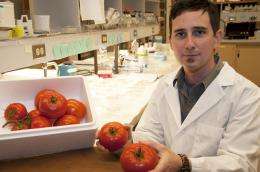
SFU doctoral student Andrew Wylie researches how to fight fungi with fungi to rescue greenhouse tomatoes and cucumbers from diseases without using chemicals.

(PhysOrg.com) -- If Andrew Wylie achieves his goal -- to use fungi to fight fungi on diseased organic greenhouse vegetables -- there’ll likely be a lot of growers giving him thanks on a future Thanksgiving weekend.

Wylie is a Simon Fraser University doctoral student in biology professor Zamir Punja’s plant pathology lab. He is on a quest to create a toolbox of biological controls that will help both organic and conventional commercial greenhouse vegetables thrive.

Wylie is researching how to use the biocontrol fungus Gliocladium catenulatum to control other that spoil or kill five to 50 per cent of commercial greenhouse tomatoes and cucumbers in North America. These vegetables are Canada’s $1.2 billion commercial organic and conventional greenhouse industries’ most valuable crops.

“Gliocladium catenulatum is considered a biological control fungus because it can either directly kill, outcompete or inhibit the growth of others,” says Wylie, the son of specialty mushroom growers. He developed an early fascination with the good and the bad sides of fungi.

Wylie is in partnership with Origin Organic Farms, the industry leader in the field of certified organic greenhouse production.

“Our lab is doing extensive work on how the airborne spores of Penicillium fungus damage greenhouse tomatoes and how the waterborne fungus, Pythium, strangles cucumbers. We need to figure out how these fungi infect and cause disease in their hosts before we can turn to Gliocladium catenulatum as a tool for attacking its fellow fungi.”

While one type of Penicillium produces an antibiotic useful to humans, another shows up as unappealing black spots on harvested tomatoes. Pythium causes a crown rot that girdles cucumbers, cutting off their nutrients and making them vulnerable to other diseases.

Wylie worries that the commercial greenhouse industries’ slim profit margins will tempt growers to take two steps backwards in what has become an industry-wide trend to go organic.

“Of concern to me is that these diseases could be prevented using synthetic fungicides,” says Wylie, who helped develop the technology that enables organic growers to compete with their hydroponic cousins.

“It is important to control tomato — and cucumber — attacking fungi and other greenhouse attackers by better understanding their causes and progression so that organic controls have a fighting chance. By doing this more difficult work now, the momentum of the organic movement is maintained and we build a toolbox of sustainable solutions to use in the future.”

Wylie notes that controlling disease-causing fungi with naturally occurring microbes is an important tool for organic growers who want to maintain their certification. But he adds that conventional hydroponic growers are turning to organic controls because they are less damaging to the environment and can be less costly than synthetic pesticides.

Provided by Simon Fraser University


Rank 5 /5 (4 votes)
Relevant PhysicsForums posts

More news stories

Manufacturing genes to attack flu virus

An international research team has manufactured a new protein that can combat deadly flu epidemics.

Biology / Biotechnology

created 2 hours ago | popularity not rated yet | comments 0 | with audio podcast

Scientist: Evolution debate will soon be history

(AP) -- Richard Leakey predicts skepticism over evolution will soon be history. Not that the avowed atheist has any doubts himself.

Biology / Evolution

created 21 hours ago | popularity 3.5 / 5 (20) | comments 81

More plant species responding to global warming than previously thought

(Phys.org) -- Far more wild plant species may be responding to global warming than previous large-scale estimates have suggested.

Biology / Ecology

created May 22, 2012 | popularity 4.6 / 5 (14) | comments 18 | with audio podcast

Thousands of shellfish found dead in Peru

Thousands of crustaceans were found dead off the coast of Lima following the mystery mass death of dolphins and pelicans, the Peruvian Navy said Friday.

Biology / Ecology

created May 26, 2012 | popularity 4.8 / 5 (5) | comments 7

For monogamous sparrows, it doesn't pay to stray (but they do it anyway)

It's quite common for a female song sparrow to stray from her breeding partner and mate with the male next door, but a new study shows that sleeping around can be costly.

Biology / Plants & Animals

created May 22, 2012 | popularity 5 / 5 (2) | comments 8 | with audio podcast


Land and sea species differ in climate change response: study

(Phys.org) -- Marine and terrestrial species will likely differ in their responses to climate warming, new research by Simon Fraser University and Australia’s University of Tasmania has found.

Almost half of new vets seek disability

(AP) -- America's newest veterans are filing for disability benefits at a historic rate, claiming to be the most medically and mentally troubled generation of former troops the nation has ever seen.

'Unzipped' carbon nanotubes could help energize fuel cells, batteries

Multi-walled carbon nanotubes riddled with defects and impurities on the outside could replace some of the expensive platinum catalysts used in fuel cells and metal-air batteries, according to scientists at ...

T cells 'hunt' parasites like animal predators seek prey, study shows

By pairing an intimate knowledge of immune-system function with a deep understanding of statistical physics, a cross-disciplinary team at the University of Pennsylvania has arrived at a surprising finding: T cells use a movement ...

Computer model used to pinpoint prime materials for efficient carbon capture

When power plants begin capturing their carbon emissions to reduce greenhouse gases – and to most in the electric power industry, it's a question of when, not if – it will be an expensive undertaking.

Change in developmental timing was crucial in the evolutionary shift from dinosaurs to birds: study

At first glance, it's hard to see how a common house sparrow and a Tyrannosaurus Rex might have anything in common. After all, one is a bird that weighs less than an ounce, and the other is a dinosaur that ...