Satellite pieces may hit Earth on weekend
October 20, 2011 By KIRSTEN GRIESHABER , Associated press
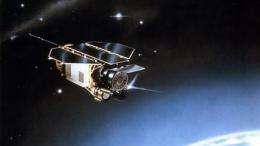
Undated artist rendering provided by EADS Astrium shows the scientific satellite Rosat. The German Aerospace Center said the retired satellite is hurtling toward the atmosphere and pieces could crash into the earth during the weekend, the center confirmed Thursday, Oct. 20, 2011. (AP Photo/EADS Astrium)
(AP) -- Pieces of a retired German satellite hurtling toward the atmosphere may crash to earth this weekend, the German Aerospace Center said Thursday.
Scientists have now honed their initial estimate of when the satellite would hit from a span of four days to either Saturday or Sunday. As it nears, they will eventually be able to estimate impact within a window of about 10 hours.
Parts of the satellite, which is the size of a minivan, will burn up during re-entry but up to 30 fragments weighing a total of 1.87 tons (1.7 metric tons) could crash into the Earth with a speed of up to 280 mph (450 kph).
The satellite orbits the Earth every 90 minutes and scientists can only say that it could hit Earth anywhere along its path, between 53-degrees north and 53-degrees south - a vast swath of territory that includes much of the planet outside the poles.
Scientists are no longer able to communicate with the dead German satellite ROSAT, which was launched in 1990.
ROSAT was used for research on black holes and neutron stars and performed the first all-sky survey of X-ray sources with an imaging telescope.
It was initially intended to only be active for 18 months but due to its great scientific success it was retired more than eight years later, in 1999 when communications were lost.
Even if the control center still had contact with the satellite, it has no engines so they would not be able to change its trajectory.
Scientists are now working on developing new technology that would allow for a controlled destruction of satellites in space, or the capture of satellites to prevent them from crashing into the Earth. But it will take many years for that technology to be implemented, the German Aerospace Center said.
As it stands, satellite debris hits the atmosphere almost every week, but most burns up upon re-entry and pieces rarely hit the Earth.
The largest single fragment of ROSAT that could hit into the Earth is the telescope's heat-resistant mirror.
The satellite will re-enter the atmosphere at a speed of 17,400 mph (28,000 kph).
More information: The German space agency on ROSAT: http://bit.ly/papMAA
©2011 The Associated Press. All rights reserved. This material may not be published, broadcast, rewritten or redistributed.
-
From lemons to lemonade: Reaction uses carbon dioxide to make carbon-based semiconductor,
32 comments
-
Thioridazine kills cancer stem cells in human while avoiding toxic side-effects of conventional cancer treatments,
3 comments
-
SpaceX private rocket blasts off for space station (Update),
42 comments
-
Climate scientists say they have solved riddle of rising sea,
31 comments
-
SpaceX capsule has 'new car' smell, astronauts say (Update),
4 comments
-
Distance of planets from stars and revolution
2 hours ago
-
revamping general concept and cosmological principle
May 25, 2012
-
Transiting Exoplanet Light Curve
May 25, 2012
-
Math behind Theoretical Physics
May 24, 2012
-
Do we know whats at the center of galaxies yet?
May 23, 2012
-
Structure of the Milky Way?
May 20, 2012
- More from Physics Forums - General Astronomy
More news stories
Land and sea species differ in climate change response: study
(Phys.org) -- Marine and terrestrial species will likely differ in their responses to climate warming, new research by Simon Fraser University and Australia’s University of Tasmania has found.
55 minutes ago |
not rated yet |
1
|
Yale study concludes public apathy over climate change unrelated to science literacy
Are members of the public divided about climate change because they don't understand the science behind it? If Americans knew more basic science and were more proficient in technical reasoning, would public consensus match ...
2 hours ago |
4 / 5 (1) |
10
|
10 million years needed to recover from mass extinction
It took some 10 million years for Earth to recover from the greatest mass extinction of all time, latest research has revealed.
Space & Earth / Earth Sciences
2 hours ago |
not rated yet |
1
|
Sophisticated simulations predict future warming
The chances of our planet being hit by a global warming of 3 degrees Celsius by 2050 is as likely as it being hit by an increase of 1.4 degrees, new research shows. Presented in the journal Nature Geoscience, the British study ...
Space & Earth / Earth Sciences
May 22, 2012 |
4.4 / 5 (9) |
51
Aliens don't want to eat us, says former SETI director
Alien life probably isnt interested in having us for dinner, enslaving us or laying eggs in our bellies, according to a recent statement by former SETI director Jill Tarter.
Space & Earth / Space Exploration
May 25, 2012 |
4.4 / 5 (14) |
39
Almost half of new vets seek disability
(AP) -- America's newest veterans are filing for disability benefits at a historic rate, claiming to be the most medically and mentally troubled generation of former troops the nation has ever seen.
'Unzipped' carbon nanotubes could help energize fuel cells, batteries
Multi-walled carbon nanotubes riddled with defects and impurities on the outside could replace some of the expensive platinum catalysts used in fuel cells and metal-air batteries, according to scientists at ...
T cells 'hunt' parasites like animal predators seek prey, study shows
By pairing an intimate knowledge of immune-system function with a deep understanding of statistical physics, a cross-disciplinary team at the University of Pennsylvania has arrived at a surprising finding: T cells use a movement ...
Computer model used to pinpoint prime materials for efficient carbon capture
When power plants begin capturing their carbon emissions to reduce greenhouse gases and to most in the electric power industry, it's a question of when, not if it will be an expensive undertaking.
Change in developmental timing was crucial in the evolutionary shift from dinosaurs to birds: study
At first glance, it's hard to see how a common house sparrow and a Tyrannosaurus Rex might have anything in common. After all, one is a bird that weighs less than an ounce, and the other is a dinosaur that ...
Nvidia trumpets Tegra 3 phone design wins for 2012
(Phys.org) -- Nvidias competitive war paint has a name, Tegra 3. On the heels of Nvidia announcements about lowering costs of its Tegra 3 processors and Nvidia-enabled tablets running Android Ice Cream ...
Oct 20, 2011
Rank: not rated yet
That covers a big slice of the globe! 53degrees north roughly dissects England/Scotland and US/Canada.