Salvage crew lands on 'creaking' N.Z. oil slick ship
October 13, 2011 by Neil Sands

The vessel was "creaking and groaning"

Enlarge

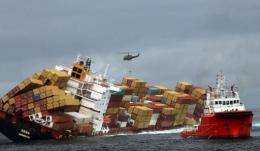
Salvage personnel are airlifted off the grounded container ship 'Rena' in the Bay of Plenty near Tauranga on October 11. The salvage crew made a daring landing on the crippled container ship leaking oil off New Zealand, as the vessel's owners apologised for the country's worst sea pollution crisis.

A salvage crew on Thursday made a daring landing on a crippled container ship leaking oil off New Zealand, as the vessel's owners apologised for the country's worst sea pollution crisis.

A helicopter winched the salvage workers onto the deck of the stricken Rena, which was "creaking and groaning" as it threatened to break apart in the North Island's Bay of Plenty after hitting a reef last week, officials said.

"It's a highly risky operation to do," Maritime New Zealand (MNZ) salvage manager Bruce Anderson said, adding that and navy were ready to evacuate the men at a moment's notice if the ship began to sink.

The boarding was a desperate attempt to restart efforts to offload from the vessel, which was abandoned on Tuesday as a storm bore down. The ship has since developed cracks in its hull and is listing badly on the reef.

Authorities, fearing that a breakup of the Rena is now inevitable, hope to drain its tanks to prevent further fuel from spewing into the environmentally sensitive area before the ship shears in two.

MNZ said anywhere from 350 to 700 tonnes of heavy fuel had already leaked from the Rena, fouling beaches and killing wildlife. They want to prevent all 1,700 tonnes on the vessel from being released if the ship breaks up and sinks.

Anderson said easing off the coast of Tauranga were providing "a window" to get the oil off but it was still too early to say when pumping could resume.

The three-man salvage crew's operation came as the Rena's owner, Costamare Shipping Company of Greece, said it was "deeply sorry" for the disaster.

In a video statement from Greece, Costamare managing director Diamantis Manos said the company was working with New Zealand authorities to establish how the ship ran aground on October 5.

He added that it would not be appropriate to speculate on how the accident happened but described the ship's captain, who has been charged by New Zealand authorities, as "an experienced master" who "has an exemplary record".

"However, to the people of Tauranga, we want to say we are deeply sorry for the situation that has arisen and the threat you are now facing from fuel oil from the vessel washing up on the beaches of your beautiful part of the world," Manos said.

For the first time, MNZ ordered the public off oil-blackened beaches on the worst-affected 35 kilometre (22 mile) stretch of coast, clearing the way for a "massive" cleanup operation involving 500 people.

"It's hard, dirty work, but with all the agencies involved and the community pulling together, we will get this oil cleaned up," MNZ site commander Nick Quinn said as the oil continued to come ashore in sluggish black waves.

Previously, the agency had only advised people not to go onto beaches in the area, one of New Zealand's most popular tourist destinations.

Residents living near affected beaches were advised to keep their windows closed as the toxic diesel oil released fumes that leave eyes stinging and throats raw.

MNZ said 200 dead birds had been recovered and it expected the toll on wildlife to increase substantially. It said that teams were trying to round up seals in the area and had caught four so far.

It said initial fears that one of 88 containers that have toppled from the ship's deck contained ferrosilicon, which is dangerous when mixed with water, were unfounded, and the container contained a water-soluble chemical.

The Rena's second officer, who was on navigation watch when the ship ploughed into the reef, was bailed in Tauranga court, charged with operating a vessel in a manner causing unnecessary danger or risk.

The ship's Filipino captain has already been bailed on the same charge, which carries a maximum penalty of NZ$10,000 ($7,800) or one year in jail.

(c) 2011 AFP


Rank not rated yet
Relevant PhysicsForums posts

More news stories

Land and sea species differ in climate change response: study

(Phys.org) -- Marine and terrestrial species will likely differ in their responses to climate warming, new research by Simon Fraser University and Australia’s University of Tasmania has found.

Space & Earth / Environment

created 55 minutes ago | popularity not rated yet | comments 1 | with audio podcast

Yale study concludes public apathy over climate change unrelated to science literacy

Are members of the public divided about climate change because they don't understand the science behind it? If Americans knew more basic science and were more proficient in technical reasoning, would public consensus match ...

Space & Earth / Environment

created 2 hours ago | popularity 4 / 5 (1) | comments 10 | with audio podcast

10 million years needed to recover from mass extinction

It took some 10 million years for Earth to recover from the greatest mass extinction of all time, latest research has revealed.

Space & Earth / Earth Sciences

created 2 hours ago | popularity not rated yet | comments 1 | with audio podcast

Sophisticated simulations predict future warming

The chances of our planet being hit by a global warming of 3 degrees Celsius by 2050 is as likely as it being hit by an increase of 1.4 degrees, new research shows. Presented in the journal Nature Geoscience, the British study ...

Space & Earth / Earth Sciences

created May 22, 2012 | popularity 4.4 / 5 (9) | comments 51

Aliens don't want to eat us, says former SETI director

Alien life probably isn’t interested in having us for dinner, enslaving us or laying eggs in our bellies, according to a recent statement by former SETI director Jill Tarter.

Space & Earth / Space Exploration

created May 25, 2012 | popularity 4.4 / 5 (14) | comments 39


Almost half of new vets seek disability

(AP) -- America's newest veterans are filing for disability benefits at a historic rate, claiming to be the most medically and mentally troubled generation of former troops the nation has ever seen.

'Unzipped' carbon nanotubes could help energize fuel cells, batteries

Multi-walled carbon nanotubes riddled with defects and impurities on the outside could replace some of the expensive platinum catalysts used in fuel cells and metal-air batteries, according to scientists at ...

T cells 'hunt' parasites like animal predators seek prey, study shows

By pairing an intimate knowledge of immune-system function with a deep understanding of statistical physics, a cross-disciplinary team at the University of Pennsylvania has arrived at a surprising finding: T cells use a movement ...

Computer model used to pinpoint prime materials for efficient carbon capture

When power plants begin capturing their carbon emissions to reduce greenhouse gases – and to most in the electric power industry, it's a question of when, not if – it will be an expensive undertaking.

Change in developmental timing was crucial in the evolutionary shift from dinosaurs to birds: study

At first glance, it's hard to see how a common house sparrow and a Tyrannosaurus Rex might have anything in common. After all, one is a bird that weighs less than an ounce, and the other is a dinosaur that ...

Nvidia trumpets Tegra 3 phone design wins for 2012

(Phys.org) -- Nvidia’s competitive war paint has a name, Tegra 3. On the heels of Nvidia announcements about lowering costs of its Tegra 3 processors and Nvidia-enabled tablets running Android Ice Cream ...