Changes in rainfall patterns are projected for next 30 years
Oct 11, 2011
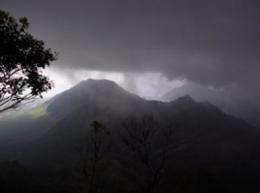
Storm clouds are visible as they move in to Kahana Valley on Oahu, Hawaii. Credit: Chase Norton, SOEST/UH-Manoa

Manoa have projected an increased frequency of heavy rainfall events but a decrease in rainfall intensity during the next 30 years (2011-2040) for the southern shoreline of Oahu, according to a recent study published in the Journal of Geophysical Research.

Chase Norton, a Meteorology Research Assistant at the School of Ocean and Earth Science and Technology (SOEST) at UH - Manoa, and colleagues (Professors Pao-Shin Chu and Thomas Schroeder) used a ; from rainfall gauges on Oahu, Hawaii; and a suite of General Circulation Models (GCMs) from the (IPCC) to project future patterns of heavy rainfall events on Oahu. GCMs play a pivotal role in the understanding of climate change and associated local changes in weather.

Heavy rainfall and flash floods are common in the Hawaiian Islands due to their steep terrain, rain‐producing weather systems, and abundant moisture supply. They have caused multimillion dollars damage to homes, properties, roads, agriculture, and other sectors. Environmentally, heavy rainfall and runoff events in Hawaii, which are likely to cause slope and coastal erosion, pollutant discharges to the near shore marine environment, coral reef degradation, among others, are expected to change as Earth undergoes an unprecedented warming. Given the socioeconomic repercussions resulting from past storm events, it is of considerable interest to investigate changes in the frequency and intensity of heavy rainfall events in Hawaii, particularly for Oahu, as it is the most populous island in Hawaii.

"The results presented in this study may benefit many agencies who are concerned with floods and relevant policy-making in the face of climate change," says Chu, UH – Manoa Meteorology Professor, Hawaii State Climate Office Director, and co-author of the study. "For instance, changes in rainstorm intensity may be a serious consideration in aquifer management – as precipitation is the primary water source for streams and groundwater supply."

Norton, Chu, and Schroeder would like to use the IPCC GCM simulations and extend the rainfall model to project future events in other locations. They also plan to use a high resolution regional climate model to project future changes in water resources in the .

Explore further: Alaska volcano shoots ash 15,000 feet into the air

Provided by University of Hawaii

4.6 /5 (5 votes)
add to favorites email to friend print save as pdf

Related Stories

Climate change: When it rains it (really) pours

Aug 07, 2008

Climate models have long predicted that global warming will increase the intensity of extreme precipitation events. A new study conducted at the University of Miami and the University of Reading (U.K.) provides ...

Floods to become commonplace by 2080

Jan 08, 2009

Flooding like that which devastated the North of England last year is set to become a common event across the UK in the next 75 years, new research has shown.

Heavy rainfall on the increase

Feb 14, 2008

Scientists at the University of East Anglia (UEA) have found that winter precipitation – such as rain and snow - became more intense in the UK during the last 100 years.

Waterborne disease risk upped in Great Lakes

Oct 08, 2008

An anticipated increased incidence of climate-related extreme rainfall events in the Great Lakes region may raise the public health risk for the 40 million people who depend on the lakes for their drinking water, according ...

Recommended for you

Alaska volcano shoots ash 15,000 feet into the air

4 hours ago

(AP)—One of Alaska's most restless volcanoes has shot an ash cloud 15,000 feet into the air in an ongoing eruption that has drawn attention from a nearby community but isn't expected to threaten air traffic.

NASA sees Cyclone Mahasen hit Bangladesh

15 hours ago

NASA's Tropical Rainfall Measuring Mission satellite known as TRMM measured Cyclone Mahasen's rainfall rates from space as it made landfall on May 16. Mahasen has since dissipated over eastern India.

Rapid climate change ruled out ice age trees

21 hours ago

Short, sharp fluctuations in the Earth's climate throughout the last ice age may have stopped trees from getting a foothold in Europe and northern Asia, scientists say.

Earth's iron core is surprisingly weak, researchers say

22 hours ago

The massive ball of iron sitting at the center of Earth is not quite as "rock-solid" as has been thought, say two Stanford mineral physicists. By conducting experiments that simulate the immense pressures deep in the planet's ...

User comments : 0

More news stories

Chinese, Indian airlines face EU pollution fines

Eight Chinese and two Indian airlines face fines of up to several million euros for not paying for their greenhouse gas emissions during flights within the bloc, the European Commission said on Friday.

Alaska volcano shoots ash 15,000 feet into the air

(AP)—One of Alaska's most restless volcanoes has shot an ash cloud 15,000 feet into the air in an ongoing eruption that has drawn attention from a nearby community but isn't expected to threaten air traffic.

Bright explosion on the Moon

For the past 8 years, NASA astronomers have been monitoring the Moon for signs of explosions caused by meteoroids hitting the lunar surface. "Lunar meteor showers" have turned out to be more common than anyone ...

Earth's iron core is surprisingly weak, researchers say

The massive ball of iron sitting at the center of Earth is not quite as "rock-solid" as has been thought, say two Stanford mineral physicists. By conducting experiments that simulate the immense pressures deep in the planet's ...

Temporal processing in the olfactory system

The neural machinery underlying our olfactory sense continues to be an enigma for neuroscience. A recent review in Neuron seeks to expand traditional ideas about how neurons in the olfactory bulb might encode information about ...