Oil slick ship ran aground as captain 'cut corner'
October 15, 2011 by Erica Berenstein

The six Filipino crewmembers are being kept at an undisclosed location

Enlarge

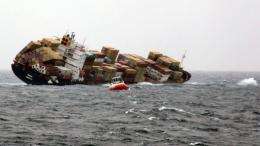
This handout photo taken and released by the New Zealand Defence Force on October 12, 2011 shows the grounded container ship Rena listing heavily to starboard in the Bay of Plenty near Tauranga. The vessel ran aground because the captain was taking a short cut, the New Zealand government alleged Saturday.

The vessel at the centre of New Zealand's worst maritime pollution disaster ran aground because the captain was taking a short cut, the New Zealand government alleged Saturday.

The accusation was made as salvage crews prepared to pump from the stricken Rena, which ran aground last week.

Anger is mounting in New Zealand over the fuel leak, with popular beaches on the North Island's east coast coated in oil and off-limits to the public, and more than 1,000 dead and oil-soaked birds recovered.

There were indications Saturday the leak has been stemmed, but the ship's agent has said the six Filipino crewmembers who are still in New Zealand are being kept at an undisclosed location amid fears for their safety.

Environment Minister Nick Smith said it appeared the Rena hit a reef off the resort area of Tauranga when the vessel was trying to get to port quickly.

"I can't confirm that. But it appears from the charts that they were in a rush to get to port, went full bore, cut the corner, and hit the reef," Smith told TV3's The Nation programme.

The ship's captain and the officer on navigational watch when the ship ran aground have already been charged with operating a vessel in a manner causing unnecessary danger or risk.

The charge carries a maximum penalty of one year in jail.

Meanwhile, Maritime New Zealand (MNZ) on-scene commander Nick Quinn said the Rena was now stable and the stern had settled on a reef.

"There are no reports of fresh oil leaking," he said as observation flights continued to monitor the situation from the air.

Quinn said salvage teams were on board the "working in very difficult and potentially " to install fuel pumping equipment.

They hoped to begin discharging oil into a waiting tanker by the end of the day.

It is believed there are still 1,346 tonnes of oil on board the Rena while about 330 tonnes have leaked into the ocean in an ecologically sensitive area teeming with wildlife, with 88 containers also falling into the water.

Matthew Watson from the salvage company Svitzer told Radio New Zealand a team on a fuel pumping barge half a nautical mile away had been testing equipment to remove the remaining oil.

Their main difficulty was finding a way to heat the fuel, which has cooled to a dense consistency and the ship's engines no longer have the power to warm it, he said.

On shore, nearly 1,000 dead birds have been recovered and a wildlife facility is caring for 110 injured birds.

Compared with some of the world's worst oil spills, the disaster remains small -- the Exxon Valdez which ran aground in 1989 in Alaska dumped 37,000 tonnes of oil into Prince William Sound.

But it is significant because of the pristine nature of New Zealand's Bay of Plenty, which contains marine reserves and wetlands and teems with wildlife including whales, dolphins, penguins, seals and rare sea birds.

(c) 2011 AFP

Filter


Move the slider to adjust rank threshold, so that you can hide some of the comments.


Display comments: newest first

ROBTHEGOB
Oct 15, 2011

Rank: 5 / 5 (1)
Lawsuit time.
kaasinees
Oct 15, 2011

Rank: 5 / 5 (1)
hang him.
sherriffwoody
Oct 16, 2011

Rank: 5 / 5 (1)
Make the company pay for the entire cleanup. They had to fly the crew out as they were worried for their safety. Its a pretty angry place on the east coast at the moment
Jimee
Oct 18, 2011

Rank: 5 / 5 (1)
Poisoning us and our world for our convenience.
Rank 4 /5 (2 votes)
Relevant PhysicsForums posts

More news stories

Yale study concludes public apathy over climate change unrelated to science literacy

Are members of the public divided about climate change because they don't understand the science behind it? If Americans knew more basic science and were more proficient in technical reasoning, would public consensus match ...

Space & Earth / Environment

created 1 hour ago | popularity not rated yet | comments 8 | with audio podcast

10 million years needed to recover from mass extinction

It took some 10 million years for Earth to recover from the greatest mass extinction of all time, latest research has revealed.

Space & Earth / Earth Sciences

created 1 hour ago | popularity not rated yet | comments 1 | with audio podcast

Sophisticated simulations predict future warming

The chances of our planet being hit by a global warming of 3 degrees Celsius by 2050 is as likely as it being hit by an increase of 1.4 degrees, new research shows. Presented in the journal Nature Geoscience, the British study ...

Space & Earth / Earth Sciences

created May 22, 2012 | popularity 4.4 / 5 (9) | comments 51

Aliens don't want to eat us, says former SETI director

Alien life probably isn’t interested in having us for dinner, enslaving us or laying eggs in our bellies, according to a recent statement by former SETI director Jill Tarter.

Space & Earth / Space Exploration

created May 25, 2012 | popularity 4.4 / 5 (14) | comments 39

Kyoto Protocol architect 'frustrated' by climate dialogue

UN climate talks are going nowhere, as politicians dither or bicker while the pace of warming dangerously speeds up, one of the architects of the Kyoto Protocol told AFP.

Space & Earth / Environment

created May 23, 2012 | popularity 3.7 / 5 (7) | comments 39


'Unzipped' carbon nanotubes could help energize fuel cells, batteries

Multi-walled carbon nanotubes riddled with defects and impurities on the outside could replace some of the expensive platinum catalysts used in fuel cells and metal-air batteries, according to scientists at ...

T cells 'hunt' parasites like animal predators seek prey, study shows

By pairing an intimate knowledge of immune-system function with a deep understanding of statistical physics, a cross-disciplinary team at the University of Pennsylvania has arrived at a surprising finding: T cells use a movement ...

Computer model used to pinpoint prime materials for efficient carbon capture

When power plants begin capturing their carbon emissions to reduce greenhouse gases – and to most in the electric power industry, it's a question of when, not if – it will be an expensive undertaking.

Change in developmental timing was crucial in the evolutionary shift from dinosaurs to birds: study

At first glance, it's hard to see how a common house sparrow and a Tyrannosaurus Rex might have anything in common. After all, one is a bird that weighs less than an ounce, and the other is a dinosaur that ...

Same gene that stunts infants' growth also makes them grow too big: research

UCLA geneticists have identified the mutation responsible for IMAGe* syndrome, a rare disorder that stunts infants' growth. The twist? The mutation occurs on the same gene that causes Beckwith-Wiedemann syndrome, which makes ...

Scientists develop ultra-sensitive test that detects diseases in their earliest stages

Scientists have developed an ultra-sensitive test that should enable them to detect signs of a disease in its earliest stages, in research published today in the journal Nature Materials.