New mystery on Mars' forgotten plains
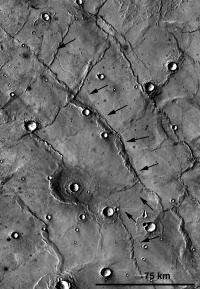
THEMIS daytime infrared image mosaic (courtesy of ASU/NASA/JPL) of Mars with north is at the top. Image is centered at 116.3°E and 25.0°S
(PhysOrg.com) -- One of the supposedly best understood and least interesting landscapes on Mars is hiding something that could rewrite the planet's history. Or not. In fact, about all that is certain is that decades of assumptions regarding the wide, flat Hesperia Planum are not holding up very well under renewed scrutiny with higher-resolution, more recent spacecraft data.
"Most scientists don't want to work on the flat things," noted geologist Tracy Gregg of University at Buffalo, State University of New York. So after early Mars scientists decided Hesperia Planum looked like a lava-filled plain, no one really revisited the matter and the place was used to exemplify something rather important: The base of a major transitional period in the geologic time scale of Mars. The period is aptly called the Hesperian and it is thought to have run from 3.7 to 3.1 billion years ago.
But when Gregg and her student Carolyn Roberts started looking at this classic Martian lava plain with modern data sets, they ran into trouble.
"There's a volcano in Hesperia Planum that not many people pay attention to because it's very small," Gregg said. "As I started looking closer at the broader region -- I can't find any other volcanic vents, any flows. I just kept looking for evidence of lava flows. It's kind of frustrating. There is nothing like that in the Hesperia Planum."
"A likely cause of this trouble is the thick dust that blankets Hesperia Planum," she said. "It covers everywhere like a snowfall."
So she turned her attention to what could be discerned on Hesperia Planum: about a dozen narrow, sinuous channels, called rilles, just a few hundred meters wide and up to hundreds of kilometers long. These rilles have no obvious sources or destinations and it is not at all clear they are volcanic.
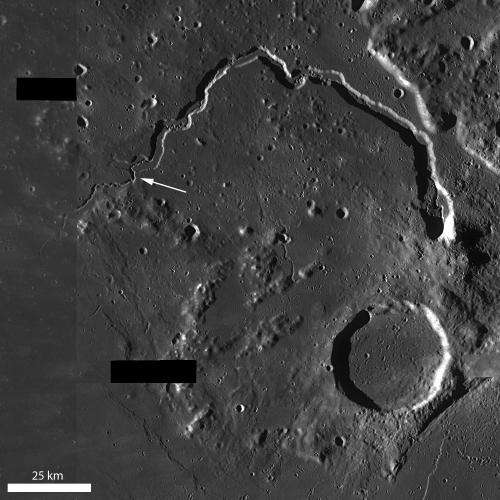
NASA/GSFC/Arizona State University Lunar Reconnaissance Orbiter image "Secrets of Schröteri" Vallis Schröteri is a sinuous rille on the moon; its inner rille diverges from the primary rille near arrow.
"The question I have is what made the channels," said Gregg. Was it water, lava, or something else? "There are some lavas that can be really, really runny. And both are liquids that run downhill." So either is a possibility.To begin to sort the matter out, Gregg and Roberts are now looking for help on the Moon. Their preliminary findings will be presented Wednesday, 12 October at the Annual Meeting of The Geological Society of America in Minneapolis.
"On the Moon we see these same kinds of features and we know that water couldn't have formed them there," Gregg said. So they are in the process of comparing channels on the Moon and Mars, using similar data sets from different spacecraft, to see if that sheds any light on the matter. She hopes to find evidence that will rule out water or lava on Hesperia Planum.
"Everybody assumed these were huge lava flows," said Gregg. "But if it turns out to be a lake deposit, it's a very different picture of what Mars was doing at that time." It would also make Hesperia Planum a good place to look for life, because water plus volcanic heat and minerals is widely believed to be a winning combination for getting life started.
"The 'volcanic' part is an interpretation that's beginning to fall apart," said Gregg. "What is holding up is that the Hesperian marks a transition between the Noachian (a time of liquid water on the surface and the formation of lots of impact craters) and the Amazonian (a drier, colder Mars)."
She has found that other scientists are interested in her work because of its possible implications on the Mars geological time scale. Gregg is not worried that Mars history will need to be rewritten, but she does suspect that Hesperia Planum is a lot more complicated than people has long thought.
More information: http://gsa.confex. … t_196462.htm
Provided by Geological Society of America
-
From lemons to lemonade: Reaction uses carbon dioxide to make carbon-based semiconductor,
32 comments
-
Thioridazine kills cancer stem cells in human while avoiding toxic side-effects of conventional cancer treatments,
3 comments
-
SpaceX private rocket blasts off for space station (Update),
42 comments
-
Climate scientists say they have solved riddle of rising sea,
31 comments
-
SpaceX capsule has 'new car' smell, astronauts say (Update),
3 comments
-
Distance of planets from stars and revolution
1 hour ago
-
revamping general concept and cosmological principle
May 25, 2012
-
Transiting Exoplanet Light Curve
May 25, 2012
-
Math behind Theoretical Physics
May 24, 2012
-
Do we know whats at the center of galaxies yet?
May 23, 2012
-
Structure of the Milky Way?
May 20, 2012
- More from Physics Forums - General Astronomy
More news stories
Yale study concludes public apathy over climate change unrelated to science literacy
Are members of the public divided about climate change because they don't understand the science behind it? If Americans knew more basic science and were more proficient in technical reasoning, would public consensus match ...
1 hour ago |
not rated yet |
8
|
10 million years needed to recover from mass extinction
It took some 10 million years for Earth to recover from the greatest mass extinction of all time, latest research has revealed.
Space & Earth / Earth Sciences
1 hour ago |
not rated yet |
1
|
Sophisticated simulations predict future warming
The chances of our planet being hit by a global warming of 3 degrees Celsius by 2050 is as likely as it being hit by an increase of 1.4 degrees, new research shows. Presented in the journal Nature Geoscience, the British study ...
Space & Earth / Earth Sciences
May 22, 2012 |
4.4 / 5 (9) |
51
Aliens don't want to eat us, says former SETI director
Alien life probably isnt interested in having us for dinner, enslaving us or laying eggs in our bellies, according to a recent statement by former SETI director Jill Tarter.
Space & Earth / Space Exploration
May 25, 2012 |
4.4 / 5 (14) |
39
Kyoto Protocol architect 'frustrated' by climate dialogue
UN climate talks are going nowhere, as politicians dither or bicker while the pace of warming dangerously speeds up, one of the architects of the Kyoto Protocol told AFP.
May 23, 2012 |
3.7 / 5 (7) |
39
'Unzipped' carbon nanotubes could help energize fuel cells, batteries
Multi-walled carbon nanotubes riddled with defects and impurities on the outside could replace some of the expensive platinum catalysts used in fuel cells and metal-air batteries, according to scientists at ...
T cells 'hunt' parasites like animal predators seek prey, study shows
By pairing an intimate knowledge of immune-system function with a deep understanding of statistical physics, a cross-disciplinary team at the University of Pennsylvania has arrived at a surprising finding: T cells use a movement ...
Computer model used to pinpoint prime materials for efficient carbon capture
When power plants begin capturing their carbon emissions to reduce greenhouse gases and to most in the electric power industry, it's a question of when, not if it will be an expensive undertaking.
Change in developmental timing was crucial in the evolutionary shift from dinosaurs to birds: study
At first glance, it's hard to see how a common house sparrow and a Tyrannosaurus Rex might have anything in common. After all, one is a bird that weighs less than an ounce, and the other is a dinosaur that ...
Same gene that stunts infants' growth also makes them grow too big: research
UCLA geneticists have identified the mutation responsible for IMAGe* syndrome, a rare disorder that stunts infants' growth. The twist? The mutation occurs on the same gene that causes Beckwith-Wiedemann syndrome, which makes ...
Scientists develop ultra-sensitive test that detects diseases in their earliest stages
Scientists have developed an ultra-sensitive test that should enable them to detect signs of a disease in its earliest stages, in research published today in the journal Nature Materials.

Oct 12, 2011
Rank: 4 / 5 (9)
Plasma discharges (BlunderDolts) power by Repellent Neutrons guided by Extremely Dubious Ætherwoobly Nonscience Theory (EDÆNT).
I also see Jesus, the Virgin Mary, the Snuffleupagus, Noah's Ark, Elvis.......
As the Illuminati have a base in Olympos Mons this could the result of test firing their new weapon of mass destruction
http://en.wikiped..._alt.jpg
Looks like a nipple :))
Oct 12, 2011
Rank: 1 / 5 (5)
From http://www.thunde...nyon.htm
"The face of the earth presents many problems for geologists, not the least of which is that the Grand Canyon is supposed to have been formed by the Colorado River. As recently as six years ago geologists were working with four different and mutually exclusive models of the canyon's creation. At a special meeting they managed to winnow the four theories down to twoneither one of them satisfactorywith more than one reason to refute them both. One geologist noted that the only way the Colorado River could have carved the canyon is if it came out of the sky."
Oct 12, 2011
Rank: 1 / 5 (5)
To be clear, any and all critics must familiarize themselves with the totality of the arguments (evident within the Thunderbolts Pictures of the Day) before claiming to know the answer. Those who argue against these claims without reading them are stalling the real conversation.
Oct 12, 2011
Rank: 5 / 5 (2)
A little further up from the arrow, the white line becomes a series of "dots and dashes", then appears to disappear in a northerly heading at the start of the first long shadow that is above the slice to which the arrow points. The presence of the "salts" appear to diminish along the right side of the longer shadow, but it may be that the salts have tumbled over the precipice and down into the longer shadowy area which is up a bit from the arrow.
Oct 12, 2011
Rank: 5 / 5 (2)
I see no evidence of early volcanic lava action in this picture in spite of its flatness. The amount of dust in the area is probably of sedimentary origin and the rilles could be the remnants of a very large salty sea or saltwater lake which boundary was the rilles on one side, and a much higher elevated terrain on the other side, also.
Oct 12, 2011
Rank: 5 / 5 (2)
Oct 12, 2011
Rank: 5 / 5 (1)
I misunderstood, that the second picture is of the Moon, not Mars. . .I apologize for wasting your time.
Oct 13, 2011
Rank: 1 / 5 (1)
That's what this looks like to me: colliding mini-plates.
Oct 13, 2011
Rank: 1 / 5 (2)
I've just read them.
Rate 1/5 your electric brain scar...
Oct 15, 2011
Rank: 1 / 5 (1)
It only takes one fool to start many errands.
And this idiots name? or are you ashamed of your creationist friends?