Abuse from other universes -- a second opinion
Oct 10, 2011 By Jon Voisey
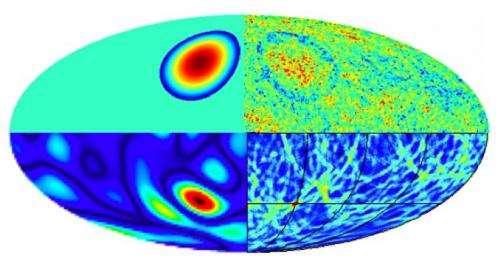
Concentric circles interpreted as bruises from collisions with alternate universes. Credit: Feeney et al.

At the end of last year, there was a flurry of activity from astronomers Gurzadyan and Penrose that considered the evidence of alternate universes or the existence of a universe prior to the Big Bang and suggested that such evidence may be imprinted on the cosmic microwave background as bruises of concentric circles. Quickly, this was followed by an announcement claiming to find just such circles. Of course, with an announcement this big, the statistical significance would need to be confirmed. A recent paper in the October issue of the Astrophysical Journal provides a second opinion.

The review was conducted by Amir Hajian at the Canadian Institute for Theoretical Astrophysics. To conduct the study, Hajian selected a large number of circles, similar to the ones reported in the previous studies and asked what the was that, randomly, the “edge” of the circles would contain hot-spots, similar to the ones predicted. These were then compared to the bruises reported by the other teams by examining their “variance” which is how much the points on the perimeter were spread around the average temperature.

Hajian notes that, with the resolution considered it would be possible to consider some 5 million circles. The results of his comparison demonstrated that it would be expected that some 0.3% of those should have features similar to the ones reported previously. With so many possibilities, this would imply that some 15,000 potential circles could be flagged as candidates for these cosmic bruises. Even the “best” candidate proposed in the Gurzadyan and Penrose study should still exist statistically.

As such, Hajian concludes that the features Gurzadyan and Penrose reported were not statistically anomalous. Hajian does not comment directly on Feeney et al.’s detection, but given theirs were constructed in a similar manner, it should be expected that they are similarly statistically insignificant. It would appear that if the fingerprints of other universes are embedded in the sky, they have been lost in the noise.

Explore further: Three centaurs follow Uranus through the solar system

add to favorites email to friend print save as pdf

Related Stories

Scientists glimpse universe before the Big Bang

Nov 23, 2010

(PhysOrg.com) -- In general, asking what happened before the Big Bang is not really considered a science question. According to Big Bang theory, time did not even exist before this point roughly 13.7 billion ...

Cosmic thread that binds us revealed

Sep 29, 2011

(PhysOrg.com) -- Astronomers at The Australian National University have found evidence for the textile that forms the fabric of the Universe.

Seeing isn't believing

Sep 07, 2011

Pay attention! It's a universal warning, which implies that keeping close watch helps us perceive the world more accurately. But a new study by Yale University cognitive psychologists Brandon Liverence and Brian Scholl finds ...

First observational test of the 'multiverse'

Aug 03, 2011

The theory that our universe is contained inside a bubble, and that multiple alternative universes exist inside their own bubbles – making up the 'multiverse' – is, for the first time, being tested by physicists.

Recommended for you

Three centaurs follow Uranus through the solar system

Jun 18, 2013

Astrophysicists from the Complutense University of Madrid have confirmed that Crantor, a large asteroid with a diameter of 70 km has an orbit similar to that of Uranus and takes the same amount of time to ...

Final curtain for Europe's deep-space telescope

Jun 17, 2013

The deep-space telescope Herschel took its final bow on Monday, climaxing a successful four-year mission to observe the birth of stars and galaxies, the European Space Agency (ESA) said.

Hubble spots a very bright contortionist

Jun 17, 2013

(Phys.org) —The contorted object captured by Hubble in this picture is IRAS 22491-1808, also known as the South America Galaxy. It is an ultra-luminous infrared galaxy (ULIRG) that emits a huge amount of ...

Study explains decades of black hole observations

Jun 14, 2013

(Phys.org) —A new study by astronomers at NASA, Johns Hopkins University and Rochester Institute of Technology confirms long-held suspicions about how stellar-mass black holes produce their highest-energy ...

User comments : 2

Adjust slider to filter visible comments by rank

Display comments: newest first

hard2grep
5 / 5 (3) Oct 10, 2011
considering most large objects in the universe are round who would suspect.
Pyle
5 / 5 (1) Oct 10, 2011
The concentric equilateral triangles was still the best: http://arxiv.org/...05v3.pdf

Perhaps other universes are cone shaped instead?

Funny that this article is out here again. I guess you get a second round of attention when a peer-reviewed journal publishes your work. Seemed more relevant a couple days after G and P's paper. (draft released December 9, 2010 http://arxiv.org/...6v1.pdf)
also for reference:
http://www.physor...big.html
http://www.physor...ses.html

More news stories

Metamorphosis of moon's water ice explained

Using data gathered by NASA's Lunar Reconnaissance Orbiter (LRO) mission, scientists believe they have solved a mystery from one of the solar system's coldest regions—a permanently shadowed crater on the ...

US doctors' group labels obesity a disease

(HealthDay)—In an effort to focus greater attention on the weight-gain epidemic plaguing the United States, the American Medical Association has now classified obesity as a disease.