Protein involved in disease progression reveals insights for intervention
September 7, 2011

Protein involved in disease progression reveals insights for intervention

Enlarge

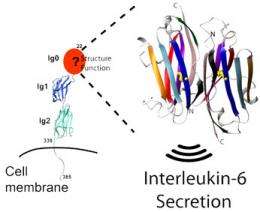
The first X-ray crystal structure of the human CD147 Ig0 domain reveals a dimer that was shown to persist in solution. The CD147 Ig0 dimer was also found to be a potent stimulator of IL-6 secretion.

A team of scientists from the University of Colorado and EMSL has characterized the biology of CD147, a type I transmembrane protein involved in the progression of inflammatory diseases, infections, and cancer—especially the cancer that develops in the cells of the retina, retinoblastoma. Using several methods including EMSL’s high-field nuclear magnetic resonance (NMR), the researchers also identified how the protein’s activity can be disrupted to reveal targets for therapeutic intervention.

The two previously identified isoforms of CD147 (also known as extracellular matrix metalloproteinase inducer or EMMPRIN) that are related to progression differ in their number of immunoglobulin (Ig)-like domains. CD147 Ig1-Ig2 is expressed in most tissues. CD147 Ig0-Ig1-Ig2 is retinal-specific and implicated in retinoblastoma. Until now, little has been known about the retinal-specific CD147 Ig0 domain. The researchers used x-ray crystallography to reveal, for the first time, the three-dimensional structure of the CD147 Ig0 domain and characterized its behavior in solution using several biophysical methods including NMR. They used these data together with mutagenesis to probe the biological activity of CD147 isoforms both with and without the CD147 Ig0 domain within multiple model cell lines.

The team’s findings revealed that the CD147 Ig0 domain is a potent stimulator of interleukin-6, a well-known contributor to retinoblastoma, and suggest that the CD147 Ig0 domain has its own receptor distinct from that of the other CD147 Ig-like domains. The researchers also showed that the CD147 Ig0 dimer is the functional unit required for activity because a single-point mutation that stopped dimer formation resulted in markedly reduced biological activity. These findings provide significant new insights that are critical for understanding the progression of many diseases and their potential intervention.

More information: JS Redzic, GS Armstrong, NG Isern, DNM Jones, JS Kieft, and EZ Eisenmesser. 2011. "The Retinal Specific CD147 Ig0 Domain: From Molecular Structure to Biological Activity." Journal of Molecular Biology 411:68-82.

Provided by Environmental Molecular Sciences Laboratory search and more info website


Rank not rated yet
Relevant PhysicsForums posts

More news stories

Manufacturing genes to attack flu virus

An international research team has manufactured a new protein that can combat deadly flu epidemics.

Biology / Biotechnology

created 2 hours ago | popularity not rated yet | comments 0 | with audio podcast

Scientist: Evolution debate will soon be history

(AP) -- Richard Leakey predicts skepticism over evolution will soon be history. Not that the avowed atheist has any doubts himself.

Biology / Evolution

created 20 hours ago | popularity 3.4 / 5 (19) | comments 78

More plant species responding to global warming than previously thought

(Phys.org) -- Far more wild plant species may be responding to global warming than previous large-scale estimates have suggested.

Biology / Ecology

created May 22, 2012 | popularity 4.6 / 5 (14) | comments 18 | with audio podcast

Thousands of shellfish found dead in Peru

Thousands of crustaceans were found dead off the coast of Lima following the mystery mass death of dolphins and pelicans, the Peruvian Navy said Friday.

Biology / Ecology

created May 26, 2012 | popularity 4.8 / 5 (5) | comments 7

For monogamous sparrows, it doesn't pay to stray (but they do it anyway)

It's quite common for a female song sparrow to stray from her breeding partner and mate with the male next door, but a new study shows that sleeping around can be costly.

Biology / Plants & Animals

created May 22, 2012 | popularity 5 / 5 (2) | comments 8 | with audio podcast


Land and sea species differ in climate change response: study

(Phys.org) -- Marine and terrestrial species will likely differ in their responses to climate warming, new research by Simon Fraser University and Australia’s University of Tasmania has found.

Almost half of new vets seek disability

(AP) -- America's newest veterans are filing for disability benefits at a historic rate, claiming to be the most medically and mentally troubled generation of former troops the nation has ever seen.

'Unzipped' carbon nanotubes could help energize fuel cells, batteries

Multi-walled carbon nanotubes riddled with defects and impurities on the outside could replace some of the expensive platinum catalysts used in fuel cells and metal-air batteries, according to scientists at ...

T cells 'hunt' parasites like animal predators seek prey, study shows

By pairing an intimate knowledge of immune-system function with a deep understanding of statistical physics, a cross-disciplinary team at the University of Pennsylvania has arrived at a surprising finding: T cells use a movement ...

Computer model used to pinpoint prime materials for efficient carbon capture

When power plants begin capturing their carbon emissions to reduce greenhouse gases – and to most in the electric power industry, it's a question of when, not if – it will be an expensive undertaking.

Change in developmental timing was crucial in the evolutionary shift from dinosaurs to birds: study

At first glance, it's hard to see how a common house sparrow and a Tyrannosaurus Rex might have anything in common. After all, one is a bird that weighs less than an ounce, and the other is a dinosaur that ...