Louisiana Tech University researchers, NASA partner to conduct zero-gravity experiments
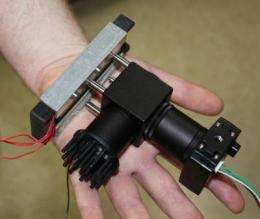
This is a DNA analyzer developed at Louisiana Tech University. Credit: Louisiana Tech University
Researchers from Louisiana Tech University will be floating high above the Gulf of Mexico this month to conduct zero-gravity testing of an experimental DNA analysis instrument developed at Tech that could benefit future NASA astronauts.
Dr. Niel Crews, assistant professor of mechanical engineering, and Collin Tranter, a graduate student with Louisiana Tech's Institute for Micromanufacturing (IfM) say the instrument could be used to monitor the health of astronauts exposed to cosmic radiation beyond Earth's protective atmosphere.
"Our goal is to understand how the system behaves under conditions similar to actual deployment in space missions," said Crews. The Louisiana Tech-developed devices are beneficial to NASA because they are small, consume less power and require little to no human operation.
The Louisiana Tech researchers will subject themselves to extreme conditions in order to conduct sensitive testing of the miniature device. NASA has used these same flights to train their astronauts.
The instrument attracted the attention of NASA scientists for possible use on the International Space Station, during inter-planetary travel and even for unmanned missions to search for life within the Solar System.
"We hope that by working with NASA, one of our DNA analysis devices will be sent into orbit to study the effects of space environments on living things, first studying DNA then cells," said Tranter. "Some further testing has to occur first, such as making sure the device works properly in low-gravity conditions. This will be done on a parabolic aircraft flight hopefully before the end of the year."
The tests will take place on a NASA airplane operating out of Ellington Field at Johnson Space Center in Houston. The flight pattern will consist of forty steep dives and climbs over the Gulf of Mexico. A controlled dive of nearly 10,000 feet in less than one minute will result in approximately 20 seconds of weightlessness for the researchers and the payload onboard. An abrupt climb back to the starting altitude will create a gravitational force twice the normal amount.
Even Hollywood has gotten into the act, using these flights to depict weightlessness on the silver screen. All of the zero-gravity scenes in the movie Apollo 13 were filmed during these flights. The alternation between zero gravity and 2G forces can so disorienting that NASA astronauts call the aircraft the "vomit comet."
NASA recently selected this system for a week-long series of flights as part of their Facilitated Access to the Space Environment for Technology (FAST) program, which focuses on expanding new technologies to be used in space flight applications.
Tranter is pursuing a Ph.D. in Nanosystems Engineering at Louisiana Tech and will continue to work with Crews on the project. He says they hope to learn very soon if their device can stand up to space environments.
"Low gravity can cause all kinds of unpredictable problems," Tranter said. "Eventually, I hope our system can reveal more about space radiation effects on DNA and cells, leading to options for safe space travel and exploration by humans. Our lab has studied some effects of radiation on DNA, such as UV exposure, but nothing on Earth compares to the environments we hope to study outside of the Earth's atmosphere."
Provided by Louisiana Tech University
-
From lemons to lemonade: Reaction uses carbon dioxide to make carbon-based semiconductor,
32 comments
-
Thioridazine kills cancer stem cells in human while avoiding toxic side-effects of conventional cancer treatments,
3 comments
-
SpaceX private rocket blasts off for space station (Update),
42 comments
-
Climate scientists say they have solved riddle of rising sea,
31 comments
-
SpaceX capsule has 'new car' smell, astronauts say (Update),
4 comments
-
Distance of planets from stars and revolution
3 hours ago
-
revamping general concept and cosmological principle
May 25, 2012
-
Transiting Exoplanet Light Curve
May 25, 2012
-
Math behind Theoretical Physics
May 24, 2012
-
Do we know whats at the center of galaxies yet?
May 23, 2012
-
Structure of the Milky Way?
May 20, 2012
- More from Physics Forums - General Astronomy
More news stories
Land and sea species differ in climate change response: study
(Phys.org) -- Marine and terrestrial species will likely differ in their responses to climate warming, new research by Simon Fraser University and Australia’s University of Tasmania has found.
1 hour ago |
not rated yet |
1
|
Yale study concludes public apathy over climate change unrelated to science literacy
Are members of the public divided about climate change because they don't understand the science behind it? If Americans knew more basic science and were more proficient in technical reasoning, would public consensus match ...
3 hours ago |
4 / 5 (1) |
10
|
10 million years needed to recover from mass extinction
It took some 10 million years for Earth to recover from the greatest mass extinction of all time, latest research has revealed.
Space & Earth / Earth Sciences
3 hours ago |
not rated yet |
1
|
Sophisticated simulations predict future warming
The chances of our planet being hit by a global warming of 3 degrees Celsius by 2050 is as likely as it being hit by an increase of 1.4 degrees, new research shows. Presented in the journal Nature Geoscience, the British study ...
Space & Earth / Earth Sciences
May 22, 2012 |
4.4 / 5 (9) |
51
Aliens don't want to eat us, says former SETI director
Alien life probably isnt interested in having us for dinner, enslaving us or laying eggs in our bellies, according to a recent statement by former SETI director Jill Tarter.
Space & Earth / Space Exploration
May 25, 2012 |
4.4 / 5 (14) |
39
'Unzipped' carbon nanotubes could help energize fuel cells, batteries
Multi-walled carbon nanotubes riddled with defects and impurities on the outside could replace some of the expensive platinum catalysts used in fuel cells and metal-air batteries, according to scientists at ...
T cells 'hunt' parasites like animal predators seek prey, study shows
By pairing an intimate knowledge of immune-system function with a deep understanding of statistical physics, a cross-disciplinary team at the University of Pennsylvania has arrived at a surprising finding: T cells use a movement ...
Computer model used to pinpoint prime materials for efficient carbon capture
When power plants begin capturing their carbon emissions to reduce greenhouse gases and to most in the electric power industry, it's a question of when, not if it will be an expensive undertaking.
Change in developmental timing was crucial in the evolutionary shift from dinosaurs to birds: study
At first glance, it's hard to see how a common house sparrow and a Tyrannosaurus Rex might have anything in common. After all, one is a bird that weighs less than an ounce, and the other is a dinosaur that ...
Almost half of new vets seek disability
(AP) -- America's newest veterans are filing for disability benefits at a historic rate, claiming to be the most medically and mentally troubled generation of former troops the nation has ever seen.
Nvidia trumpets Tegra 3 phone design wins for 2012
(Phys.org) -- Nvidias competitive war paint has a name, Tegra 3. On the heels of Nvidia announcements about lowering costs of its Tegra 3 processors and Nvidia-enabled tablets running Android Ice Cream ...