Earth to satellite: When will you hit -- and where?
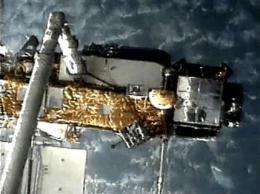
(AP) -- NASA scientists are doing their best to tell us where a plummeting six-ton satellite will fall later this week. It's just that if they're off a little bit, it could mean the difference between hitting Florida or landing on New York. Or, say, Iran or India.
Pinpointing where and when hurtling space debris will strike is an imprecise science. For now, scientists predict the earliest it will hit is Thursday U.S. time, the latest Saturday. The strike zone covers most of Earth.
Not that citizens need to take cover. The satellite will break into pieces, and scientists put the odds of it hitting someone at 1-in-3,200. As far as anyone knows, falling space debris has never injured anyone. Nor has significant property damage been reported. That's because most of the planet is covered in water and there are vast regions of empty land.
If you do come across what you suspect is a satellite piece, NASA doesn't want you to pick it up. The space agency says there are no toxic chemicals present, but there could be sharp edges. Also, it's government property. It's against the law to keep it as a souvenir or sell it on eBay. NASA's advice is to report it to the police.
The 20-year-old research satellite is expected to break into more than 100 pieces as it enters the atmosphere, most of it burning up. Twenty-six of the heaviest metal parts are expected to reach Earth, the biggest chunk weighing about 300 pounds. The debris could be scattered over an area about 500 miles long.
Jonathan McDowell, for one, isn't worried. He is in the potential strike zone - along with most of the world's 7 billion citizens. McDowell is with the Harvard-Smithsonian Center for Astrophysics in Cambridge, Mass.
"There's stuff that's heavy that falls out of the sky almost every year," McDowell says. So far this year, he noted, two massive Russian rocket stages have taken the plunge.
As for the odds of the satellite hitting someone, "it's a small chance. We take much bigger chances all the time in our lives," McDowell says. "So I'm not putting my tin helmet on or hiding under a rock."
All told, 1,200 pounds of wreckage is expected to smack down - the heaviest pieces made of titanium, stainless steel or beryllium. That represents just one-tenth the mass of the satellite, which stretches 35 feet long and 15 feet in diameter.
The strike zone straddles all points between latitudes 57 degrees north and 57 degrees south. That's as far north as Edmonton and Alberta, Canada, and Aberdeen, Scotland, and as far south as Cape Horn, the southernmost tip of South America. Every continent but Antarctica is in the crosshairs.
Back when UARS, the Upper Atmosphere Research Satellite, was launched to study the ozone layer in 1991, NASA didn't always pay attention to the "what goes up must come down" rule. Nowadays, satellites must be designed either to burn up on re-entering the atmosphere or to have enough fuel to be steered into a watery grave or up into a higher, long-term orbit.
The International Space Station - the largest manmade structure ever to orbit the planet - is no exception. NASA has a plan to bring it down safely sometime after 2020.
Russia's old Mir station came down over the Pacific, in a controlled re-entry, in 2001. But one of its predecessors, Salyut 7, fell uncontrolled through the atmosphere in 1991. The most recent uncontrolled return of a large NASA satellite was in 2002.
The most sensational case of all was Skylab, the early U.S. space station whose impending demise three decades ago alarmed people around the world and touched off a guessing game as to where it might land. It plummeted harmlessly into the Indian Ocean and onto remote parts of Australia in July 1979.
The $740 million UARS was decommissioned in 2005, after NASA lowered its orbit with the little remaining fuel on board. NASA didn't want to keep it up longer than necessary, for fear of a collision or an exploding fuel tank, either of which would have left a lot of space litter.
Predicting where the satellite will strike is a little like predicting the weather several days out, says NASA orbital debris scientist Mark Matney.
Experts expect to have a good idea by Thursday of when and where UARS might fall, Matney says. They won't be able to pinpoint the exact time, but they should be able to narrow it to a few hours.
Given the spacecraft's orbital speed of 17,500 mph, or 5 miles per second, a prediction that is off by just a few minutes could mean a 1,000-mile error. It probably won't be clear where it fell until afterward, Matney says.
If it happens in darkness, it should be visible.
"If someone is lucky enough to be near the re-entry at nighttime, they'll get quite a show," says Matney, who works at Johnson Space Center in Houston, also in the potential strike zone.
Space junk in general is on the rise, much of it destroyed or broken satellites and chunks of used rockets. More than 20,000 manmade objects at least 4 inches in diameter are being tracked in orbit.
It's mostly a threat to astronauts in space, rather than people on Earth. In June, the six residents of the International Space Station took shelter in their docked Soyuz lifeboats because of passing debris. The unidentified object came within 1,100 feet of the complex, the closest call yet.
More information: NASA: http://www.nasa.gov/mission-pages/uars/index.html
©2011 The Associated Press. All rights reserved. This material may not be published, broadcast, rewritten or redistributed.


