NASA satellite to crash into Earth Friday
September 23, 2011 by Kerry Sheridan
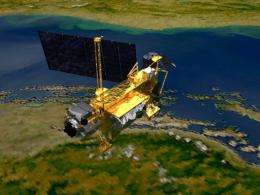
An image provided by NASA shows an illustration of the Upper Atmosphere Research Satellite (UARS), which was launched in 1991. Fragments from the six-ton NASA satellite are hurtling towards Earth, while the exact site of the crash-landing remain a mystery into the final hours.
A six-ton satellite hurtled toward Earth on Friday, and NASA admitted it had little idea where the biggest piece of US space junk in 30 years will crash into the planet.
Parts that survive the fiery re-entry into Earth's atmosphere may weigh as little as two pounds (one kilogram) or as much as 350 pounds (158 kilograms), NASA said, and the debris field is expected to span 500 miles (800 kilometers).
NASA stressed that the risk is "extremely small" that any of the 26 fragments expected to survive re-entry would hit any of the planet's seven billion people.
"The chances that you (yes, I mean YOU) will be hit by a piece of the #UARS satellite today are one in several trillion. Very unlikely," NASA said in a message on the microblogging site Twitter.
The satellite is expected to re-enter Earth's atmosphere "sometime during the afternoon or early evening of Sept. 23, Eastern Daylight Time," NASA said in its most recent update.
"It is still too early to predict the time and location of re-entry with any more certainty, but predictions will become more refined in the next 24 hours."
The Upper Atmosphere Research Satellite (UARS) was not expected to fall over North America, NASA added. And given that the world is 70 percent water, an ocean landing was considered likely.
Orbital debris scientists say the pieces will fall somewhere between 57 north latitude and 57 south latitude, which covers most of the populated world.
The influence of solar flares and the tumbling motion of the satellite make it difficult to narrow down the location, experts said, as the Internet lit up with rumors of where and when it would fall.
The US Department of Defense and NASA were busy tracking the debris and keeping all federal disaster agencies informed, a NASA spokeswoman said.
The Federal Aviation Administration issued a notice Thursday to pilots and flight crews of the potential hazard, and urged them to report any falling space debris and take note of its position and time.
Orbital debris experts say space junk of this size from broken-down satellites and spent rockets tends to fall back to Earth about once a year, though this is the biggest NASA satellite to fall in three decades.
NASA's Skylab crashed into western Australia in 1979.
The surviving chunks of the tour-bus sized UARS, which launched in 1991, will likely include titanium fuel tanks, beryllium housing and stainless steel batteries and wheel rims.
NASA has also said that in 50 years of space exploration no one has ever been confirmed injured by falling space junk.
"No consideration ever was given to shooting it down," NASA spokeswoman Beth Dickey said.
The craft contains no fuel and so is not expected to explode on impact, and NASA also said on Twitter that talk of "flaming space debris" is a "myth."
"Pieces of UARS landing on Earth will not be very hot. Heating stops 20 miles up, cools after that," NASA said.
However the US space agency has warned anyone who comes across what they believe may be UARS debris not to touch it but to contact authorities for assistance.
Space law professor Frans von der Dunk from the University of Nebraska-Lincoln told AFP that the United States will likely have to pay damages to any country where the debris falls.
"The damage to be compensated is essentially without limit," von der Dunk said, referring to the 1972 Liability Convention to which the United States is one of 80 state signatories.
"Damage here concerns 'loss of life, personal injury or other impairment of health; or loss of or damage to property of States or of persons, natural or juridical, or property of international intergovernmental organizations,'" he said, reading from the agreement.
(c) 2011 AFP
-
From lemons to lemonade: Reaction uses carbon dioxide to make carbon-based semiconductor,
32 comments
-
Thioridazine kills cancer stem cells in human while avoiding toxic side-effects of conventional cancer treatments,
3 comments
-
SpaceX private rocket blasts off for space station (Update),
42 comments
-
Climate scientists say they have solved riddle of rising sea,
31 comments
-
SpaceX capsule has 'new car' smell, astronauts say (Update),
2 comments
-
revamping general concept and cosmological principle
May 25, 2012
-
Transiting Exoplanet Light Curve
May 25, 2012
-
Math behind Theoretical Physics
May 24, 2012
-
Do we know whats at the center of galaxies yet?
May 23, 2012
-
Structure of the Milky Way?
May 20, 2012
-
What would it take to terraform Pluto and Charon?
May 19, 2012
- More from Physics Forums - General Astronomy
More news stories
Sophisticated simulations predict future warming
The chances of our planet being hit by a global warming of 3 degrees Celsius by 2050 is as likely as it being hit by an increase of 1.4 degrees, new research shows. Presented in the journal Nature Geoscience, the British study ...
Space & Earth / Earth Sciences
May 22, 2012 |
4.4 / 5 (9) |
51
Kyoto Protocol architect 'frustrated' by climate dialogue
UN climate talks are going nowhere, as politicians dither or bicker while the pace of warming dangerously speeds up, one of the architects of the Kyoto Protocol told AFP.
May 23, 2012 |
3.7 / 5 (7) |
39
Aliens don't want to eat us, says former SETI director
Alien life probably isnt interested in having us for dinner, enslaving us or laying eggs in our bellies, according to a recent statement by former SETI director Jill Tarter.
Space & Earth / Space Exploration
May 25, 2012 |
4.4 / 5 (13) |
37
Dragon arrives at space station in historic 1st (Update 2)
The privately bankrolled Dragon capsule made a historic arrival at the International Space Station on Friday, triumphantly captured by astronauts wielding a giant robot arm.
Space & Earth / Space Exploration
May 25, 2012 |
5 / 5 (10) |
19
What's the big deal about private space launches?
(AP) -- The first private spaceship is headed to the International Space Station. Some questions and answers about the cargo mission by Space Exploration Technologies, known as SpaceX:
Space & Earth / Space Exploration
May 22, 2012 |
5 / 5 (6) |
32
Nvidia trumpets Tegra 3 phone design wins for 2012
(Phys.org) -- Nvidias competitive war paint has a name, Tegra 3. On the heels of Nvidia announcements about lowering costs of its Tegra 3 processors and Nvidia-enabled tablets running Android Ice Cream ...
Browser wars flare in mobile space
The browser wars are heating up again, but this time the fight is for dominance of the mobile Internet.
Scientist: Evolution debate will soon be history
(AP) -- Richard Leakey predicts skepticism over evolution will soon be history. Not that the avowed atheist has any doubts himself.
Dell tablet leak: 10.1-inch display, two-battery choice
(Phys.org) -- Headline after headline talks about vendors tablets in the wings as likely number-one contenders for the iPad. Such claims have justifiably been taken with a grain of salt, considering ...
Keep food safety in mind this memorial day weekend
(HealthDay) -- Picnics, parades and cookouts are as much a part of Memorial Day weekend as tributes to the United States' war veterans.
Social welfare cuts ultimately come with heavy price, researchers say
(Phys.org) -- Slashing government funding for Medicaid, food stamps and other programs that serve the poor while politically popular with some lawmakers and many conservatives may do more harm ...