Bats adjust their 'field-of-view'
September 13, 2011

bat

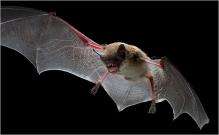
A new study reveals that the way fruit bats use biosonar to 'see' their surroundings is significantly more advanced than first thought. The study, published September 13 in the online, open access journal PLoS Biology, examines Egyptian fruit bats (Rousettus aegyptiacus), which use echolocation to orient inside their caves and to find fruit hidden in the branches of trees. Their high-frequency clicks form a sonar beam that spreads across a fan-shaped area, and the returning echoes allow them to locate and identify objects in that region. As these bats were considered to have little control over their vocalizations, scientists have puzzled over how they are able to navigate through complex environments.

The research team, led by Nachum Ulanovsky of the Weizmann Institute in Israel and Cynthia Moss of the University of Maryland, reports that these bats adapt to environmental complexity using two tactics. First, they alter the width of their sonar beam, similar to the way humans can adjust their spotlight of attention in order to spot, for example, a friend in a crowded room. Second, they modify the intensity of their emissions. "The work presented here reveals a new parameter under adaptive control in bat echolocation", says Ulanovsky.

Ulanovsky and his team trained five Egyptian fruit bats to locate and land on a mango-sized plastic sphere placed in various locations in a large, dark room equipped with an array of 20 microphones that recorded vocalizations. In one set of experiments, the researchers simulated an obstacle-filled forest by surrounding the sphere with two nets spread between four poles. To reach the , the bats flew through a narrow corridor whose width and orientation varied from trial to trial.

In the obstacle-filled environment, the bats covered three times as much area with each pair of clicks as they did when the obstacles weren't there. The angle separating each two beams was also wider and the volume of the clicks louder, and these differences became more pronounced as they drew further into the corridor and therefore closer to their obstacles. This larger 'field of view' allowed the bats to track the sphere and the poles simultaneously, and avoid collisions while landing.

"This is the first report, in any sensory system, of an active increase in field-of-view in response to changes in environmental complexity," says Ulanovsky. Although these new findings may be unique to Egyptian because of their rapid tongue movements, Ulanovsky explains that their results "suggest that active sensing of space by animals can be much more sophisticated than previously thought – and they call for a re-examination of current theories of spatial orientation and perception."

More information: Yovel Y, Falk B, Moss CF, Ulanovsky N (2011) Active Control of Acoustic Field-of-View in a Biosonar System. PLoS Biol 9(9): e1001150. doi:10.1371/journal.pbio.1001150

Provided by Public Library of Science search and more info website


Rank 5 /5 (5 votes)
Relevant PhysicsForums posts

More news stories

Scientist: Evolution debate will soon be history

(AP) -- Richard Leakey predicts skepticism over evolution will soon be history. Not that the avowed atheist has any doubts himself.

Biology / Evolution

created 17 hours ago | popularity 3.3 / 5 (17) | comments 54

More plant species responding to global warming than previously thought

(Phys.org) -- Far more wild plant species may be responding to global warming than previous large-scale estimates have suggested.

Biology / Ecology

created May 22, 2012 | popularity 4.6 / 5 (14) | comments 18 | with audio podcast

Thousands of shellfish found dead in Peru

Thousands of crustaceans were found dead off the coast of Lima following the mystery mass death of dolphins and pelicans, the Peruvian Navy said Friday.

Biology / Ecology

created May 26, 2012 | popularity 4.8 / 5 (4) | comments 7

For monogamous sparrows, it doesn't pay to stray (but they do it anyway)

It's quite common for a female song sparrow to stray from her breeding partner and mate with the male next door, but a new study shows that sleeping around can be costly.

Biology / Plants & Animals

created May 22, 2012 | popularity 5 / 5 (2) | comments 7 | with audio podcast

Study uncovers secret to speedy burrowing by razor clams

(Phys.org) -- If you look at a razor burrowing clam sitting in a bucket, you’d never guess that it could burrow itself down into the soil, much less do it with any speed. Razor clams look like fat straws, ...

Biology / Plants & Animals

created May 25, 2012 | popularity 1 / 5 (1) | comments 3 | with audio podcast report


Browser wars flare in mobile space

The browser wars are heating up again, but this time the fight is for dominance of the mobile Internet.

Nvidia trumpets Tegra 3 phone design wins for 2012

(Phys.org) -- Nvidia’s competitive war paint has a name, Tegra 3. On the heels of Nvidia announcements about lowering costs of its Tegra 3 processors and Nvidia-enabled tablets running Android Ice Cream ...

Dell tablet leak: 10.1-inch display, two-battery choice

(Phys.org) -- Headline after headline talks about vendors’ tablets in the wings as likely number-one contenders for the iPad. Such claims have justifiably been taken with a grain of salt, considering ...

Keep food safety in mind this memorial day weekend

(HealthDay) -- Picnics, parades and cookouts are as much a part of Memorial Day weekend as tributes to the United States' war veterans.

Social welfare cuts ultimately come with heavy price, researchers say

(Phys.org) -- Slashing government funding for Medicaid, food stamps and other programs that serve the poor – while politically popular with some lawmakers and many conservatives – may do more harm ...

Is a classical electrodynamics law incompatible with special relativity?

(Phys.org) -- The laws of classical electromagnetism that were developed in the 19th century are the same laws that scientists use today. They include Maxwell’s four equations along with the Lorentz la ...