WWF calls for action to save Mekong dolphins
August 17, 2011

The Mekong River Irrawaddy dolphin has been listed as critically endangered since 2004

Enlarge

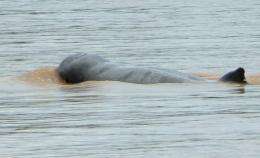
A dolphin in the Mekong river near the town of Kratie, northeast of Phnom Penh. Conservation group WWF called for urgent action to prevent the extinction of freshwater dolphins in the Mekong River, including the creation of special conservation zones.

Conservation group WWF on Wednesday called for urgent action to prevent the extinction of freshwater dolphins in the Mekong River, including the creation of special conservation zones.

Entanglement in , low calf and a steady degradation of the creature's habitat are threatening the estimated 85 Irrawaddy dolphins left in Cambodia and Laos, WWF said.

"Evidence is strong that very few young animals survive to adulthood, as older dolphins die off and are not replaced," Li Lifeng, director of WWF's freshwater programme, said in a statement.

"This tiny population is at high risk by its small size alone. With the added pressures of gill net entanglement and high calf mortality we are really worried for the future of dolphins."

The group urged the Cambodian government to consider a ban on gill nets.

But the Cambodian official tasked with caring for the country's Irrawaddy dolphins criticised the group's research methods and insisted there remained "about 155 to 175" of the animals in the Mekong.

"WWF does not do proper scientific research. I do not know what kind of methodology they are using," Touch Seang Tana, chairman of Cambodia's Commission to Conserve Mekong River Dolphins and Develop Eco-tourism, told AFP.

He added that according to his findings, dolphin numbers were slowly improving. "Last year, we had 12 newborns," he said.

The government and WWF clashed over the same issue in 2009, when WWF estimated there were just 64 to 76 Irrawaddy dolphins left in the river, partly because of pollution and illegal fishing methods.

The group said its current estimate of 85 dolphins was higher because of better monitoring techniques, not because the population had increased.

It also said more research was needed to explain the calf deaths.

"We're still unsure, however it may be related to such as contamination, or physiological issues in the small population. There is no evidence that low calf survival is due to fishing," Li told AFP.

The Irrawaddy dolphin, which inhabits a 190-kilometre (118-mile) stretch in Cambodia and Laos, has been listed as critically endangered since 2004, the WWF said.

Irrawaddy are also found in coastal areas in south and southeast Asia, in the Irrawaddy river in Myanmar and in the Mahakam river in Indonesia, it added.

In recent years, the Cambodian government has been promoting dolphin-watching to attract eco-tourism and has cracked down on the use of illegal nets.

(c) 2011 AFP

Filter


Move the slider to adjust rank threshold, so that you can hide some of the comments.


Display comments: newest first

Moebius
Aug 17, 2011

Rank: not rated yet
When are we going to start moving species like this somewhere they can establish themselves in safety. There must be places in the big old USA where species well worth saving, like this one, can survive. I would think that if they can survive in the Mekong they could survive in the Mississippi. The Cheetah is another that might find a place out west with a little help.
Jonseer
Aug 17, 2011

Rank: not rated yet
When are we going to start moving species like this somewhere safe, like the Mississippi

While I totally agree with your sentiment, because they live in tropical areas, the Mississippi itself is out of the question. The waters it drains from the Rocky Mtns and Upper Midwest ensure the river water is too cold even at its mouth.

The best place would be the Florida Peninsula - The Saint Johns River and the Everglades as well as a river or two in Texas within a couple hundred miles of the Gulf, and maybe the Savanna river in Georgia.

The swamps along the gulf coast might work too, because their waters are warmed substantially as it slowly moves towards the gulf.
Rank not rated yet
Relevant PhysicsForums posts

More news stories

Manufacturing genes to attack flu virus

An international research team has manufactured a new protein that can combat deadly flu epidemics.

Biology / Biotechnology

created 34 minutes ago | popularity not rated yet | comments 0 | with audio podcast

Scientist: Evolution debate will soon be history

(AP) -- Richard Leakey predicts skepticism over evolution will soon be history. Not that the avowed atheist has any doubts himself.

Biology / Evolution

created 19 hours ago | popularity 3.3 / 5 (18) | comments 69

More plant species responding to global warming than previously thought

(Phys.org) -- Far more wild plant species may be responding to global warming than previous large-scale estimates have suggested.

Biology / Ecology

created May 22, 2012 | popularity 4.6 / 5 (14) | comments 18 | with audio podcast

Thousands of shellfish found dead in Peru

Thousands of crustaceans were found dead off the coast of Lima following the mystery mass death of dolphins and pelicans, the Peruvian Navy said Friday.

Biology / Ecology

created May 26, 2012 | popularity 4.8 / 5 (4) | comments 7

For monogamous sparrows, it doesn't pay to stray (but they do it anyway)

It's quite common for a female song sparrow to stray from her breeding partner and mate with the male next door, but a new study shows that sleeping around can be costly.

Biology / Plants & Animals

created May 22, 2012 | popularity 5 / 5 (2) | comments 7 | with audio podcast


Change in developmental timing was crucial in the evolutionary shift from dinosaurs to birds: study

At first glance, it's hard to see how a common house sparrow and a Tyrannosaurus Rex might have anything in common. After all, one is a bird that weighs less than an ounce, and the other is a dinosaur that ...

Computer model used to pinpoint prime materials for efficient carbon capture

When power plants begin capturing their carbon emissions to reduce greenhouse gases – and to most in the electric power industry, it's a question of when, not if – it will be an expensive undertaking.

'Unzipped' carbon nanotubes could help energize fuel cells, batteries

Multi-walled carbon nanotubes riddled with defects and impurities on the outside could replace some of the expensive platinum catalysts used in fuel cells and metal-air batteries, according to scientists at ...

T cells 'hunt' parasites like animal predators seek prey, study shows

By pairing an intimate knowledge of immune-system function with a deep understanding of statistical physics, a cross-disciplinary team at the University of Pennsylvania has arrived at a surprising finding: T cells use a movement ...

Yale study concludes public apathy over climate change unrelated to science literacy

Are members of the public divided about climate change because they don't understand the science behind it? If Americans knew more basic science and were more proficient in technical reasoning, would public consensus match ...

Same gene that stunts infants' growth also makes them grow too big: research

UCLA geneticists have identified the mutation responsible for IMAGe* syndrome, a rare disorder that stunts infants' growth. The twist? The mutation occurs on the same gene that causes Beckwith-Wiedemann syndrome, which makes ...