VLT looks into the eyes of the virgin
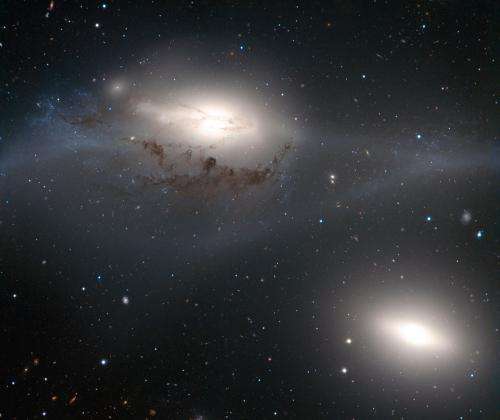
This striking image, taken with the FORS2 instrument on the Very Large Telescope, shows a beautiful yet peculiar pair of galaxies, NGC 4438 and NGC 4435, nicknamed The Eyes. The larger of these, at the top of the picture, NGC 4438, is thought to have once been a spiral galaxy that was strongly deformed by collisions in the relatively recent past. The two galaxies belong to the Virgo Cluster and are about 50 million light-years away. Credit: ESO/Gems project
(PhysOrg.com) -- ESO's Very Large Telescope has taken a striking image of a beautiful yet peculiar pair of galaxies nicknamed The Eyes. The larger of these, NGC 4438, was once a spiral galaxy but has become badly deformed by collisions with other galaxies in the last few hundred million years. This picture is the first to come out of ESO's Cosmic Gems programme, an initiative in which ESO has granted dedicated observing time for outreach purposes.
The Eyes are about 50 million light-years away in the constellation of Virgo (The Virgin) and are some 100 000 light-years apart. The nickname comes from the apparent similarity between the cores of this pair of galaxies -- two white ovals that resemble a pair of eyes glowing in the dark when seen in a moderate-sized telescope.
But although the centres of these two galaxies look similar, their outskirts could not be more different. The galaxy in the lower right, known as NGC 4435, is compact and seems to be almost devoid of gas and dust. In contrast, in the large galaxy in the upper left (NGC 4438) a lane of obscuring dust is visible just below its nucleus, young stars can be seen left of its centre, and gas extends at least up to the edges of the image.
The contents of NGC 4438 have been stripped out by a violent process: a collision with another galaxy. This clash has distorted the galaxy's spiral shape, much as could happen to the Milky Way when it collides with its neighbouring galaxy Andromeda in three or four billion years.
NGC 4435 could be the culprit. Some astronomers believe that the damage caused to NGC 4438 resulted from an approach between the two galaxies to within about 16 000 light-years that happened some 100 million years ago. But while the larger galaxy was damaged, the smaller one was significantly more affected by the collision. Gravitational tides from this clash are probably responsible for ripping away the contents of NGC 4438, and for reducing NGC 4435's mass and removing most of its gas and dust.
Another possibility is that the giant elliptical galaxy Messier 86, further away from The Eyes and not visible in this image, was responsible for the damage caused to NGC 4438. Recent observations have found filaments of ionised hydrogen gas connecting the two large galaxies, indicating that they may have collided in the past.
The elliptical galaxy Messier 86 and The Eyes belong to the Virgo Cluster, a very rich grouping of galaxies. In such close quarters, galaxy collisions are fairly frequent, so perhaps NGC 4438 suffered from encounters with both NGC 4435 and Messier 86.
This picture is the first to be produced as part of the ESO Cosmic Gems programme. This is a new initiative to produce astronomical images for educational and public outreach purposes. The programme mainly makes use of time when the sky conditions are not suitable for science observations to take pictures of interesting, intriguing or visually attractive objects. The data are also made available to professional astronomers through ESO's science archive.
In this case, although there were some clouds, the atmosphere was exceptionally stable, which allowed very sharp details to be revealed in this image taken using the VLT's FORS2 instrument. Light passing through two different filters was used: red (coloured red) and green-yellow (coloured blue), and the exposure times were 1800 seconds and 1980 seconds, respectively.
Provided by
ESO
-
From lemons to lemonade: Reaction uses carbon dioxide to make carbon-based semiconductor,
32 comments
-
Thioridazine kills cancer stem cells in human while avoiding toxic side-effects of conventional cancer treatments,
3 comments
-
SpaceX private rocket blasts off for space station (Update),
42 comments
-
Climate scientists say they have solved riddle of rising sea,
31 comments
-
SpaceX capsule has 'new car' smell, astronauts say (Update),
2 comments
-
revamping general concept and cosmological principle
May 25, 2012
-
Transiting Exoplanet Light Curve
May 25, 2012
-
Math behind Theoretical Physics
May 24, 2012
-
Do we know whats at the center of galaxies yet?
May 23, 2012
-
Structure of the Milky Way?
May 20, 2012
-
What would it take to terraform Pluto and Charon?
May 19, 2012
- More from Physics Forums - General Astronomy
More news stories
Yale study concludes public apathy over climate change unrelated to science literacy
Are members of the public divided about climate change because they don't understand the science behind it? If Americans knew more basic science and were more proficient in technical reasoning, would public consensus match ...
32 minutes ago |
not rated yet |
2
|
10 million years needed to recover from mass extinction
It took some 10 million years for Earth to recover from the greatest mass extinction of all time, latest research has revealed.
Space & Earth / Earth Sciences
33 minutes ago |
not rated yet |
0
|
Sophisticated simulations predict future warming
The chances of our planet being hit by a global warming of 3 degrees Celsius by 2050 is as likely as it being hit by an increase of 1.4 degrees, new research shows. Presented in the journal Nature Geoscience, the British study ...
Space & Earth / Earth Sciences
May 22, 2012 |
4.4 / 5 (9) |
51
Aliens don't want to eat us, says former SETI director
Alien life probably isnt interested in having us for dinner, enslaving us or laying eggs in our bellies, according to a recent statement by former SETI director Jill Tarter.
Space & Earth / Space Exploration
May 25, 2012 |
4.4 / 5 (13) |
39
Kyoto Protocol architect 'frustrated' by climate dialogue
UN climate talks are going nowhere, as politicians dither or bicker while the pace of warming dangerously speeds up, one of the architects of the Kyoto Protocol told AFP.
May 23, 2012 |
3.7 / 5 (7) |
39
Change in developmental timing was crucial in the evolutionary shift from dinosaurs to birds: study
At first glance, it's hard to see how a common house sparrow and a Tyrannosaurus Rex might have anything in common. After all, one is a bird that weighs less than an ounce, and the other is a dinosaur that ...
Computer model used to pinpoint prime materials for efficient carbon capture
When power plants begin capturing their carbon emissions to reduce greenhouse gases and to most in the electric power industry, it's a question of when, not if it will be an expensive undertaking.
'Unzipped' carbon nanotubes could help energize fuel cells, batteries
Multi-walled carbon nanotubes riddled with defects and impurities on the outside could replace some of the expensive platinum catalysts used in fuel cells and metal-air batteries, according to scientists at ...
T cells 'hunt' parasites like animal predators seek prey, study shows
By pairing an intimate knowledge of immune-system function with a deep understanding of statistical physics, a cross-disciplinary team at the University of Pennsylvania has arrived at a surprising finding: T cells use a movement ...
Manufacturing genes to attack flu virus
An international research team has manufactured a new protein that can combat deadly flu epidemics.
Same gene that stunts infants' growth also makes them grow too big: research
UCLA geneticists have identified the mutation responsible for IMAGe* syndrome, a rare disorder that stunts infants' growth. The twist? The mutation occurs on the same gene that causes Beckwith-Wiedemann syndrome, which makes ...
Aug 24, 2011
Rank: 5 / 5 (2)
And VLT likes what he sees
Aug 24, 2011
Rank: 5 / 5 (3)
A composite image of NGC 4438/M 86 with the hydrogen-alpha tail can be found here: http://www.noao.e.../M86.jpg
The paper's authors argue that the smaller galaxy NGC 4435 is unlikely to be involved as it displays no tidal distortions and has a much higher velocity than nearby NGC 4438.