The star that should not exist
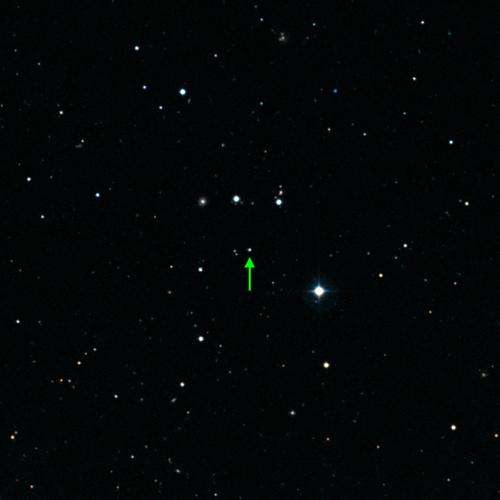
At the centre of this picture is a very unremarkable looking faint star, too faint to be seen through all but the largest amateur telescopes. This ancient star, in the constellation of Leo (The Lion), is called SDSS J102915+172927 and has been found to have the lowest amount of elements heavier than helium of all stars yet studied. It has a mass smaller than that of the Sun and is probably more than 13 billion years old. Credit: ESO/Digitized Sky Survey 2
(PhysOrg.com) -- A team of European astronomers has used ESOs Very Large Telescope (VLT) to track down a star in the Milky Way that many thought was impossible. They discovered that this star is composed almost entirely of hydrogen and helium, with only remarkably small amounts of other chemical elements in it. This intriguing composition places it in the "forbidden zone" of a widely accepted theory of star formation, meaning that it should never have come into existence in the first place. The results will appear in the 1 September 2011 issue of the journal Nature.
A faint star in the constellation of Leo (The Lion), called SDSS J102915+172927, has been found to have the lowest amount of elements heavier than helium (what astronomers call metals) of all stars yet studied. It has a mass smaller than that of the Sun and is probably more than 13 billion years old.
A widely accepted theory predicts that stars like this, with low mass and extremely low quantities of metals, shouldnt exist because the clouds of material from which they formed could never have condensed, said Elisabetta Caffau (Zentrum fur Astronomie der Universität Heidelberg, Germany and Observatoire de Paris, France), lead author of the paper. It was surprising to find, for the first time, a star in this forbidden zone, and it means we may have to revisit some of the star formation models.
The team analysed the properties of the star using the X-shooter and UVES instruments on the VLT. This allowed them to measure how abundant the various chemical elements were in the star. They found that the proportion of metals in SDSS J102915+172927 is more than 20 000 times smaller than that of the Sun.
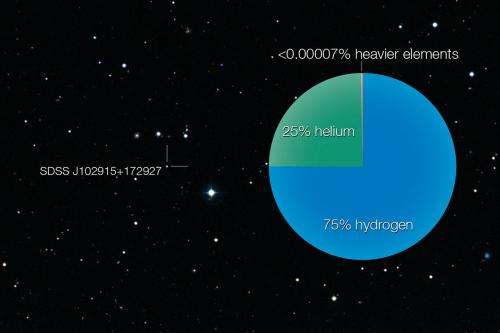
An ancient star in the constellation of Leo (The Lion), called SDSS J102915+172927, has been found to have the lowest amount of elements heavier than helium of all stars yet studied. The pie-chart shows the star’s composition: it is almost entirely made from hydrogen and helium with only a tiny trace of heavier elements. Credit: ESO/Digitized Sky Survey 2
The star is faint, and so metal-poor that we could only detect the signature of one element heavier than helium calcium in our first observations, said Piercarlo Bonifacio (Observatoire de Paris, France), who supervised the project. We had to ask for additional telescope time from ESOs Director General to study the stars light in even more detail, and with a long exposure time, to try to find other metals.Cosmologists believe that the lightest chemical elements hydrogen and helium were created shortly after the Big Bang, together with some lithium, while almost all other elements were formed later in stars. Supernova explosions spread the stellar material into the interstellar medium, making it richer in metals. New stars form from this enriched medium so they have higher amounts of metals in their composition than the older stars. Therefore, the proportion of metals in a star tells us how old it is.
The star we have studied is extremely metal-poor, meaning it is very primitive. It could be one of the oldest stars ever found, adds Lorenzo Monaco (ESO, Chile), also involved in the study.
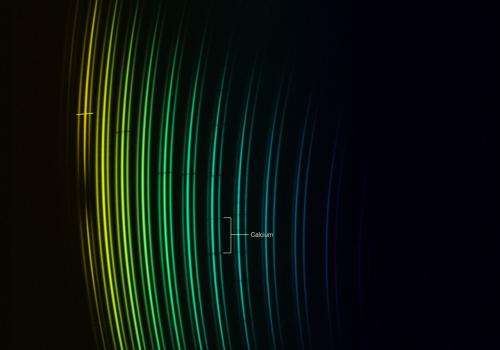
This picture shows the distribution of the light of different colours coming from the remarkable star SDSS J102915+172927 after it has been split up by the X-Shooter instrument on the ESO VLT. Different colours fall in different places in this strange picture and astronomers can use this data to find the chemical signals from different elements within the star, which show up as dark interruptions of the curved lines. The spectrum of the star appears to be triple at each wavelengths as it was split up using an integral field unit to collect as much light as possible. This ancient star has been found to have the lowest amount of elements heavier than helium of all stars yet studied. The only evidence of elements heavier than helium is two dark lines from the element calcium. Credit: ESO/E. Caffau
Also very surprising was the lack of lithium in SDSS J102915+172927. Such an old star should have a composition similar to that of the Universe shortly after the Big Bang, with a few more metals in it. But the team found that the proportion of lithium in the star was at least fifty times less than expected in the material produced by the Big Bang.It is a mystery how the lithium that formed just after the beginning of the Universe was destroyed in this star. Bonifacio added.
The researchers also point out that this freakish star is probably not unique. We have identified several more candidate stars that might have metal levels similar to, or even lower than, those in SDSS J102915+172927. We are now planning to observe them with the VLT to see if this is the case, concludes Caffau.
Provided by
ESO
-
From lemons to lemonade: Reaction uses carbon dioxide to make carbon-based semiconductor,
32 comments
-
Thioridazine kills cancer stem cells in human while avoiding toxic side-effects of conventional cancer treatments,
3 comments
-
SpaceX private rocket blasts off for space station (Update),
42 comments
-
Climate scientists say they have solved riddle of rising sea,
31 comments
-
SpaceX capsule has 'new car' smell, astronauts say (Update),
2 comments
-
revamping general concept and cosmological principle
May 25, 2012
-
Transiting Exoplanet Light Curve
May 25, 2012
-
Math behind Theoretical Physics
May 24, 2012
-
Do we know whats at the center of galaxies yet?
May 23, 2012
-
Structure of the Milky Way?
May 20, 2012
-
What would it take to terraform Pluto and Charon?
May 19, 2012
- More from Physics Forums - General Astronomy
More news stories
Yale study concludes public apathy over climate change unrelated to science literacy
Are members of the public divided about climate change because they don't understand the science behind it? If Americans knew more basic science and were more proficient in technical reasoning, would public consensus match ...
2 minutes ago |
not rated yet |
0
|
10 million years needed to recover from mass extinction
It took some 10 million years for Earth to recover from the greatest mass extinction of all time, latest research has revealed.
Space & Earth / Earth Sciences
3 minutes ago |
not rated yet |
0
|
Sophisticated simulations predict future warming
The chances of our planet being hit by a global warming of 3 degrees Celsius by 2050 is as likely as it being hit by an increase of 1.4 degrees, new research shows. Presented in the journal Nature Geoscience, the British study ...
Space & Earth / Earth Sciences
May 22, 2012 |
4.4 / 5 (9) |
51
Aliens don't want to eat us, says former SETI director
Alien life probably isnt interested in having us for dinner, enslaving us or laying eggs in our bellies, according to a recent statement by former SETI director Jill Tarter.
Space & Earth / Space Exploration
May 25, 2012 |
4.4 / 5 (13) |
39
Kyoto Protocol architect 'frustrated' by climate dialogue
UN climate talks are going nowhere, as politicians dither or bicker while the pace of warming dangerously speeds up, one of the architects of the Kyoto Protocol told AFP.
May 23, 2012 |
3.7 / 5 (7) |
39
Change in developmental timing was crucial in the evolutionary shift from dinosaurs to birds: study
At first glance, it's hard to see how a common house sparrow and a Tyrannosaurus Rex might have anything in common. After all, one is a bird that weighs less than an ounce, and the other is a dinosaur that ...
Computer model used to pinpoint prime materials for efficient carbon capture
When power plants begin capturing their carbon emissions to reduce greenhouse gases and to most in the electric power industry, it's a question of when, not if it will be an expensive undertaking.
'Unzipped' carbon nanotubes could help energize fuel cells, batteries
Multi-walled carbon nanotubes riddled with defects and impurities on the outside could replace some of the expensive platinum catalysts used in fuel cells and metal-air batteries, according to scientists at ...
T cells 'hunt' parasites like animal predators seek prey, study shows
By pairing an intimate knowledge of immune-system function with a deep understanding of statistical physics, a cross-disciplinary team at the University of Pennsylvania has arrived at a surprising finding: T cells use a movement ...
Manufacturing genes to attack flu virus
An international research team has manufactured a new protein that can combat deadly flu epidemics.
Same gene that stunts infants' growth also makes them grow too big: research
UCLA geneticists have identified the mutation responsible for IMAGe* syndrome, a rare disorder that stunts infants' growth. The twist? The mutation occurs on the same gene that causes Beckwith-Wiedemann syndrome, which makes ...


Aug 31, 2011
Rank: 2.8 / 5 (18)
Look, if you have any confidence in the big bang theory, then you have to assume that star formation came about originally in a metal poor environment and that contradicting star formation models are wrong. So there's you're f%^&ing answer, a metal poor star.
This should be of considerable interest, but I don't understand the confusion - you kind of have to logically expect it if you believe in all the standard theories.
Aug 31, 2011
Rank: 1.3 / 5 (37)
In fact Ive always wondered why, if we can see the big bang right now (or up to 300,000 years after the big bang) then we must be traveling away from that big bang at close to the speed of light otherwise the light would have caught up to us long ago and we would only see whatever is left where the initial big bang occurred and we would also see some weird ghost image of the stuff close to us that passed between us and the big bang while we were still traveling close to the speed of light away from the big bang.
I mean how is it possible that we can even see back that far and dont give me that speed of light bull because you know its a giant leap. Like they keep building bigger telescopes to see back further into the big bang well how can that light enter the receptor yet still be observable later?
Aug 31, 2011
Rank: 5 / 5 (13)
Aug 31, 2011
Rank: 1.6 / 5 (14)
It's like, "Really? You don't even understand the REAL fundamentals of these bodies, yet you are going to make the claim they shouldn't exist?"
Screw Science, lets just throw our hands up and say it all should not exist! That's much easier anyways, right? lol
Aug 31, 2011
Rank: 1.3 / 5 (15)
It's like, "Really? You don't even understand the REAL fundamentals of these bodies, yet you are going to make the claim they shouldn't exist?"
Screw Science, lets just throw our hands up and say it all should not exist! That's much easier anyways, right? lol
Aug 31, 2011
Rank: 4.5 / 5 (15)
We "see" the big bang in two ways: cosmic microwave background radiation and extremely distant stars, both of which only allow us to infer information about the bang. I don't think anyone will claim that we can literally see the big bang, nor will anyone go as far as to say the big bang is, without question, how the universe came into existence
Aug 31, 2011
Rank: 5 / 5 (7)
Puzzle solved :-)
Aug 31, 2011
Rank: 4 / 5 (21)
this is proof of neutron repulsion, electric universe, 6000 yr old earth, static universe,whatecer tuxfords idols model says....did i miss any?
Figured i'd save the cranks some time. lol
Aug 31, 2011
Rank: 5 / 5 (7)
3_______4_____7
2He plus 2He = 4Be plus (gamma)
7__________7
4Be plus e- = 3Li plus (neutrino)
Because Calcium has a atom number of 20 it is quite hard to find a equation that goes from Helium to Calcium before it would go to Lithium. It's pretty strange and I would love to read the article when it comes out. Pretty interesting results.
Aug 31, 2011
Rank: 5 / 5 (6)
I wouldn't dream of it. This line seriously made me laugh out loud.
Aug 31, 2011
Rank: 4.7 / 5 (3)
To start with, according to Einstein the universe is not 13.7 Gigayears old in absolute terms. It is 13.7 Gyr just in terms of time measured in our reference frame. An observer in a different reference frame may measure it as just 1 year old, even if he is passing near earth at this moment.
Secondly, when you say that we are travelling at "near speed of light from the big bang" you are not taking into account that the space itself is expanding,( as measured by the red shift ), which has moved as to a much bigger distance from "BB remmanents" than our relative speed from them. In that sense we are far from being accelerated to relativistic speeds.
Aug 31, 2011
Rank: 5 / 5 (3)
If the star really is that old - as it ought to be, given its mass - then it long predates the formation of the galaxy it's in. It's got to be a long, long way from the ancient star formation zone that gave it birth.
Was it a migrant, ejected from a long-ago galaxy and wandering the void, eventually scooped up by the Milky Way and sent into a regularized orbit?
Could it have brought planets with it on its voyage? Or accumulated some on the way?
In any event, I tend to agree with That Guy's point, if not his annoyed tone. If the star was formed 13 billion years ago, as this one appears to have done, then we shouldn't expect much metallic content. And we should expect that there is a star-formation route in that early hydrogen-helium-lithium environment. Since a method of formation in that environment isn't covered in the current theory of star formation, current theory needs work.
The low lithium level sure is perplexing.
Aug 31, 2011
Rank: 4.5 / 5 (2)
I was under the understanding that the very first stars that should have burned out by now - actaully would look like the one in the article --- right -- H and He in a big ole cloud would condense due to gravity and form a star due to pressure and fusion and all... if that is incorrect -- and heavy elements are still only created by supernova -- then how did any star form period ---
or did i miss something -- I often do
Aug 31, 2011
Rank: 5 / 5 (1)
Aug 31, 2011
Rank: 5 / 5 (3)
we don't even know what's on the bottom of the ocean, and just because we have telescopes doesn't mean we don't know more about what there is to know about the bottom of the ocean, than we know about all there is to know about the universe.....and we know prescious little about the bottom of the ocean.
just because more people might be cosmologists, and we might have more textbooks about the universe and the research on it, doesn't mean the universe isn't still, the biggest mystery still out there. !
Aug 31, 2011
Rank: 1.8 / 5 (17)
Aug 31, 2011
Rank: 4.2 / 5 (5)
The biggest surprise was that a population III (ie, the first gen) star could still be around. Most are hypothesized to be giants of several hundred solar masses which would burn through their fuel in much less than a billion years and then explode to seed the next gen of stars, but the article didn't mention the star's mass. The other surprise is the dearth of lithium in the star's spectra.
Aug 31, 2011
Rank: 1.5 / 5 (17)
2. Helium is element #2, the next lightest element.
3. Several studies show that stars sort elements by mass, and the degree of mass fractionation changes over time [1-4].
Therefore, this report is questionable.
1. "Mass-Fractionated Isotopes of Kr and Xe in Solar Wind" (1972)
www.omatumr.com/D...ata1.htm
2. "Trans-iron elements in SEP events", APJ 540, L111L114 (2000)
http://epact2.gsf...0HiZ.pdf
3. "Solar abundance of elements from neutron-capture
cross sections", 36th LPSC, 1033 (2005)
www.lpi.usra.edu/...1033.pdf
4. "The Sun is a plasma diffuser that sorts atoms by mass"
Physics of Atomic Nuclei 69, 1847-1856 (2006)
http://arxiv.org/.../0609509
Oliver K. Manuel
Aug 31, 2011
Rank: 4.3 / 5 (6)
That comment is hard to follow, but we probably do know more about the cosmos than the bottom of our oceans. That's because the cosmos is more observationally accessible and the cosmological principle greatly simplifies the physical variations (unlike the hard to access micro and macro environments of the deep ocean).
The origin of the universe and the nature of reality (quantum mechanics) certainly are the biggest mysteries one can think of.
Sep 01, 2011
Rank: 2.3 / 5 (3)
Sep 01, 2011
Rank: 5 / 5 (1)
I wonder if it could have planets, wouldn't that be a gas. So to speak:)
Sep 01, 2011
Rank: 1.7 / 5 (3)
Sep 01, 2011
Rank: 1 / 5 (2)
We *do* see whatever is left, which is the cosmic microwave background radiation that pervades the sky.
Not all of the available radiation enters the receptor at once. More of it can be seen, later.
Sep 01, 2011
Rank: 1 / 5 (16)
Sep 01, 2011
Rank: 1 / 5 (14)
Sep 01, 2011
Rank: 1 / 5 (15)
Sep 01, 2011
Rank: 1 / 5 (15)
That Because they have Faith And not Logical order..It may not be fun..or exciting, but it works.. Logical displacement is key..Energy always displaces other energy in consintrated form..They know to much about physical science and not logic...Plus it's a human thing..everyone wonts to act like its so fun and exciteing...They wouldn't know what to do with them selves with out happy people around them..sad but true..They all will lie, cheat, or steal in order to retain there sence of reality..This come from scientist around the world...It's a truth we all live with. you'll find this in your family, at your work, in your socail group..
Sep 01, 2011
Rank: 5 / 5 (3)
Because space expands. Think expansions like a man running away from a stationary source of sound. If he runs fast enough then the sound will reach him at a much later time than if he had stood still. This is why we can still see the remnants from the big bang from all over the place.
(At this point the analogy breaks down because since space expands every point once coincided with the place of the big bang and therefore we do not se the remnants of that event coming from one direction but from all directions)
Right under the image it says:
"It has a mass smaller than that of the Sun"
Sep 01, 2011
Rank: 5 / 5 (1)
"A widely accepted theory predicts that stars like this, with low mass and extremely low quantities of metals, shouldnt exist because the clouds of material from which they formed could never have condensed"
Some thoughts about how such clouds could have condensed:
Any passing gravitatinoal influence (a galaxy, a black hole or merely a big, wandering star) could create enough of a disturbance in the gas cloud to create regions of high enoug denisty to start collapsing.
Doesn't explain the missing lithium, though. That's a bit of a doozy.
Sep 01, 2011
Rank: 4.2 / 5 (5)
Sep 01, 2011
Rank: 4.5 / 5 (8)
Bet it is a LOT less. It has to be a Red Dwarf to still exist.
That is based on its low metal content.
That and it has calcium instead.
Several people here think this somehow makes the BB go away. To the contrary I don't see how such a star could exist in an infinitely old universe. Sure can't exist in Oliver's universe. Yet it does and there are more as well.
This is going to be interesting over time.
Ethelred
Sep 01, 2011
Rank: 3.6 / 5 (5)
Doesn't explain the lack of lithium, but perhaps the primordial universe contained less lithium than our models predict.
Sep 01, 2011
Rank: 1.4 / 5 (11)
http://www.physor...mer.html
This mistake is too assume such stars are old. Again, evidence against the Big Bang fantasy, which is likely supported by the military/intelligence disinformation community. (T.Brown admitted his flying disk patents had been classified in 1952 in his proposal to the Navy.)
I predict these lone metal-poor stars will be found to be more rare. That this star remains smaller than the sun, and still so very old is also a bit difficult to explain? Need a mechanism to explain how this lithium is destroyed over time?
http://www.physor...522.html
Sep 01, 2011
Rank: 5 / 5 (6)
Ethelred
Hi Eth, hope that bet is just a beer. It doesn't have to be all that much less. Even at just 0.7 times one stellar mass a star's lifetime increases to around 20 billion years. No need to go to 0.4 Sol mass (red dwarfs).
A star's lifetime=mass/luminosity so for main-sequence stars you can use the formula (%solar mass)/(%solar mass)^3 × 10^10 years to calculate lifetime.
Sep 01, 2011
Rank: 5 / 5 (6)
http://www.astron...n/s2.htm
Sep 01, 2011
Rank: 5 / 5 (1)
..> maybe it already exploded but we have yet to see the explosion.......distance....yeah , its a factor
Sep 01, 2011
Rank: 4.3 / 5 (6)
http://www.scienc...ll_shine
The authors posit that 1st gen giant stars might have been born in huge gas clouds that forged several stellar embryos rather than just one.
The infant stars in each cloud were closely spaced and their mutual gravity could kick the lowest mass embryo from the tightly packed group before that infant had a chance to grow into a massive, short lived star.
A few of these ejected, underweight stars could have survived to the present day if they managed to accumulate no more than the equivalent of 80% of the suns mass from their birth cloud.
The paper was criticized for making assumptions about how the early gas clouds behaved and for the length of their simulations, but perhaps given this discovery, they may be on to something.
Sep 01, 2011
Rank: 1.4 / 5 (11)
The amount of elements heavier than helium at the top of the stellar atmosphere depends on the level of magnetic activity that separates elements in a star by mass like a plasma diffuser [1].
A 2004 survey of solar-like stars with little or no sunspot activity from magnetic fields protruding through the photosphere concluded:
"We thought we knew how to detect Maunder minimum stars, but we don't . . . our study shows that the vast majority of stars identified as Maunder minimum stars are well above the main sequence, which means they're not sun-like at all, but are either evolved stars or stars rich in metals like iron and nickel" [2].
1. ""The Sun is a plasma diffuser that sorts atoms by mass"
http://arxiv.org/.../0609509
2. "Was 17th century solar funk a rarity?"
www.berkeley.edu/...er.shtml
Sep 02, 2011
Rank: not rated yet
may work in some circumstances better than observation as observation allways is based on a limted number of degrees of freedom (visual,aural,etc.)and interpretative instrumentation...Science is an exploration of what is first by observation,then repeat observation using whatever technique is available...The conclusions based on the observation are allways in a state of flux as the same experiment,observation etc will,if there is sufficient interest in the observation be refined overtime..It happens to be the way science works and technology evolves apace..Relax ..its a simple observation
Sep 02, 2011
Rank: 1.4 / 5 (11)
Our infinite universe is cyclic [1].
Everything that exists is exactly as it should be, including you and me [2] riding on the third ball of dirt orbiting the Sun - living between an energetic pulsar and cold outer space.
Reincarnation is even possible in this cyclic universe [1].
In another ~20 Gyr, we may be here again, hopefully better able to live life that we were this time.
1. "Is the Universe Expanding?", The Journal of Cosmology 13, 4187-4190 (2011):
http://journalofc...102.html
2. "Origin and Evolution of Life", J. Mod. Physics (2011) 587-594
http://dl.dropbox...5079.pdf
Best wishes on the journey!
Oliver K. Manuel
Sep 02, 2011
Rank: 4.6 / 5 (8)
Sep 02, 2011
Rank: 1.4 / 5 (10)
I suspect that the days of consensus science, and nonsense like yours, are numbered.
Time will tell.
Sep 02, 2011
Rank: 3.5 / 5 (6)
Sep 02, 2011
Rank: 4.3 / 5 (6)
Sep 02, 2011
Rank: 4.3 / 5 (10)
Sigh, facepalm... we're IN the Big Bang dummy, along with everything else.
Sep 02, 2011
Rank: 1.4 / 5 (11)
Time will show who has been hiding, avoiding or manipulating experimental observations and data since 1971 that would have revealed the
1. Origin [Science 195, 208-209 (1977)];
www.omatumr.com/a...enon.pdf
2. Composition [Meteoritics 18, 209-222 (1983)];
www.omatumr.com/a...nces.pdf
3. Source of energy [The APEIRON Journal (2011)] that sustains life, and
http://arxiv.org/...2.1499v1
4. Controls Earths changing climate [Energy & Environ. 20, 131-144 (2009]
http://arxiv.org/pdf/0905.0704
Then we will know who has a place in science !
With kind regards,
Oliver K Manuel
Former NASA Principal
Investigator for Apollo
Sep 03, 2011
Rank: 2.6 / 5 (5)
Sep 03, 2011
Rank: 1.7 / 5 (11)
Which poses a question, are all cosmologists really female?
Sep 03, 2011
Rank: 4 / 5 (8)
No. It is quit unlike you claim it should be.
Again an assertion totally with evidence to support it. There is no pulsar in the Sun as that would result in a naked Neutron Star and no life in the solar system due to x-ray bombardment.
Reincarnation is exactly as possible in this Universe as in the one you propose. It requires magic.
No. That also does not fit the evidence. They Universe is NOT contracting.
A fantasy and not reality.>>
Sep 03, 2011
Rank: 3.9 / 5 (7)
Ethelred
Sep 03, 2011
Rank: 5 / 5 (1)
Sep 03, 2011
Rank: not rated yet
LOL! Wow I hope you're trolling. Otherwise, you are an idiot.
Sep 04, 2011
Rank: 1.6 / 5 (7)
Sep 04, 2011
Rank: 1 / 5 (1)
Light moves at 300,000 km per second and moves so much faster than the expansion of the universe.
What makes the light when it comes to expansion limit?
Hazards light out into nothing or becoming light slowed down because the newly can not move outside of the limit of the expansion of the universe is.
Sep 04, 2011
Rank: 5 / 5 (2)
"Light moves at 300,000 km per second and moves so much faster than the expansion of the universe."
- But in the early expansion the rate was MUCH faster than C, so effectively moving backwards in time relative to everything else, no need to slow down light.
Sep 04, 2011
Rank: 1.8 / 5 (5)
Only because we do not really understand anything about the cosmos. One day.. we will.
Sep 04, 2011
Rank: 5 / 5 (6)
Sep 04, 2011
Rank: 1 / 5 (8)
You are exactly right!
Our Sun is a model for stars that fill the cosmos.
Four decades (1971-2011) of lock-step, consensus "science" directed by those who control government research funds have almost destroyed the world's greatest economic, scientific, democratic system in order to avoid the threat of mutual nuclear annihilation by:
a.) Uniting Nations,
b.) Reducing Nationalism,
c.) Ending the Arms and Space Races,
d.) Making Climate Change our "Common Enemy", and
e.) Adopting the Bilderberg Model of a Hydrogen-filled Sun as Earth's stable heat source with absolutely NO influence on climate change.
http://dl.dropbox...oots.pdf
Even basic science disciplines, like cosmology, particle, nuclear and astro- physics, were undercut by the deep roots of the AGW scandal.
With kind regards,
Oliver K. Manuel
Sep 04, 2011
Rank: 5 / 5 (3)
Several posters here have questioned whether low mass Population III would have formed to begin with (if this star is indeed a representative of this class). Try searching for "low mass population III stars" to find some current research on such objects. Theoretical work over the last decade has uncovered several possible mechanisms for the formation of these early stars.
In theory a primordial 0.8 solar mass Pop III star should still be shining today, but what to look for?
A substantial body of work on low-mass Pop III stars focuses on how such stars may appear in the present day universe and how to discriminate between low mass Pop III stars and peculiar low mass Pop I and Pop II imposters. And for the record, the paper on this star does not ID it as a Pop III object, but it may turn out to be a candidate.
Sep 04, 2011
Rank: 1.8 / 5 (5)
Sep 04, 2011
Rank: 5 / 5 (3)
Oh, I'd expect several more independent observations bluehigh. Besides trying to confirm observed lines and abundances, they'll surely be looking for additional lines/elements. It's the nature of the business.;)
Sep 05, 2011
Rank: 1.6 / 5 (7)
Reflects the sad state of cosmology based on computer models instead of observations.
With kind regards,
Oliver K Manuel
Former NASA Principal
Investigator for Apollo
Sep 05, 2011
Rank: 1 / 5 (1)
Sep 05, 2011
Rank: 1 / 5 (9)
www.irishweathero...26.html/
The videos may be the demise of the AGW and SSM scams, world leaders, and leaders of the scientific community that ignored empirical facts:
Earths unstable heat source, a pulsar, causes continuous climate change and continuous evolution of life Earth:
http://dl.dropbox...5079.pdf
World leaders and leaders of the Western scientific community (the US NAS, the UKs RS, and the UNs IPCC) and editors of once-respected research journals (Nature, Science, PRS, PNAS, etc.) failed to condemn evidence of thirty years of data manipulation in Climategate documents and e-mails.
http://joannenova...imeline/
Sep 05, 2011
Rank: 1 / 5 (10)
http://dl.dropbox...oots.pdf
a.) Weakening our national security,
b.) Undercutting principles of democracy,
c.) Making a mockery of scientific principles,
d.) Destroying confidence in world leaders, and
e.) Producing a Climate-gate record of 30-years of deception.
http://joannenova...imeline/
For more details of deception in science on Professor Curry's climate blog:
http://judithcurr...l-paper/
With kind regards,
Oliver K. Manuel
Former NASA Principal
Investigator for Apollo
Sep 05, 2011
Rank: 5 / 5 (1)
Grow up.
Sep 05, 2011
Rank: 4.5 / 5 (8)
Re-posting the exact same paranoid fantasies based entirely on a desire to make reality go away is not helping you. It is simply more evidence that you are a Crank. And we didn't exactly need more since you are the Poster Boy on the site.
So how about you tell us where there is laboratory evidence that unbound neutrons have ever been seen to decay. Test after test of proton decay which should also detect neutron decay has never seen either.
Ethelred
Sep 05, 2011
Rank: 5 / 5 (5)
It is an unusual star, the only one currently know with a very low metalicity ([Fe/H]=-5) that has essentially solar-like ratios of other heavy elements to Fe, where the other extremely metal-poor stars were relatively Carbon-rich.
Ultimately this is a discovery paper and the report of the discovery that this star was extremely metal-poor had to be reported first somewhere. The low (undetected, but consistent with a solar-like Fe:C ratio) carbon abundance challenges some existing low-mass star formation theories and this is why the first report appeared in "Nature".
The authors have identified nearly 2900 candidate, low-metal stars and examined 6 finding this one. No doubt they plan to examine more, and with this report, they and others are free to examine this one more as well.
Sep 05, 2011
Rank: 1.7 / 5 (6)
I find it hard to believe you would pose such a question on a physics discussion group.
You could find the answer in any good textbook of physics or chemistry.
Or at any number of web sites:
1. www.particleadven...npe.html
"A neutron (udd) decays to a proton (uud), an electron, and an antineutrino. This is called neutron beta decay. (The term beta ray was used for electrons in nuclear decays because they didn't know they were electrons!)"
2. http://en.wikiped...on_decay
"In nuclear physics, neutron decay may refer to:
a. neutron emission by an atomic nucleus
b. free neutron decay
c. beta decay of a neutron inside an atomic nucleus
d. baryon decay as predicted by grand unified theories"
Sep 05, 2011
Rank: 3 / 5 (4)
No. Not even even in physics book and definitely not in a chemistry book.
Which is NOT what I was asking. I am FULLY aware that UNBOUND neutrons decay. I asked about BOUND neutrons.
Which isn't actually the decay of a neutron it is the emission of one that will later decay if does not become bound again.>>
Sep 05, 2011
Rank: 3.4 / 5 (5)
Which only occurs is in atoms with way too many neutrons. So many that a neutron will eventually be unbound. The pressure in a neutron star should prevent that as in that case ALL the neutrons will be right up against many neutrons. The Strong Force will be with them.
Undetected. And it was that lack of detection that I talking about. The lack of detection is a major problem for those GUTS. None of them fit the evidence at present due to that complete lack of decay.
That is the closest you have come to actually answering though. You have pretended that the question had never been asked for nearly two years now. This however is not an answer it is just another evasion.>>
Sep 05, 2011
Rank: 3.7 / 5 (6)
I await the proof. Physical evidence for the first and math will do for the second since there is no way to get at a neutron star.
Ethelred
Sep 05, 2011
Rank: 1 / 5 (8)
2. A "bound neutron" is part of the nucleus.
Decay occurs in both cases, as explained in the information provided.
You may have a comprehension problem. E.g.,
After that question was answered, she becomes angrier:
You are not at fault.
With kind regards,
Oliver K. Manuel
Sep 06, 2011
Rank: 5 / 5 (5)
Sep 06, 2011
Rank: 3.7 / 5 (6)
A neutron in a neutron star is not free either. AND neutrons in unstable nuclei are not really bound. That is why they decay. The Weak Force is just a higher order version of EM.
Or I may understand it better than you. Much more likely considering it has taken you TWO YEARS to reply to the question.
Gee two errors in one sentence. I am not angry and wasn't. I do not get angry online and ETHELRED is in no way the same as Ethel. Which I have pointed out to you before. I find that people that confuse the two tend to be misogynists.
True. Not in error either.
Whereas you can't even get my sex right. Not surprising for a bisexual child abuser.
Ethelred
Sep 06, 2011
Rank: 5 / 5 (5)
This is the only possible reason that Oliver actually answered you in the first place.
Sep 06, 2011
Rank: 5 / 5 (7)
Sep 07, 2011
Rank: 4.6 / 5 (9)
Still it did get a response from Oliver. True he made more errors than I did but it was a response. Meaningless as it was since it still isn't what he needs to support his position.
He does indeed need evidence that BOUND neutrons decay. And that neutrons repel each other in a way that the Pauli Exclusion Principle does not cover, that is that they repel each other much more strongly and for a longer distance than the PEP requires. The latter is needed for him to claim that neutrons in a neutron star are not bound.
Ethelred
Sep 07, 2011
Rank: 5 / 5 (1)
Yes. Neutron emission is one of the modes for spontaneous nuclear decays that transforms the nucleus. The others are electron emission (beta decay), positron emission, proton emission, alpha decay, and spontaneous fission.
I have read your papers before, and my question is this:
In your model for stellar energy production via neutron repulsion, which nuclei (or what are the general properties of the nuclei) are those that eject the neutrons that decay? It is not perfectly clear from your papers.
A related question (I think): you also refer to this equation rxn
--> n E
where E ~ 10-22 MeV. What are these "" which you refer to? Are they related to the neutrons in the nuclei that eject the neutrons? I am unfamiliar with this notation.
Many kind thanks in advance for your reply.
Sep 07, 2011
Rank: 5 / 5 (1)
would be
(n) -- n plus E
and the item in quotes was a "bracket n bracket"
Let's see if this works...
Sep 07, 2011
Rank: 1 / 5 (7)
Neutron stars [1] decay by:
a.) Neutron emission and
b.) Fragmentation (fission)
The lower limit on a neutron star is a single neutron.
Many ago (before you were born?) nuclear scientists tried to find a di-neutron.
Since 1971, experimental data that disagree with the Bilderberg model of the Sun [2] were avoided to protect the illusion that Earth's heat source is steady and in equilibrium [2].
That falsehood is the cornerstone of anthropogenic climate change story.
The Sun has evolved, Earth's climate has changed, both continue to evolve, as does life [3]
Reference:
1. Neutron repulsion, The APEIRON Journal (2011) in press
http://arxiv.org/...2.1499v1
www.youtube.com/w...yLYSiPO0
2. The Bilderberg model, Solar Physics (1968) vol 3, 5-25
http://adsabs.har...oPh.3.5G
Sep 07, 2011
Rank: 1 / 5 (7)
http://dl.dropbox...5079.pdf
I regret that it took 40 years to figure out that the Bilderberg model of the Sun [2] and the AGW model of Earth's climate are two peas in the same propaganda pod.
We were abundantly blessed with the old curse,
"May you live in interesting times!"
With kind regards,
Oliver K. Manuel
Former NASA Principal
Investigator for Apollo
Sep 07, 2011
Rank: 4.4 / 5 (7)
Please clarify that since, as it is, it is quite beyond even the remotest concept of rational thinking.
Indeed it is right up there with you claim that the Sun has a rigid iron mantle that can be seen in Sun spots despite the photo you use as evidence does not have any signs of more than the expected trace of iron.
Ethelred
Sep 08, 2011
Rank: 5 / 5 (5)
couldnt help but notice you completely ignored stellar_d's post and that when anyone asks you how bound neutrons decay you throw your arms up and cant think of anything other than "because it is".