Space first: Live 3-D images from orbit
August 17, 2011

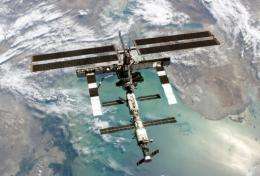
A view of the International Space Station flying over the North Caspian Sea

Enlarge

The International Space Station (ISS) flies over the North Caspian Sea in 2005. On August 6, NASA astronaut Ron Garan produced the first live 3-D video images from space when he used a stereoscopic camera to film the inside of the ISS and streamed the images live to ESA's research and technology centre in the Netherlands, it said.

Astronauts have produced the first live 3-D video images in the 50-year history of space travel, the European Space Agency (ESA) said on Wednesday.

On August 6, NASA astronaut Ron Garan used a stereoscopic camera to film the inside of the (ISS) and streamed the images live to ESA's research and technology centre in the Netherlands, it said.

Viewers wore polarised glasses similar to those used in cinemas "and were amazed by the quality of the images," ESA said in a press release.

The experiment, using a shoebox-sized gadget called the Erasmus Recording Binocular (ERB-2), should have a practical use on the ISS.

"The camera could also be used in the future outside the ISS to support the astronauts' or other critical robotic operations," said ERB-2 coordinator Massimo Sabbatini.

"This really felt like being in space with an astronaut by your side."

The agency plans to post ERB-2 images on a new ESA YouTube 3-D channel.

In the meantime, it has posted small clip on its website (http://www.esa.int … index_0.html). Viewers need red-and-blue stereo glasses to get the 3-D effect.

(c) 2011 AFP

4.2 /5 (5 votes)  

Rank 4.2 /5 (5 votes)
Relevant PhysicsForums posts
  • revamping general concept and cosmological principle
    createdMay 25, 2012
  • Transiting Exoplanet Light Curve
    createdMay 25, 2012
  • Math behind Theoretical Physics
    createdMay 24, 2012
  • Do we know whats at the center of galaxies yet?
    createdMay 23, 2012
  • Structure of the Milky Way?
    createdMay 20, 2012
  • What would it take to terraform Pluto and Charon?
    createdMay 19, 2012
  • More from Physics Forums - General Astronomy

More news stories

Yale study concludes public apathy over climate change unrelated to science literacy

Are members of the public divided about climate change because they don't understand the science behind it? If Americans knew more basic science and were more proficient in technical reasoning, would public consensus match ...

Space & Earth / Environment

created 2 minutes ago | popularity not rated yet | comments 0 | with audio podcast

10 million years needed to recover from mass extinction

It took some 10 million years for Earth to recover from the greatest mass extinction of all time, latest research has revealed.

Space & Earth / Earth Sciences

created 3 minutes ago | popularity not rated yet | comments 0 | with audio podcast

Sophisticated simulations predict future warming

The chances of our planet being hit by a global warming of 3 degrees Celsius by 2050 is as likely as it being hit by an increase of 1.4 degrees, new research shows. Presented in the journal Nature Geoscience, the British study ...

Space & Earth / Earth Sciences

created May 22, 2012 | popularity 4.4 / 5 (9) | comments 51

Aliens don't want to eat us, says former SETI director

Alien life probably isn’t interested in having us for dinner, enslaving us or laying eggs in our bellies, according to a recent statement by former SETI director Jill Tarter.

Space & Earth / Space Exploration

created May 25, 2012 | popularity 4.4 / 5 (13) | comments 39

Kyoto Protocol architect 'frustrated' by climate dialogue

UN climate talks are going nowhere, as politicians dither or bicker while the pace of warming dangerously speeds up, one of the architects of the Kyoto Protocol told AFP.

Space & Earth / Environment

created May 23, 2012 | popularity 3.7 / 5 (7) | comments 39


Change in developmental timing was crucial in the evolutionary shift from dinosaurs to birds: study

At first glance, it's hard to see how a common house sparrow and a Tyrannosaurus Rex might have anything in common. After all, one is a bird that weighs less than an ounce, and the other is a dinosaur that ...

Computer model used to pinpoint prime materials for efficient carbon capture

When power plants begin capturing their carbon emissions to reduce greenhouse gases – and to most in the electric power industry, it's a question of when, not if – it will be an expensive undertaking.

'Unzipped' carbon nanotubes could help energize fuel cells, batteries

Multi-walled carbon nanotubes riddled with defects and impurities on the outside could replace some of the expensive platinum catalysts used in fuel cells and metal-air batteries, according to scientists at ...

T cells 'hunt' parasites like animal predators seek prey, study shows

By pairing an intimate knowledge of immune-system function with a deep understanding of statistical physics, a cross-disciplinary team at the University of Pennsylvania has arrived at a surprising finding: T cells use a movement ...

Manufacturing genes to attack flu virus

An international research team has manufactured a new protein that can combat deadly flu epidemics.

Same gene that stunts infants' growth also makes them grow too big: research

UCLA geneticists have identified the mutation responsible for IMAGe* syndrome, a rare disorder that stunts infants' growth. The twist? The mutation occurs on the same gene that causes Beckwith-Wiedemann syndrome, which makes ...