How to enjoy the 2011 Perseid meteor shower
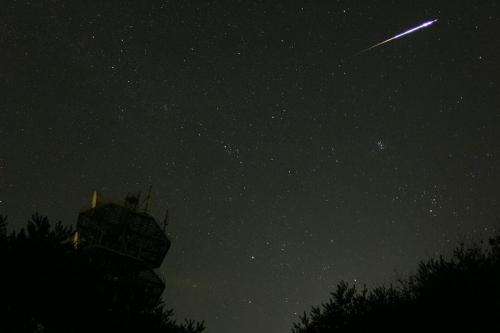
August 12, 2011 By Adrian West, Universe Today
Credit: NasaImages
Its time for the Perseid Meteor Shower and you want to bag some meteors (shooting stars), but how? Maybe you just want to know where and what time to look, or perhaps you are having a Perseid party and you want everyone to have a great time.
If so, then please read on...
First, you dont need a telescope or binoculars or any high tech equipment. You just need your own eyes and glasses if you wear them.
Its a good idea to be away from bright lights and if possible have a red light torch or red flashlight, but most importantly try to get your eyes adapted to the dark.
Bright light will instantaneously ruin dark adaption so shining flashlights into faces is a big no-no and looking directly at the Moon isnt going to help either. Position yourself so you dont get the Moon in your view.
The Perseids dont rain down out of the sky; they appear every few minutes and this year, you may only see the rarer bright ones and very bright fireballs due to the full Moon that will be up, and the glare it will unfortunately provide. But if you can get in a good position to avoid the glare, sit back and wait to see some meteors. This is totally worth the wait, but you need to be comfortable or you will give up, go indoors and not see any.
The best bet is to get a reclining garden chair or airbed or something similar to lay back and relax upon. Lots of people put those yard trampolines to very good use and use them as meteor observing platforms.
Dress warmly and cover yourself with blankets or a sleeping bag, August is a summer month, but it can get quite chilly at 1:00am and this will make you give up early too, so stay warm.
Have plenty of drinks and snacks ready so you can basically camp out and not have to keep on getting up, or doing things, because this is when you will, ironically, miss the best fireball of the evening.
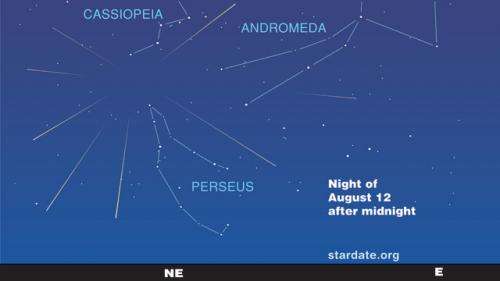
Credit: Stardate/McDonald Observatory
Where do I look and what direction?This is the most common question I hear people ask about meteor showers and the answer is very simple.
Follow the above comfort guidelines, look up and away from the Moon and fill your gaze with the sky.
Perseid meteors originate from a fixed point in the sky called the radiant, which is in the constellation of Perseus, however meteors will appear in any part of the sky. You can trace their paths back to the radiant.
After midnight, look towards the East/Northeast part of the your sky to find Perseus. To find it look for the easily identifiable constellation Cassiopeia, the big W in sky! Perseus is just below Cassiopeia.
You can draw, take pictures and even video the Perseids, but the simplest and most enjoyable thing is to lay back, relax and be patient and you will be rewarded with a great a view.
The best times to look will be in the dark pre-dawn sky on August 11, 12 and 13, 2011.
You can also follow along with Universe Today and Meteorwatch.org with #meteorwatch on twitter. Ask questions, see what others are seeing, share your experiences and images using the hashtag #meteorwatch
Most of all, enjoy your Perseid experience and have fun!
Source: Universe Today
-
From lemons to lemonade: Reaction uses carbon dioxide to make carbon-based semiconductor,
32 comments
-
Thioridazine kills cancer stem cells in human while avoiding toxic side-effects of conventional cancer treatments,
3 comments
-
SpaceX private rocket blasts off for space station (Update),
42 comments
-
Climate scientists say they have solved riddle of rising sea,
31 comments
-
SpaceX capsule has 'new car' smell, astronauts say (Update),
2 comments
-
revamping general concept and cosmological principle
May 25, 2012
-
Transiting Exoplanet Light Curve
May 25, 2012
-
Math behind Theoretical Physics
May 24, 2012
-
Do we know whats at the center of galaxies yet?
May 23, 2012
-
Structure of the Milky Way?
May 20, 2012
-
What would it take to terraform Pluto and Charon?
May 19, 2012
- More from Physics Forums - General Astronomy
More news stories
Yale study concludes public apathy over climate change unrelated to science literacy
Are members of the public divided about climate change because they don't understand the science behind it? If Americans knew more basic science and were more proficient in technical reasoning, would public consensus match ...
2 minutes ago |
not rated yet |
0
|
10 million years needed to recover from mass extinction
It took some 10 million years for Earth to recover from the greatest mass extinction of all time, latest research has revealed.
Space & Earth / Earth Sciences
3 minutes ago |
not rated yet |
0
|
Sophisticated simulations predict future warming
The chances of our planet being hit by a global warming of 3 degrees Celsius by 2050 is as likely as it being hit by an increase of 1.4 degrees, new research shows. Presented in the journal Nature Geoscience, the British study ...
Space & Earth / Earth Sciences
May 22, 2012 |
4.4 / 5 (9) |
51
Aliens don't want to eat us, says former SETI director
Alien life probably isnt interested in having us for dinner, enslaving us or laying eggs in our bellies, according to a recent statement by former SETI director Jill Tarter.
Space & Earth / Space Exploration
May 25, 2012 |
4.4 / 5 (13) |
39
Kyoto Protocol architect 'frustrated' by climate dialogue
UN climate talks are going nowhere, as politicians dither or bicker while the pace of warming dangerously speeds up, one of the architects of the Kyoto Protocol told AFP.
May 23, 2012 |
3.7 / 5 (7) |
39
Change in developmental timing was crucial in the evolutionary shift from dinosaurs to birds: study
At first glance, it's hard to see how a common house sparrow and a Tyrannosaurus Rex might have anything in common. After all, one is a bird that weighs less than an ounce, and the other is a dinosaur that ...
Computer model used to pinpoint prime materials for efficient carbon capture
When power plants begin capturing their carbon emissions to reduce greenhouse gases and to most in the electric power industry, it's a question of when, not if it will be an expensive undertaking.
'Unzipped' carbon nanotubes could help energize fuel cells, batteries
Multi-walled carbon nanotubes riddled with defects and impurities on the outside could replace some of the expensive platinum catalysts used in fuel cells and metal-air batteries, according to scientists at ...
T cells 'hunt' parasites like animal predators seek prey, study shows
By pairing an intimate knowledge of immune-system function with a deep understanding of statistical physics, a cross-disciplinary team at the University of Pennsylvania has arrived at a surprising finding: T cells use a movement ...
Manufacturing genes to attack flu virus
An international research team has manufactured a new protein that can combat deadly flu epidemics.
Same gene that stunts infants' growth also makes them grow too big: research
UCLA geneticists have identified the mutation responsible for IMAGe* syndrome, a rare disorder that stunts infants' growth. The twist? The mutation occurs on the same gene that causes Beckwith-Wiedemann syndrome, which makes ...
