An octave spanning chip-based optical ruler
August 8, 2011 By Olivia Meyer-Streng

An octave spanning chip-based optical ruler

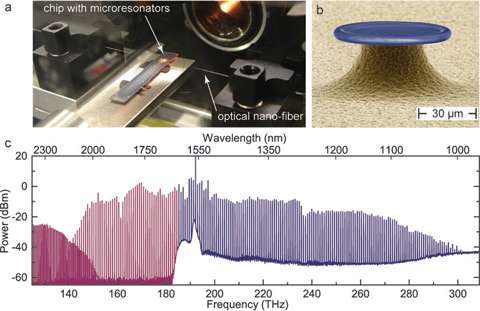
Octave spanning frequency comb generation in a microresonator. Panel (a) shows the experiment with a glass nano-fiber and a silicon chip with optical resonators. A scanning electron microscope picture of a resonator is shown in panel (b). Panel (c) shows the optical spectrum of the frequency comb generated in such a microresonator seeded by a single frequency laser.

More than a decade ago, the frequency comb technique was developed at the Max Planck In-stitute of Quantum Optics by Professor Theodor W. Hänsch. The new tool has stimulated fun-damental research as well as laser development and its applications because it gave rise to a major increase in the accuracy of measuring optical frequencies. Already a couple of years ago, a team of scientists around Dr. Tobias Kippenberg, formerly Leader of the Max Planck Research Group “Laboratory of Photonics and Quantum Measurements” at MPQ, who has since then become Associate Professor at the Ecole Polytechnique Fédérale de Lausanne (EPFL), succeeded for the first time in generating optical frequency combs using chip-based quartz glass toroids with diameters on the micrometer scale. Now the scientists made a big step further: their new microresonators produce light over a range of more than an octave and are at the same time precisely tunable (PRL 107, 063901, 1 August 2011). This achievement brings a variety of applications into reach, such as optical telecommunications or the precise calibration of spectrographs in astrophysics.

A frequency comb is a light source containing – similar to a rainbow – a large spectrum of colors. However, the frequencies are not continuously distributed. Instead, up to a million spectral lines are spaced in exactly the same distance. The superposition of this “comb” with another laser beam results in a pattern from which the unknown laser frequency can be determined with very high accuracy. The frequency comb developed by Prof. Hänsch is based on a mode-locking process in short-pulse lasers. This set-up consists of many optical components, even though it is made today relatively compact and commercially available. Indeed, Menlo System a spin-off company established by MPQ which is meanwhile marketing the frequency comb technology worldwide.
 
A couple of years ago, the group “Laboratory of Photonics and Quantum Measurements”, which was associated with the Laser Spectroscopy Division of Professor Hänsch, has succeeded in generating a frequency comb by means of a tiny microstructure, a toroidal glass resonator with a diameter of less than 100 micrometres. This was done in cooperation with Dr. Ronald Holzwarth from Menlo Sys-tems Ltd. and promises to radically reduce the size of frequency comb generators.
 
Using a “nanowire” made of glass the scientists couple light from a diode laser into this monolithic structure, where it is stored for a rather long time. This leads to extremely high light intensities inside the resonator, i.e. photon densities, which again produce nonlinear effects such as ‘four-wave mixing’ induced by the Kerr effect: two light quanta of equal energy are converted to two photons of which one light quantum has a higher energy, the other a lower energy than the original ones. The newly produced light fields can in turn interact with the original light fields, thereby producing new frequencies. From this cascade emerges a broad, discrete spectrum of frequencies. By optimizing the geometry of the toroid microresonator, Dr. Pascal Del’Haye (MPQ) and Tobias Herr (EPFL), doc-toral students at the referred experiment, have managed to compensate the effects of dispersion, such that the photon round-trip time inside the resonator remains the same for all light frequencies. Now the microresonators produce light over the range of more than an octave, from von 900 bis 2170 nm (near IR), for the first time. (As on the keyboard of a piano, the range of an octave corresponds to a doubling of the frequency.)
 
By raising the intensity of the coupled into the resonator the frequencies of the comb can be shifted simultaneously. The higher intensities increase the temperature of the glass structure by up to 800 degree Celsius whereby the resonator is expanding and changing its index of refraction. Both effects lead to a shift of the comb lines towards lower frequencies, i.e. longer wavelengths. The broad range of frequencies as well as the tunability is an important pre-condition for self-referencing, where the lower range of the spectrum is doubled and compared to the upper part. Self-referencing is an important precondition for the use of frequency combs in metrology.
 
Also optical telecommunications will profit from the new tool. Whereas in the conventional fre-quency comb the lines are extremely close and of very low intensity, the spectral lines of the mono-lithic have a separation of about 850 gigahertz and powers of the order of one milliwatt. This spacing and power level corresponds to the typical requirements for the “carriers” of the data channels in fibre-based optical communications. Tunability and broad range make the device also suitable for very precise calibration of spectrographs for astrophysics. Due to the large variety of possible applications many groups worldwide show interest in using the resonators for the miniaturi-zation of photonic devices. A number of other geometries and materials are investigated, e.g. pol-ished crystals, highly reflective fiber cavities and silicon structures based on computer-chip technol-ogy.

More information: P. Del’Haye, et al., Octave Spanning Tunable Frequency Comb from a Microresonator, Phys. Rev. Lett. 107, 063901, 1. August 2011. DOI: 10.1103/PhysRevLett.107.063901

Provided by Max Planck Institute

4.7 /5 (3 votes)  

Filter


Move the slider to adjust rank threshold, so that you can hide some of the comments.


Display comments: newest first

Techno1
Aug 08, 2011

Rank: 5 / 5 (1)
One of the things that annoys me about all of these new discoveries are patent laws.

There are probably a million uses for something like this in various industries, and I doubt 90% of them will ever be discovered in my life time, because nobody in the relevant industry will ever even hear about these devices (and that goes for most of the stuff on here.)

Unless they sit around reading physics articles every day, it's a strong likelihood they will never even know about the majority of this technology.

This is unfortunate, because innovation is all about combining different technologies to develop new applications, or do old things in totally new ways.

I've regularly made the joke to people that if most companies and governments really understood the internet and modern computers, half the remaining jobs would disappear over night.

You can replace almost any "white collar" job in the world, except science, engineering, and medicine, with software on a computer.
Rank 4.7 /5 (3 votes)
Relevant PhysicsForums posts
  • Water flow question
    created3 hours ago
  • [Drift velocity] Factors affecting velocity
    created6 hours ago
  • does cold gasoline have less energy
    created6 hours ago
  • distribution of molecules throughout the atmosphere
    created8 hours ago
  • The Global Positioning System !
    created9 hours ago
  • A Question relating Power
    created10 hours ago
  • More from Physics Forums - General Physics

More news stories

Is a classical electrodynamics law incompatible with special relativity?

(Phys.org) -- The laws of classical electromagnetism that were developed in the 19th century are the same laws that scientists use today. They include Maxwell’s four equations along with the Lorentz la ...

Physics / General Physics

created May 24, 2012 | popularity 4.7 / 5 (17) | comments 43 | with audio podcast feature

Landmark calculation clears the way to answering how matter is formed

(Phys.org) -- An international collaboration of scientists, including Thomas Blum, associate professor of physics, is reporting in landmark detail the decay process of a subatomic particle called a kaon – ...

Physics / General Physics

created May 25, 2012 | popularity 4.3 / 5 (22) | comments 50 | with audio podcast

Lying in wait for WIMPs: Researchers seek to dramatically increase sensitivity of Large Underground Xenon detector

Although it's invisible, dark matter accounts for at least 80 percent of the matter in the universe. No one knows what it is, but most scientists would bet on weakly interacting massive particles, or WIMPs.

Physics / General Physics

created May 23, 2012 | popularity 4 / 5 (7) | comments 15 | with audio podcast

Hawaii lab turns laser-powered bubbles into microrobots

(Phys.org) -- A team of scientists from the University of Hawaii are working on microrobots created from bubbles of air in a saline solution. The bubbles take on their title of “robots” as a laser ...

Physics / General Physics

created May 23, 2012 | popularity 5 / 5 (4) | comments 2 | with audio podcast weblog

Sound increases the efficiency of boiling

Scientists at the Georgia Institute of Technology achieved a 17-percent increase in boiling efficiency by using an acoustic field to enhance heat transfer. The acoustic field does this by efficiently removing vapor bubbles ...

Physics / Soft Matter

created May 24, 2012 | popularity 5 / 5 (2) | comments 2


Computer model used to pinpoint prime materials for efficient carbon capture

When power plants begin capturing their carbon emissions to reduce greenhouse gases – and to most in the electric power industry, it's a question of when, not if – it will be an expensive undertaking.

'Unzipped' carbon nanotubes could help energize fuel cells, batteries

Multi-walled carbon nanotubes riddled with defects and impurities on the outside could replace some of the expensive platinum catalysts used in fuel cells and metal-air batteries, according to scientists at ...

T cells 'hunt' parasites like animal predators seek prey, study shows

By pairing an intimate knowledge of immune-system function with a deep understanding of statistical physics, a cross-disciplinary team at the University of Pennsylvania has arrived at a surprising finding: T cells use a movement ...

Yale study concludes public apathy over climate change unrelated to science literacy

Are members of the public divided about climate change because they don't understand the science behind it? If Americans knew more basic science and were more proficient in technical reasoning, would public consensus match ...

Same gene that stunts infants' growth also makes them grow too big: research

UCLA geneticists have identified the mutation responsible for IMAGe* syndrome, a rare disorder that stunts infants' growth. The twist? The mutation occurs on the same gene that causes Beckwith-Wiedemann syndrome, which makes ...

Change in developmental timing was crucial in the evolutionary shift from dinosaurs to birds: study

At first glance, it's hard to see how a common house sparrow and a Tyrannosaurus Rex might have anything in common. After all, one is a bird that weighs less than an ounce, and the other is a dinosaur that ...