N.Z.'s lost penguin to hitch home on research ship
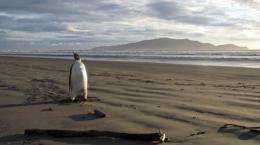
The emperor penguin that washed up lost on a New Zealand beach more than 3,000 kilometres (1,900 miles) from its Antarctic home, and was taken to Wellington Zoo on June 24, 2011. The penguin will be shipped back to sub-antarctic waters later this month on a scientific research vessel, Wellington Zoo said Wednesday.
A wayward Emperor penguin that washed up in New Zealand will be shipped back to sub-antarctic waters later this month on a scientific research vessel, Wellington Zoo said Wednesday.
The adult male penguin, nicknamed "Happy Feet", was found wandering on a beach near the capital in June and taken to the zoo to recuperate when he became ill after eating sand and sticks.
With the bird, only the second Emperor penguin ever recorded in New Zealand, restored to full health, zoo chief executive Karen Fifield said plans had been finalised to ship him back to the Southern Ocean.
Fifield said the National Institute of Water and Atmospheric Research (NIWA) ship Tangaroa would set sail from Wellington on August 29 with the penguin aboard.
The ship, which will carry out research into Southern Ocean fisheries, will release the bird four days into the voyage near Campbell Island, which is within the normal feeding range of Emperor penguins.
"This is an excellent result for everyone involved, and for the penguin, and is a great example of organisations working together for the best outcome," Fifield said.
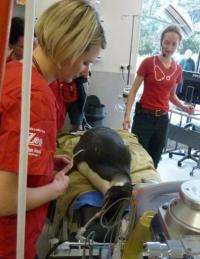
A medical team readies the operation room in preparation for surgery on an ailing Emperor penguin (C) at the Wellington zoo on June 27, 2011. One of New Zealand's top surgeons was enlisted to operate on the penguin found lost on a beach near Wellington. Surgeon John Wyeth performed a delicate two-hour operation on the bird, nicknamed "Happy Feet" to remove sand and sticks from its stomach.
The hope is that Happy Feet will swim home to Antarctica, where Emperor penguins live in colonies ranging in size from a few hundred to more than 20,000 pairs."The NIWA team are looking forward to having this extra special guest onboard the vessel with us for the journey," research manager Rob Murdoch said.
"Happy Feet has captured the hearts of New Zealanders and people across the world, and were pleased to be able to help safely return him to the Southern Ocean."
While aboard the ship, Happy Feet will be housed in a specially designed crate that Fifield said would keep him "cold and comfortable", with a vet and two NIWA staff to look after him.
The penguin will be fitted with a satellite tracking device before he is released, so scientists and the public can track his progress on the zoo's website.
It is thought the bird fell ill on the beach after mistaking sand for snow and eating it in a bid to lower his temperature, clogging his gut and leading to a series of operations to clear his stomach.
A diet of "fish milkshakes" at the zoo has seen Happy Feet's weight increase four kilograms (nine pounds) to 26 kilograms, giving him sufficient reserves for what will still be an arduous 2,000 kilometre (1,250 mile) swim home.
The Emperor penguin is the largest species of the distinctive waddling creature and can grow up to 1.15 metres (3ft 9in) tall.
The reason for Happy Feet's appearance in New Zealand remains a mystery, although experts say Emperor penguins take to the open sea during the Antarctic summer and this one may have simply wandered further than most.
(c) 2011 AFP
-
From lemons to lemonade: Reaction uses carbon dioxide to make carbon-based semiconductor,
32 comments
-
Thioridazine kills cancer stem cells in human while avoiding toxic side-effects of conventional cancer treatments,
3 comments
-
SpaceX private rocket blasts off for space station (Update),
42 comments
-
Climate scientists say they have solved riddle of rising sea,
31 comments
-
SpaceX capsule has 'new car' smell, astronauts say (Update),
3 comments
-
What would stain as translucent on light-coloured fabric?
20 hours ago
-
How do I identify different bacteria on culture plates?
May 26, 2012
-
Why Do Dogs do Strange things...
May 25, 2012
-
What does exophillic and endophillic mean in terms of mosquito and their control?
May 24, 2012
-
Semen stains glows under black lights (uv light)?
May 23, 2012
-
Question on Human Chromosome 2
May 23, 2012
- More from Physics Forums - Biology
More news stories
Manufacturing genes to attack flu virus
An international research team has manufactured a new protein that can combat deadly flu epidemics.
1 hour ago |
not rated yet |
0
|
Scientist: Evolution debate will soon be history
(AP) -- Richard Leakey predicts skepticism over evolution will soon be history. Not that the avowed atheist has any doubts himself.
19 hours ago |
3.3 / 5 (18) |
73
More plant species responding to global warming than previously thought
(Phys.org) -- Far more wild plant species may be responding to global warming than previous large-scale estimates have suggested.
May 22, 2012 |
4.6 / 5 (14) |
18
|
Thousands of shellfish found dead in Peru
Thousands of crustaceans were found dead off the coast of Lima following the mystery mass death of dolphins and pelicans, the Peruvian Navy said Friday.
May 26, 2012 |
4.8 / 5 (4) |
7
For monogamous sparrows, it doesn't pay to stray (but they do it anyway)
It's quite common for a female song sparrow to stray from her breeding partner and mate with the male next door, but a new study shows that sleeping around can be costly.
May 22, 2012 |
5 / 5 (2) |
8
|
Computer model used to pinpoint prime materials for efficient carbon capture
When power plants begin capturing their carbon emissions to reduce greenhouse gases and to most in the electric power industry, it's a question of when, not if it will be an expensive undertaking.
'Unzipped' carbon nanotubes could help energize fuel cells, batteries
Multi-walled carbon nanotubes riddled with defects and impurities on the outside could replace some of the expensive platinum catalysts used in fuel cells and metal-air batteries, according to scientists at ...
T cells 'hunt' parasites like animal predators seek prey, study shows
By pairing an intimate knowledge of immune-system function with a deep understanding of statistical physics, a cross-disciplinary team at the University of Pennsylvania has arrived at a surprising finding: T cells use a movement ...
Yale study concludes public apathy over climate change unrelated to science literacy
Are members of the public divided about climate change because they don't understand the science behind it? If Americans knew more basic science and were more proficient in technical reasoning, would public consensus match ...
Same gene that stunts infants' growth also makes them grow too big: research
UCLA geneticists have identified the mutation responsible for IMAGe* syndrome, a rare disorder that stunts infants' growth. The twist? The mutation occurs on the same gene that causes Beckwith-Wiedemann syndrome, which makes ...
Change in developmental timing was crucial in the evolutionary shift from dinosaurs to birds: study
At first glance, it's hard to see how a common house sparrow and a Tyrannosaurus Rex might have anything in common. After all, one is a bird that weighs less than an ounce, and the other is a dinosaur that ...

Aug 17, 2011
Rank: not rated yet
Aug 17, 2011
Rank: not rated yet