Melting glaciers signal climate change in Bolivia
Scientists and peasants combine traditional farming techniques and cutting-edge research to grow food sustainably in the high Andes, where the ecology is rapidly changing.
Measuring how farmers use water and forecasting long-term water supply in the Illimani watershed to help communities adapt to climate change.
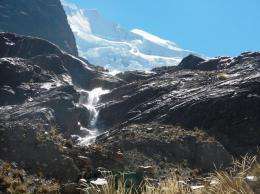
For centuries, the Illimani glacier, overlooking Bolivia’s capital La Paz, has sustained life on the slopes of the country’s second highest mountain. In this arid region, the glacier acts as a natural reservoir, providing the only source of water during the dry season to agricultural indigenous communities.
In recent years, climate change has brought erratic rainfall, rising temperatures, and high water demand. As a result, the glacier is shrinking, sparking conflicts over water and threatening the survival of villages in the Illimani watershed. It’s a pattern repeated throughout the Andes and in other mountainous regions because temperatures have been rising faster at higher altitudes. A 2011 international study found that water stress will likely continue to increase, particularly in large high-altitude cities such as La Paz, Quito, and Bogota which are home to millions of people.
Those living in the Illimani watershed knew the glacier was shrinking. However, no one knew how water use was changing and how the local environment was going to change in years to come. Answering these questions is critical to shaping water use policies that will allow the region to adapt to a rapidly shifting climate.
That’s what researchers from the Universidad Mayor San Andres, the country’s largest university, and Bolivian NGO Agua Sustentable have set out to do with the support of Canada’s International Development Research Centre (IDRC).
Two years into the project, researchers are developing a detailed picture of how the Illimani watershed is changing and establishing a sound basis for water governance informed by the best scientific data.
A key insight has been the dramatic extent of shifts in farming in the watershed produced by climate change. Until a few decades ago, villagers practiced subsistence agriculture, growing a wide variety of crops that they traded with other villages. Rising temperatures and greater water availability from the melting glacier have led farmers to switch to cash crops and extend agriculture to higher altitudes. “Now we cultivate all year round, not like before when agriculture was only possible during very specific periods,” says Leandro Gutiérrez, a farmer in the village of Khapi.
The area under cultivation has tripled over the past three decades, with the greatest expansion occurring in the last 10 years. New economic opportunities and better transportation to markets in La Paz have brought migrants to the area. Many communities have expanded ten-fold.
Population growth and agricultural intensification means farmers use more water. “Everyone is trying to benefit from the bonanza, but it’s clear that it’s not going to be sustainable,” says IDRC program officer Marco Rondon, who notes that conflicts over water are escalating. The switch from diverse crops to intensive monocropping has also brought new and devastating pests and is depleting the soil. “The lettuce plagues are extremely aggressive and they were not in our crops before,” says farmer José Apaza.
To get reliable climatological information on this little-studied region, meteorological stations have been installed across the watershed, including one at high altitude next to the glacier. Rondon describes it as the best in the Andes: “There are few such stations at high elevation anywhere in the world so it’s generating key data,” he says.
By combining new meteorological information with remote sensing images and other techniques, researchers have discovered that the glacier is retreating by 10 to 12 metres a year, “a massive loss,” says Rondon. They have also generated a three-dimensional map of the glacier. The scientists are integrating this greater understanding of the local environment with global climate models to predict future temperature increases and precipitation patterns.
The project has also led to better understanding of the hydrological importance of bofedales (peat lands), which are common at the base of the Andes. New research has discovered how much water these natural sponges hold and release and has highlighted the vital role these small areas play in the water cycle of Andean ecosystems. However, 75% of local peat lands have been lost in recent decades to overgrazing, long dry periods, and other causes. The findings reinforce the importance of preserving these areas.
As subsistence farmers have turned to the market economy, their livelihoods now depend on single crops. When asked what they would do if a pest wiped out their crop, farmers responded they would abandon their villages and move to the city, says project leader Magali Garcia. “They don’t have any resilience at all now,” she says.
Researchers are working with farmers to return to traditional agricultural methods by reintroducing fruit trees and rotating crops. Shade from trees reduces evaporation. Greater agricultural diversity increases resilience to disease and pests, allows the soil to replenish itself, and provides new sources of income.
To further improve conservation, researchers tested low-cost reservoirs that water the fields through efficient drip irrigation during the dry season. The success of the pilot project has generated great demand for these reservoirs. Researchers also found that by irrigating less but at optimal times, farmers could use 30% less water to grow maize.
Garcia says the key to successful adaptation in the Illimani watershed is the growing understanding that melting glaciers are just one element in climate change. “It’s a system,” says Garcia, “made up of a connected series of social, economic, and environmental changes. It has to be addressed in an integral way.”
The Illimani watershed project is an excellent example of an integrated approach that considers farmers’ concerns and conditions. Researchers are now working with communities to design a fair and sustainable water use strategy for the future.
Provided by ResearchSEA


