Why East Coast earthquakes travel so far
August 23, 2011 by Kerry Sheridan
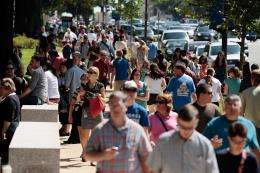
Tourists and government employees fill the National Mall after a 5.9 magnitude earthquake struck the east coast in Washington, DC. The quake that struck mid-afternoon near Richmond, Virginia was the strongest in the state since 1897, and shook the eastern seaboard for some 30 seconds, sparking a wave of panic among residents.
A rare 5.8 earthquake that rattled the eastern United States on Tuesday was felt over a wide area from Toronto, Canada down to Georgia due to the hard, brittle quality of the ground, experts said.
The quake that struck mid-afternoon near Richmond, Virginia was the strongest in the state since 1897, and shook the eastern seaboard for some 30 seconds, sparking a wave of panic among residents.
"Earthquakes of this magnitude are unusual in your area, but the fact that you shook so hard and the event was actually some distance from you is not unusual," Thomas Jordan, director of Southern California Earthquake Center based at the University of Southern California, told AFP by phone.
The outer rocky shell of the Earth, known as the lithosphere, is colder on the East Coast than in California, which is well known for experiencing frequent earthquakes.
"So when something shakes, it is like hitting a bar of steel, it rings pretty well. Whereas on the West Coast, the rocks are higher temperature and it is more like hitting something quite a bit softer," he said.
Lucy Jones, a USGS spokeswoman, said the West Coast crust is broken up by active faults so it "doesn't do as good of a job of transmitting the energy."
"On the East Coast, you have this old, hard, cold crust that does a lovely job of transmitting the waves like a solid bell," she said on CNN, so that an earthquake "can definitely be felt hundreds of miles away."
The US East Coast has plenty of fault lines, but they are ancient, and are inside a creaky plate that is under pressure from being jostled and pushed by other plates, experts said.
Occasionally, pressure builds up and stresses will be released in earthquakes, like the one on Tuesday.
"They are faults that used to be very active faults hundreds of millions of years ago, unlike the faults on the West Coast... (that) are active today," Jordan said.
Jack Boatwright, a seismologist with USGS, told AFP that one aftershock of 2.8 magnitude was recorded in the hour following the quake.
Other parts of the world that are similar to the US East Coast in terms of earthquake dynamics would include India, as well as some parts of Russia and Australia, he added.
"In India, that large triangle is relatively old, so we think that it conducts energy similarly," he said.
Other differences between East and West Coast quakes are the sounds they make -- residents of California are less likely to hear banging associated with a big quake unless they are very near the epicenter, he said.
"On the East Coast you might hear it many kilometers (miles) away, so don't distrust the people who said they heard it," Boatwright said.
Jordan added that the likelihood of a bigger quake in the near future was minimal.
"There is a small probability that this could be the first of a set of earthquakes and there could a larger earthquake coming, but the chances of that are small, about three to five percent."
On the US East Coast, where brick and wood buildings are not typically built to withstand shaking, a local official in Virginia said they were investigating calls of structural damage.
Washington's National Cathedral reported "significant damage," with parts of three of the central tower's four pinnacles, its uppermost spires, having fallen off. No one was injured by the falling debris.
"On the East Coast you have a lot of structures that, since they haven't been built to withstand earthquakes, don't do a very good job if they are actually shaking," said Jordan.
Any damage that occurs is typically close to the epicenter in such quakes, and the area where the quake struck was not a heavily populated town center.
(c) 2011 AFP
-
From lemons to lemonade: Reaction uses carbon dioxide to make carbon-based semiconductor,
32 comments
-
Thioridazine kills cancer stem cells in human while avoiding toxic side-effects of conventional cancer treatments,
3 comments
-
SpaceX private rocket blasts off for space station (Update),
42 comments
-
Climate scientists say they have solved riddle of rising sea,
31 comments
-
SpaceX capsule has 'new car' smell, astronauts say (Update),
2 comments
-
Hypothetical desert earth
14 hours ago
-
More human population = greater mass?
May 25, 2012
-
Conversion from aircraft bearing to normal degrees
May 23, 2012
-
Interpretation/Analysis of the Lab results(HEPA filter)
May 22, 2012
-
Has anyone here attended the The Urbino Summer School in Paleoclimatology?
May 22, 2012
-
Earthquakes: Mag 6 N. Italy and Mag 5.6 W. Bulgaria
May 21, 2012
- More from Physics Forums - Earth
More news stories
Sophisticated simulations predict future warming
The chances of our planet being hit by a global warming of 3 degrees Celsius by 2050 is as likely as it being hit by an increase of 1.4 degrees, new research shows. Presented in the journal Nature Geoscience, the British study ...
Space & Earth / Earth Sciences
May 22, 2012 |
4.4 / 5 (9) |
51
Kyoto Protocol architect 'frustrated' by climate dialogue
UN climate talks are going nowhere, as politicians dither or bicker while the pace of warming dangerously speeds up, one of the architects of the Kyoto Protocol told AFP.
May 23, 2012 |
3.7 / 5 (7) |
39
Aliens don't want to eat us, says former SETI director
Alien life probably isnt interested in having us for dinner, enslaving us or laying eggs in our bellies, according to a recent statement by former SETI director Jill Tarter.
Space & Earth / Space Exploration
May 25, 2012 |
4.4 / 5 (13) |
38
Dragon arrives at space station in historic 1st (Update 2)
The privately bankrolled Dragon capsule made a historic arrival at the International Space Station on Friday, triumphantly captured by astronauts wielding a giant robot arm.
Space & Earth / Space Exploration
May 25, 2012 |
5 / 5 (10) |
19
What's the big deal about private space launches?
(AP) -- The first private spaceship is headed to the International Space Station. Some questions and answers about the cargo mission by Space Exploration Technologies, known as SpaceX:
Space & Earth / Space Exploration
May 22, 2012 |
5 / 5 (6) |
35
Nvidia trumpets Tegra 3 phone design wins for 2012
(Phys.org) -- Nvidias competitive war paint has a name, Tegra 3. On the heels of Nvidia announcements about lowering costs of its Tegra 3 processors and Nvidia-enabled tablets running Android Ice Cream ...
Browser wars flare in mobile space
The browser wars are heating up again, but this time the fight is for dominance of the mobile Internet.
Scientist: Evolution debate will soon be history
(AP) -- Richard Leakey predicts skepticism over evolution will soon be history. Not that the avowed atheist has any doubts himself.
Dell tablet leak: 10.1-inch display, two-battery choice
(Phys.org) -- Headline after headline talks about vendors tablets in the wings as likely number-one contenders for the iPad. Such claims have justifiably been taken with a grain of salt, considering ...
Keep food safety in mind this memorial day weekend
(HealthDay) -- Picnics, parades and cookouts are as much a part of Memorial Day weekend as tributes to the United States' war veterans.
Social welfare cuts ultimately come with heavy price, researchers say
(Phys.org) -- Slashing government funding for Medicaid, food stamps and other programs that serve the poor while politically popular with some lawmakers and many conservatives may do more harm ...
Aug 23, 2011
Rank: 3.2 / 5 (9)
OK, ok this is off topic and superfluous...but I just couldn't stop myself.
Aug 23, 2011
Rank: 3.7 / 5 (3)
NEWS UPDATE - Black hole devouring earths core - Fermilab admits 'slight miscalculation'-
Aug 23, 2011
Rank: 2 / 5 (4)
Unfortunately, we seem to have little or no understanding of earthquakes.
With kind regards,
Oliver K. Manuel
Former NASA Principal
Investigator for Apollo