New discovery sheds light on the ecosystem of young galaxies
Aug 29, 2011
New discovery sheds light on the ecosystem of young galaxies
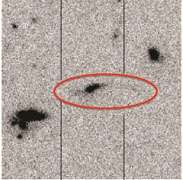
An image of the galaxy from the Hubble Space telescope archive, that shows that the underlying galaxy is highly distorted, with extended stellar tails to the left and right. Image is courtesy of Michael Rauch.

(PhysOrg.com) -- A team of scientists, led by Michael Rauch from the Carnegie Observatories, has discovered a distant galaxy that may help elucidate two fundamental questions of galaxy formation: How galaxies take in matter and how they give off energetic radiation. Their work will be published in the Monthly Notices of the Royal Astronomical Society.

During the epoch when the first galaxies formed, it is believed that they radiated energy, which hit surrounding neutral and excited them to the point where they were stripped of electrons. This produced the ionized plasma that today fills the universe. But little is known about how this high-energy light was able to escape from the immediate surroundings of a galaxy, known as the galactic halo. The galaxies we observe today tend to be completely surrounded by gaseous halos of neutral hydrogen, which absorb all light capable of ionizing hydrogen before it has a chance to escape.

Rauch and his team, using the Magellan Telescopes at Las Campanas Observatory and archival images from the , discovered a galaxy with an extended patch of light surrounding it. The objects appearance means that roughly half of the galaxy's radiation must be escaping and exciting hydrogen atoms outside of its halo.

The key to the escape of radiation can be found in the unusual, distorted shape of the newly observed galaxy. It appears that the object had recently been hit by another galaxy, creating a hole in its halo, allowing radiation to pass through.

"The loss of radiation during galactic interactions and collisions like the one seen here may be able to account for the re-ionization of the universe", Rauch said. "This galaxy is a leftover from a population of once-numerous . And looking back to a time when the universe was more dense, crashes between galaxies would have been much more common than today."

The new observation also helps scientists better understand the flow of inbound matter, from which a galaxy originally forms. In the present case, the escaping ionizing radiation illuminated a long train of incoming gas, which is feeding new matter into the galaxy. The existence of such structures had been predicted by theory, but they had not been seen previously because they barely emit any light of their own.

Explore further: South Africa's new radio telescope reveals giant outbursts from binary star system

Provided by Carnegie Institution

4.5 /5 (4 votes)

Related Stories

When Dwarfs Gave Way to Giants

May 17, 2006

The first galaxies were small - about 10,000 times less massive than the Milky Way. Billions of years ago, those mini-furnaces forged a multitude of hot, massive stars. In the process, they sowed the seeds ...

Dwarf galaxy has giant surprise

Jan 12, 2005

Huge gas disk may be similar to stuff of early universe An astronomer studying small irregular galaxies has discovered a remarkable feature in one of them that may provide key clues to understanding how galaxies form and ...

Fossil Galaxy Reveals Clues to Early Universe

Jan 12, 2006

A tiny galaxy has given astronomers a glimpse of a time when the first bright objects in the universe formed, ending the dark ages that followed the birth of the universe.

New stars from old gas surprise astronomers

Feb 18, 2009

(PhysOrg.com) -- Evidence of star birth within a cloud of primordial gas has given astronomers a glimpse of a previously unknown mode of galaxy formation. The cloud, known as the Leo Ring, appears to lack ...

'Big baby' galaxy found in newborn Universe

Sep 28, 2005

The NASA/ESA Hubble Space Telescope and NASA’s Spitzer Space Telescope have teamed up to 'weigh' the stars in distant galaxies. One of these galaxies is not only one of the most distant ever seen, but it appears to be unusually ...

Recommended for you

Galaxy's Ring of Fire

6 hours ago

Johnny Cash may have preferred this galaxy's burning ring of fire to the one he sang about falling into in his popular song. The "starburst ring" seen at center in red and yellow hues is not the product of ...

4C+29.30: Black hole powered jets plow into galaxy

May 15, 2013

(Phys.org) —This composite image of a galaxy illustrates how the intense gravity of a supermassive black hole can be tapped to generate immense power. The image contains X-ray data from NASA's Chandra X-ray ...

A space-time magnifying glass

May 15, 2013

(Phys.org) —Bright arcs are smeared around the heart of galaxy cluster Abell S1077 in this image taken by the NASA/ESA Hubble space telescope. The arcs are stretched images of distant galaxies distorted ...

User comments : 0

More news stories

Galaxy's Ring of Fire

Johnny Cash may have preferred this galaxy's burning ring of fire to the one he sang about falling into in his popular song. The "starburst ring" seen at center in red and yellow hues is not the product of ...

Alaska volcano shoots ash 15,000 feet into the air

(AP)—One of Alaska's most restless volcanoes has shot an ash cloud 15,000 feet into the air in an ongoing eruption that has drawn attention from a nearby community but isn't expected to threaten air traffic.

Chinese, Indian airlines face EU pollution fines

Eight Chinese and two Indian airlines face fines of up to several million euros for not paying for their greenhouse gas emissions during flights within the bloc, the European Commission said on Friday.

Morocco to harness the wind in energy hunt

Morocco is ploughing ahead with a programme to boost wind energy production, particularly in the southern Tarfaya region, where Africa's largest wind farm is set to open in 2014.

US seizes Bitcoin operator accounts

US authorities seized the accounts of a Bitcoin digital currency exchange operator, claiming it was functioning as an "unlicensed money service business," court documents showed Friday.