One reporter's look back at the space shuttle era
(AP) -- A space shuttle commander once confided that countdowns were invented merely to make astronauts nervous, and he was - every time. But when the count reached zero and the booster rockets ignited, he was in total, calm control.
For a journalist like me, the jitters last longer. The final nine minutes before launch are agonizing - but so are the first nine minutes of the flight - the time it takes for a space shuttle to safely reach orbit.
Before blastoff, my hands perspire. I fidget. Stand, then sit. Stand again. I look out my big picture window at the launch pad straight ahead, then glance at the close-up view on TVs tuned to the NASA channel.
I cross myself and say a silent prayer.
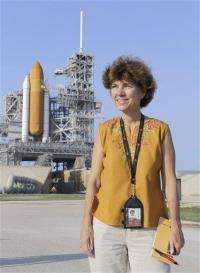
As the aerospace writer for The Associated Press for 21 years, I've watched space shuttles launch 98 times from my reporter's hot seat three miles away - 99 times by the time Atlantis takes off on the last shuttle flight before the fleet retires.
When I took over the job in 1990, the space shuttle had been flying for nearly a decade and endured one tragedy, Challenger. And the classic, cosmic shot of a jetpacking spacewalker all alone against the black void of space already had been snapped.
My first shuttle launch coincidentally was Atlantis - and I learned just how fickle these majestic mechanical beasts were when it came to Florida's equally fickle weather. It took six tries to get off the ground that stormy February.
It wasn't just a cold front that gummed up the countdown five times in a single week. It was the common cold. The commander was sick, and for the only time, a shuttle launch was delayed by germs.
Since then, there has been a string of memorable moments:
- Launch of the Hubble Space Telescope and the five missions for repair and upgrades.
- First and only three-man spacewalk to snatch a stranded satellite.
- Blundered test of a satellite on the end of 12 miles of electricity-conducting cord.
- Flights to Russia's broken-down Mir space station.
- Debut of NASA's first woman space commander.
- Orbital encore of John Glenn, the first American to circle the Earth.
- Dozens of flights hoisting the building blocks of the International Space Station.
- Final voyages of Discovery, Endeavour and, now, Atlantis.
And, of course, there was the 2003 Columbia disaster, still burned into my heart and soul.
Eight years later, my Kennedy Space Center ID badge holder still holds my name tag from the prelaunch reception in honor of the Israeli astronaut who was among the seven who perished aboard Columbia. I met his wife, four children and elderly father that night, all of them so incredibly proud.
I'm often asked whether it's boring to cover flight after flight, year after year.
The short answer: never. Something unexpected always seems to pop up.
That three-man spacewalk? It was never meant to be: A fancy NASA tool failed to capture the spinning Intelsat satellite, and the astronauts had to use their gloved hands to get it on board.
That 12-mile satellite tether? The line snapped and the experimental craft was lost.
And there were dropped spacewalker tools, menacing pieces of space junk, clogged shuttle toilets, a rash of dead baby rats for a brain research study, woodpeckers' attack on a shuttle's external fuel tank .
Once Atlantis launches, it's a sight that won't be seen again from U.S. soil for at least three to five years - possibly longer. And that's too bad because nothing beats the fire, smoke and thunder of a rocket launch with humans on board. Talk about suspense and drama.
"Five minutes and counting ..."
That's my cue to pick up the phone and call my editor, to keep an open phone line. Now I've got a phone glued to my ear for the duration. Don't send out the launch bulletin, I warn, until I give you the word. There could be a launch pad abort with a single second left on the countdown clock.
"Three minutes ..."
By then others have darted outside to watch the launch in its full majesty, and I am mostly alone.
"Two minutes ..."
The tension mounts.
"One minute ..."
I keep my phone conversation to a minimum, not wanting to miss any last-minute problems.
"Nine, eight, seven, main engines start, five, four, three, two, one!"
The booster rockets thunder to life. It takes a minute or so for the roar to reach my ears. The two-story trailer shakes as if in an earthquake. Books tumble from shelves. Magazines crash to the floor. Yet I'm transfixed, watching the TV images of the ascending shuttle.
"Go at throttle up." I wasn't at the Challenger launch accident, but that phrase still chills me, as it does everyone else who realizes just how dangerous these machines are. It was at that mark that Challenger burst apart.
"Keep the astronauts safe" is my prayer.
The exhaust plume is still hovering over the pad by the time the shuttle reaches orbit, 8 1/2 minutes into the flight. "MECO," comes the call from Mission Control. "Main engine cut-off." The shuttle is in orbit.
Only now do I breathe easily.
Challenger taught NASA to hold the applause and cheers until a shuttle reached orbit.
Backslapping and handshakes erupt in Launch Control, barely a stone's throw from the press site. The beans and cornbread come out for the launch team, a tradition dating back to the earliest days of the program.
NASA bigwigs pop over for the obligatory post-launch news conference. And then the press site clears out. The focus turns to Mission Control in Houston for the rest of the voyage.
By the time I drive home - almost always one of the last to leave - there is little evidence of what just transpired.
The astronauts strode out of crew quarters like gladiators headed into battle, climbed aboard the silver astrovan for the ride to the pad, crawled into their spaceship, and rocketed off the planet into orbit.
Like Mercury, Gemini, Apollo and Skylab, the 30-year shuttle program will be relegated to the history books. This time, there's more uncertainty for what will follow, and for many that's a painful pill.
"There are millions of people in this country that have grown up with the shuttle program and have never been alive without the shuttle flying," launch director Mike Leinbach remarked this week.
The shuttle program provided more than an exciting career for me; it provided a husband. He traveled from Italy to see a launch. Lucky for us, fuel leaks kept the shuttles grounded much of that year, so he came back the next summer - and the next - until he joined me in Cape Canaveral.
Our son's middle name is Neil - named for Neil Armstrong, the first man to walk on the moon. Still a young boy, Nicolas Neil dreams about becoming an astronaut and flying one day to Mars. I plan for him to watch Atlantis blast off, so he can tell his children - and his children's children - what it was like to see the last space shuttle soar.
©2011 The Associated Press. All rights reserved. This material may not be published, broadcast, rewritten or redistributed.


