Happy anniversary, Neptune
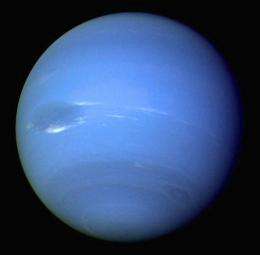
Today, July 11, 2011 marks the first full orbit of the planet Neptune since its discovery on the night of September 23-24, 1846. But there’s a lot more to learn about this anniversary than just the date. Step inside and let’s find out...
Pinpointing Neptune is a wonderful story. For many years we’ve been taught that the discovery of Neptune was done by mathematical calculations. This came about in 1821 when Alexis Bouvard was publishing his findings for Uranus and noticed a gravitational perturbation. This led him to hypothesize an unknown body was crossing the path. Enter miscommunications, politics and astronomer John Adams…
“It is more likely that Adams realised that his proposed orbits were moving ever closer to a “forbidden” zone of resonance.” says Brian Sheen of Roseland Observatory. “Uranus orbits in 84 years, Neptune in 165, nearly a 2:1 resonance, this brings about much greater perturbations than were being measured. In fact the mid 19th century is a quiet period and much bigger swings are evident now.”
In 1843 John Couch Adams used the data Bouvard proposed to begin working on a proposed orbit, but it would be several years later before Urbain Le Verrier verified its existence through physical observation – at the same time as Johann Gottfried Galle. Says Sheen; “It is often said that Adams never published his results. In fact a published paper was printed by November 1846 and appeared in the 1851 Nautical Almanack published in 1847.”
Unknown to both at the time – and in a great twist of irony – Galileo had actually observed Neptune on December 28, 1612, and again on January 27, 1613, but didn’t realize it was a planet. Small wonder he thought it was a fixed star, because as luck would have it, Neptune turned retrograde at the same time as his first observation! But Galileo was a great observer and made drawings of his find. Given all that we know today, it’s pretty astonishing his limited equipment was able to perceive the blue planet, let alone realize its minor movement against the ecliptic meant something. After all, the very concept of the ecliptic plane was new!
“It has been known for several decades that this unknown star was actually the planet Neptune,” says University of Melbourne physicist, David Jamieson. “Computer simulations show the precision of his observations revealing that Neptune would have looked just like a faint star almost exactly where Galileo observed it.”
But we digress...
Today, July 11 would be the anniversary of Neptune’s first full barycentric orbit – a celebration that has taken us 164.79 years of waiting to celebrate. Tomorrow, July 12 is the anniversary of Neptune’s heliocentric completion. However, don’t expect Neptune to be in the exact same position in relation to the celestial sphere as it was on either date. While over 150 years is but a wink in the cosmic eye, it is certainly more than enough time for our solar system to have shifted That having been over simply said, what will happen at 21:48 and 24.6 seconds UT on July 11 is that Neptune will return to its exact longitudinal position in respect to the invariable plane. Is it close to its discovery point? Well, in a sense, yes. It will be within 1.5 arc seconds of its 1846 location relative to the barycentre. In visual terms, that’s just a whisker.
Is Neptune observable right now? You betcha’. But it’s not going to be easy... You’ll find it at RA 22h 11m 14s – Dec 11 47′ 1″ at its longitudinal anniversary time. Need a map? Here you go…
As you can see, it’s going to be quite late at night before Neptune has well cleared the horizon – but what an opportunity! Because of its small size, I recommend using a telescope for stability and printing a map from a planetarium program for more detailed star fields. It’s certainly not going to look like the Voyager image above, but you can expect to see a slightly blue colored disk that averages about magnitude 8 (well within reach of smaller scopes). If you have never seen Neptune before, compare it in your mind’s eye to one of Jupiter’s moons and you’ll be able to pick it out of starry background much easier.
Good luck, clear skies and happy anniversary Neptune!
Source: Universe Today


