Gemini image captures elegant beauty of planetary nebula discovered by amateur astronomer
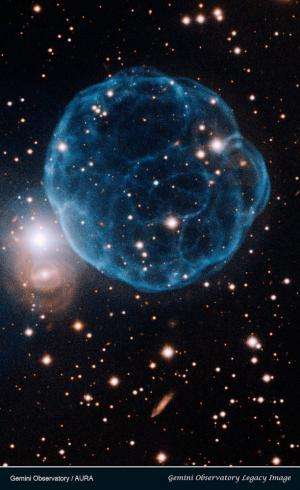
(PhysOrg.com) -- In a partnership between amateur and professional astronomers, the recent discovery of a dying star’s last gasps could help resolve a decades-old debate among astronomers. That is, are stellar companions key to the formation and structure of planetary nebulae?
The discovery, by Austrian amateur astronomer Matthias Kronberger, is featured at an International Astronomical Union symposium on planetary nebulae this week in Spain’s Canary Islands. The research team’s work features a striking image of the new nebula obtained with the Gemini Observatory.
Not coincidently, the location of the new nebula (named Kronberger 61, or Kn 61, after its discoverer) is within a relatively small patch of sky being intensely monitored by NASA’s Kepler planet finding mission. Kepler's goal is to determine the frequency of Earth-sized planets around Sun-like stars. In the process, the effects of other close stellar and/or planetary companions are detectable.
“Kn 61 is among a rather small collection of planetary nebulae that are strategically placed within Kepler’s gaze,” said Orsola De Marco of Macquarie University in Sydney, Australia who is the author of a 2009 paper speculating on how companion stars or even planets may influence and shape the intricate structure seen in many planetary nebulae. “Explaining the puffs left behind when medium sized stars like our Sun expel their last-breaths is a source of heated debate among astronomers, especially the part that companions might play,” says De Marco, “it literally keeps us up at night!”
NASA's Kepler Mission monitors a 105 square degree portion of the sky near the northern constellation of Cygnus the Swan. Kepler’s field-of-view is comparable to the area of your hand held at arm's length. The spacecraft continuously stares at more than 150,000 stars in the same patch of sky observing the changes in brightness. The presence of a companion can cause these brightness fluctuations through eclipses or tidal disruptions. However, most commonly in such binaries, the total amount of light received changes due to reflections from, and heating of, the companion by the star – analogous to the Moon’s phases. “It is a gamble that possible companions, or even planets, can be found due to these usually small light variations,” says George Jacoby of the Giant Magellan Telescope Organization and the Carnegie Observatories (Pasadena). “However, with enough objects it becomes statistically very likely that we will uncover several where the geometries are favorable – we are playing an odds game and it isn’t yet known if Kn 61 will prove to have a companion.” Jacoby also serves as the Principal Investigator for a program to obtain follow-up observations of Kn 61’s central star with Kepler.
To increase their odds, professional and amateur astronomers are working as partners to comb through the entire Kepler field looking for planetary nebula candidates. To date six have been found including this one by Kronberger, a member of the amateur group called the “Deep Sky Hunters.” The group, dedicated to finding new objects in our galaxy and beyond, has found two planetary nebulae in the Kepler field so far (including Kn 61) and a possible third, which, according to Jacoby, “…are extremely rare and each, a valuable gem.”
The detection techniques used by professional and amateurs are similar; in the case of Kn 61 images from the Digital Sky Survey (DSS) provided the data used in the discovery. “Without this close collaboration with amateurs, this discovery would probably not have been made before the end of the Kepler mission. Professionals, using precious telescope time, aren’t as flexible as amateurs who did this using existing data and in their spare time. This was a fantastic pro-am collaboration of discovery,” says Jacoby, who serves as the liaison with the Deep Sky Hunters (DSH) and requested their help to survey the Kepler field. Jacoby published a paper with DSH members in 2010 that describes the techniques used.
“Planetary nebulae present a profound mystery,” says De Marco. “Some recent theories suggest that planetary nebulae form only in close binary or even planetary systems — on the other hand, the conventional textbook explanation is that most stars, even solo stars like our sun, will meet this fate. That might just be too simple.”
However, Jacoby points out that observations from the ground have yet to find a high percentage of binaries associated with planetary nebulae. “This is quite likely due to our inability to detect these binaries from the ground and if so then Kepler is likely to push the debate strongly in one direction or the other.”
Planetary nebulae are common throughout our neighborhood of the galaxy with over 3,000 known and identified. Likely the “end of life” event for stars like our Sun, they form after nuclear fusion can no longer sustain the pressure of gravity in a geriatric star and it becomes unstable, pulsates and throws off a significant shell of gas from its outer layers. This expanding shell is what we see as a planetary nebula when its gas is ionized and glows due to the radiation still emitted by the central star. A key question with planetary nebulae is how companions (stars or even planets) around the central, primary star might impact the complex structures seen in many planetary nebulae. However, to date, a low percentage (about 20%) of these central stars have been found with companions. If this low fraction is due to the fact that the companions are relatively small or distant then current ground-based observations are simply not able to detect the companions – in which case the space-based Kepler telescope will likely be able to fill this observational gap.
The discovery, as well as the new Gemini image, were both presented today at the International Astronomical Union Symposium: “Planetary Nebulae: an Eye to the Future,” in Puerto de la Cruz, Tenerife, Spain from July 25-29, 2011.
The research team includes: George Jacoby, Giant Magellan Telescope Organization and the Carnegie Observatories (Pasadena); Orsola De Marco of Macquarie University in Sydney Australia & the American Museum of Natural History, New York; Steve Howell, Deputy Project Scientist at Kepler; and the Deep Sky Hunter Matthias Kronberger.
Provided by Gemini Observatory


