Voyager 1 measures magnetic mayhem
June 1, 2011 By Tammy Plotner

Voyager 1 measures magnetic mayhem

Enlarge

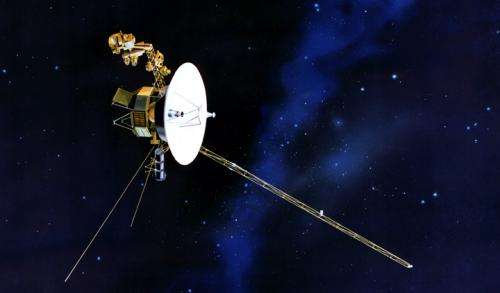
Artist's Conception of Voyager - Credit: NASA

When Voyager 1 passed into the heliosheath in 2004, it became the first man-made object to explore the remote edge of the Sun’s magnetic influence. Launched by NASA on September 5, 1977, the probe was designed to study the outer Solar System and eventually interstellar space. One of its missions was to look for the heliopause – the boundary at which the solar wind transitions into the interstellar medium. What it found was mayhem...

According to NASA, Voyager 1 has crossed into an area where the velocity of the hot ionized gas, or plasma, emanating directly outward from the sun has slowed to zero. Scientists suspect the solar wind has been turned sideways by the pressure from the interstellar wind in the region between stars. “The solar wind has turned the corner,” said Ed Stone, Voyager project scientist based at the California Institute of Technology in Pasadena, Calif. “Voyager 1 is getting close to interstellar space.”

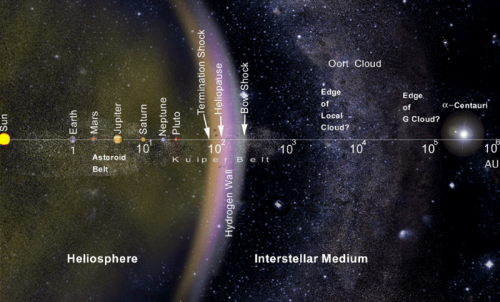
Now it has entered the heliosheath, an area ranging from 1.5 to 15 billion kilometers thick (930 million to 9.3 billion miles) and starting roughly 14 billion km (8.7 billion mi) from the Sun. But there’s nothing quiet here. This is the area where outgoing flows of solar wind begin to be repelled by interstellar particles and magnetic fields pushing towards the solar system. While passing through the heliosheath, Voyager 1 experienced many sudden and drastic changes in the surrounding driven by structures called current sheets.
Voyager 1 measures magnetic mayhem
Enlarge

Illustration Courtesy of NASA

The team of L. F. Burlaga: Geospace Physics Laboratory, NASA Goddard Space Flight Center and N. F. Ness of the Institute for Astrophysics and Computational Sciences have been studying the ongoing results sent back by Voyager and have come to a new conclusion – there are three distinct types of current sheets.

“The structures, appearing as proton boundary layers (PBLs), magnetic holes or humps, or sector boundaries, were identified by characteristic ffluctuations in either magnetic field strength or direction as the spacecraft crossed nearly 500 million km (310 million mi) of heliosheath in 2009. PBLs are defined by a rapid jump in magnetic field strength, with one observed event resulting in a doubling of the field strength in just half an hour.” said the team. “Passing through a sector boundary led to a sudden change in direction of the magnetic field. Magnetic holes saw the field strength drop to near zero before returning to the original background strength. Magnetic humps consisted of a sudden spike in strength and then a return to initial levels.”

But this isn’t the first time the Voyager has returned zero readings. In December 2004 the intrepid probe broke the barrier of the termination shock and data from Voyager 1′s Low-Energy Charged Particle Instrument was used to deduce the ’s velocity. When the speed of the particles matched the speed of the spacecraft, scientists knew they had a null number on their records. “When I realized that we were getting solid zeroes, I was amazed,” said Rob Decker, a Voyager Low-Energy Charged Particle Instrument co-investigator and senior staff scientist at the Johns Hopkins University Applied Physics Laboratory in Laurel, Md. “Here was Voyager, a spacecraft that has been a workhorse for 33 years, showing us something completely new again.”

A new is what we need to continue our understanding of what lay at the furthest reaches of our now explorable space. Says Burlaga, “The firsthand detections made by are likely to be extremely important for researchers trying to decide between current leading theories for the source and structure of current sheets.”

Source: Universe Today

Filter


Move the slider to adjust rank threshold, so that you can hide some of the comments.


Display comments: newest first

LariAnn
Jun 01, 2011

Rank: not rated yet
All of our space probes should have been built as well and long-lasting as the Voyagers - we'd have gotten so much more bang for the buck that way. We'd have long lasting probes around every planet and touring moons, asteroids, comets, etc. When was the decision made to build disposable, short-lived probes instead of probes like the Voyagers?
sstritt
Jun 01, 2011

Rank: 5 / 5 (4)
All of our space probes should have been built as well and long-lasting as the Voyagers - we'd have gotten so much more bang for the buck that way. We'd have long lasting probes around every planet and touring moons, asteroids, comets, etc. When was the decision made to build disposable, short-lived probes instead of probes like the Voyagers?

I don't really think we build disposable probes. Voyagers were equipped with plutonium power due to their extreme distance from the sun.I think this is the secret to their longevity, not superior construction. Launching radioactive material into space is now considered-well you know..
zevkirsh
Jun 01, 2011

Rank: 1 / 5 (3)
for all we know there is space garbage of ours that has gotten much farther than the voyager.
unlikely but possible.
ACW
Jun 02, 2011

Rank: not rated yet
Not really.

All earlier space junk did not have the trajectory that the Voyagers have, thanks in part to gravity assist.
am_Unition
Jun 02, 2011

Rank: 4.5 / 5 (2)
All of our space probes should have been built as well and long-lasting as the Voyagers - we'd have gotten so much more bang for the buck that way. We'd have long lasting probes around every planet and touring moons, asteroids, comets, etc. When was the decision made to build disposable, short-lived probes instead of probes like the Voyagers?


"The buck" that you speak of is precisely wherein the problem lies, at least usually.

Who will fund the continued ground support operations and data acquisition?

Are orbital corrections required, and if so, is there enough fuel to perform them?

As it turns out, rocket science is pretty complicated. Blowing people up on Earth is definitely easier, sustainable, and traditional, so let's fund that instead (sarcasm).
Rank 5 /5 (8 votes)
Relevant PhysicsForums posts
  • revamping general concept and cosmological principle
    createdMay 25, 2012
  • Transiting Exoplanet Light Curve
    createdMay 25, 2012
  • Math behind Theoretical Physics
    createdMay 24, 2012
  • Do we know whats at the center of galaxies yet?
    createdMay 23, 2012
  • Structure of the Milky Way?
    createdMay 20, 2012
  • What would it take to terraform Pluto and Charon?
    createdMay 19, 2012
  • More from Physics Forums - General Astronomy

More news stories

Sophisticated simulations predict future warming

The chances of our planet being hit by a global warming of 3 degrees Celsius by 2050 is as likely as it being hit by an increase of 1.4 degrees, new research shows. Presented in the journal Nature Geoscience, the British study ...

Space & Earth / Earth Sciences

created May 22, 2012 | popularity 4.4 / 5 (9) | comments 51

Dragon arrives at space station in historic 1st (Update 2)

The privately bankrolled Dragon capsule made a historic arrival at the International Space Station on Friday, triumphantly captured by astronauts wielding a giant robot arm.

Space & Earth / Space Exploration

created May 25, 2012 | popularity 5 / 5 (10) | comments 19

Kyoto Protocol architect 'frustrated' by climate dialogue

UN climate talks are going nowhere, as politicians dither or bicker while the pace of warming dangerously speeds up, one of the architects of the Kyoto Protocol told AFP.

Space & Earth / Environment

created May 23, 2012 | popularity 3.7 / 5 (7) | comments 39

Aliens don't want to eat us, says former SETI director

Alien life probably isn’t interested in having us for dinner, enslaving us or laying eggs in our bellies, according to a recent statement by former SETI director Jill Tarter.

Space & Earth / Space Exploration

created May 25, 2012 | popularity 4.4 / 5 (13) | comments 37

What's the big deal about private space launches?

(AP) -- The first private spaceship is headed to the International Space Station. Some questions and answers about the cargo mission by Space Exploration Technologies, known as SpaceX:

Space & Earth / Space Exploration

created May 22, 2012 | popularity 5 / 5 (6) | comments 32


Nvidia trumpets Tegra 3 phone design wins for 2012

(Phys.org) -- Nvidia’s competitive war paint has a name, Tegra 3. On the heels of Nvidia announcements about lowering costs of its Tegra 3 processors and Nvidia-enabled tablets running Android Ice Cream ...

Browser wars flare in mobile space

The browser wars are heating up again, but this time the fight is for dominance of the mobile Internet.

Scientist: Evolution debate will soon be history

(AP) -- Richard Leakey predicts skepticism over evolution will soon be history. Not that the avowed atheist has any doubts himself.

Dell tablet leak: 10.1-inch display, two-battery choice

(Phys.org) -- Headline after headline talks about vendors’ tablets in the wings as likely number-one contenders for the iPad. Such claims have justifiably been taken with a grain of salt, considering ...

Keep food safety in mind this memorial day weekend

(HealthDay) -- Picnics, parades and cookouts are as much a part of Memorial Day weekend as tributes to the United States' war veterans.

Family history of Alzheimer's affects functional connectivity

(HealthDay) -- Cognitively normal individuals with a family history of late-onset Alzheimer's disease (AD) may display lower resting state functional connectivity in the default mode network (DMN) of the brain, ...